

GAIL (India) Limited is India’s largest natural gas transmission and marketing company and plays a critical role in the country’s energy infrastructure. Established as a government-owned enterprise, GAIL operates an extensive pipeline network, LNG sourcing business, petrochemical plants, and city gas distribution ventures. As India accelerates its transition toward cleaner fuels and expands its gas-based economy, GAIL is positioned to benefit from rising natural gas consumption.
Investors closely monitor GAIL because of its dominant market position, strong government backing, consistent dividend payments, and strategic role in India’s energy security. The company’s future growth prospects are supported by ongoing pipeline expansion projects, increasing LNG demand, growth in city gas distribution networks, and government initiatives to raise the share of natural gas in India’s energy mix. Despite cyclical fluctuations in commodity prices and energy demand, GAIL remains one of the most significant energy infrastructure companies in India. Long-term investors view the company as a potential beneficiary of India’s industrial growth, urbanization, and clean energy transition, making it an attractive stock for both income and growth-oriented portfolios.
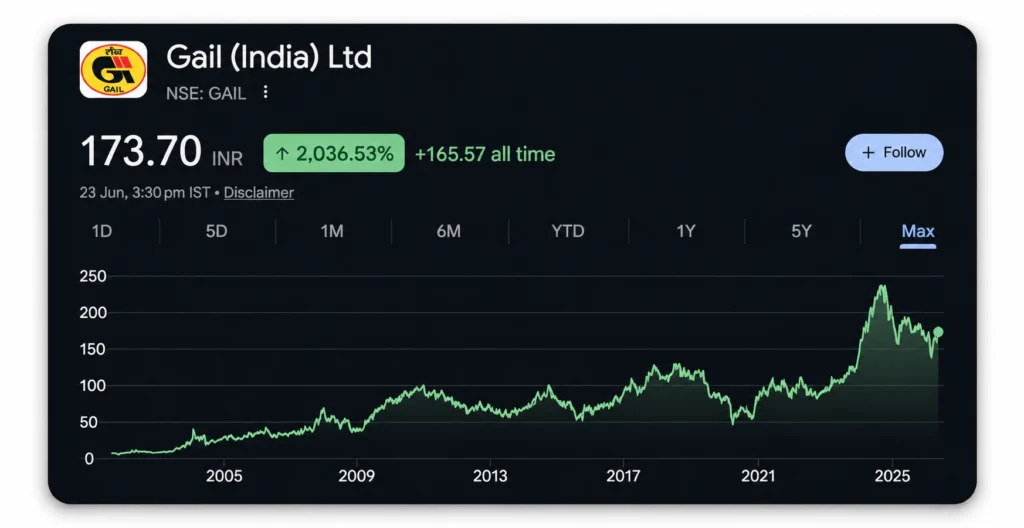
GAIL Share Price Market Overview
| Metric | Value |
|---|---|
| Current Share Price | ₹135–180 |
| Market Capitalization | ₹1.05–1.11 Lakh Crore |
| P/E Ratio | 14–15 |
| Book Value | ₹114–135 |
| ROE | 8.5%–10% |
| Dividend Yield | 3%–5% |
| 52-Week High | ₹200–203 |
| 52-Week Low | ₹134–135 |
| Face Value | ₹10 |
| Industry | Gas Transmission & Marketing |
What Does GAIL Do?
GAIL is India’s leading natural gas infrastructure company. Its core business segments include:
- Natural gas transmission through pipeline networks.
- Natural gas trading and marketing.
- LNG sourcing and regasification.
- Petrochemical manufacturing.
- LPG transmission.
- City gas distribution through joint ventures.
- Renewable energy initiatives.
The company generates revenue primarily from gas transportation tariffs, gas trading margins, LNG imports, petrochemical sales, and LPG transportation. Its extensive pipeline infrastructure creates significant entry barriers for competitors and gives GAIL a dominant position in India’s gas value chain.
Financial Performance
| Financial Year | Revenue (₹ Cr) | Net Profit (₹ Cr) | EPS (₹) |
|---|---|---|---|
| FY2022 | 91,646 | 10,364 | 15.7 |
| FY2023 | 1,44,302 | 6,681 | 10.2 |
| FY2024 | 1,34,507 | 8,836 | 13.4 |
| FY2025 | 1,43,559 | 11,312 | 17.2 |
FY2025 revenue growth was approximately 6.7% over FY2024.
Major Price-Moving Events
- Expansion of gas pipeline infrastructure.
- Government push toward gas-based economy.
- LNG demand growth.
- Changes in natural gas pricing.
- Global energy price fluctuations.
- Dividend announcements.
- Petrochemical business performance.
Shareholding Pattern
| Shareholder Category | Holding |
|---|---|
| Promoters | 51.88% |
| FIIs | 14.91% |
| DIIs | 26.55% |
| Public | 6.66% |
| Others | Balance |
Growth Factors
India’s energy sector is undergoing a major transformation, creating strong long-term opportunities for natural gas companies. India’s natural gas demand is expected to grow steadily over the next two decades, supported by increasing energy consumption and the country’s shift toward cleaner fuels. The company is also benefiting from various expansion plans, including the development of new gas pipeline projects, LNG infrastructure expansion, and continued City Gas Distribution (CGD) network growth, which can help improve market reach and revenue potential.
In addition, several capacity addition projects are underway to enhance pipeline connectivity across key industrial regions, ensuring a more efficient gas transportation network. The company is also exploring new growth areas such as green hydrogen initiatives, renewable energy projects, and biofuel opportunities, which could diversify its business model and support future earnings. Supportive government policies promoting natural gas usage and the broader energy transition further strengthen the industry’s outlook.
Looking ahead, demand is expected to be driven by multiple factors, including rapid industrialization, urbanization, growing fertilizer sector requirements, increasing power generation demand, and the widespread adoption of cleaner fuel alternatives. These trends position the natural gas sector for sustained growth over the coming years.
Risks and Challenges
The company faces competition from both public and private gas infrastructure players, which may impact market share and growth opportunities over time. Additionally, its business remains subject to regulatory oversight, with government-controlled tariffs and pricing policies influencing profitability and operational flexibility.
Investors should also consider the company’s significant capital expenditure requirements, which can lead to higher debt levels as it expands its infrastructure network. During periods of economic slowdown, industrial demand for natural gas may weaken, affecting revenue growth. Furthermore, factors such as global LNG price volatility, currency exchange fluctuations, and uncertainties surrounding the long-term energy transition can create additional risks for the business and its future performance.
GAIL Share Price Target 2026–2050
| Year | Minimum Target | Average Target | Maximum Target |
|---|---|---|---|
| 2026 | ₹135 | ₹187 | ₹240.84 |
| 2027 | ₹295.08 | ₹364 | ₹385.50 |
| 2028 | ₹415.42 | ₹459 | ₹508.04 |
| 2029 | ₹524.54 | ₹439 | ₹475.84 |
| 2030 | ₹464.39 | ₹560 | ₹680.55 |
| 2035 | ₹936.60 | ₹980 | ₹1,068.02 |
| 2040 | ₹1,675.94 | ₹1,750 | ₹1,965.73 |
| 2050 | ₹3,105.55 | ₹3,465 | ₹3,683.02 |
GAIL Share Price Target 2026
The 2026 target assumes stable gas transmission volumes, healthy LNG demand, and continued infrastructure expansion. Government efforts to increase natural gas usage across industries could support revenue growth. A stable energy pricing environment and continued dividend payouts may also improve investor sentiment. If earnings growth remains strong and valuations expand moderately, GAIL could trade between ₹135 and ₹240.84 during 2026.
Monthly Target Table 2026
| Month | Estimated Target Price |
|---|---|
| January | ₹135 |
| February | ₹149.50 |
| March | ₹158.06 |
| April | ₹195.66 |
| May | ₹187.04 |
| June | ₹198.55 |
| July | ₹210.65 |
| August | ₹218.05 |
| September | ₹228.32 |
| October | ₹231.49 |
| November | ₹225.40 |
| December | ₹240.84 |
GAIL Share Price Target 2030
By 2030, India’s gas infrastructure is expected to be significantly larger than today. Higher transmission volumes, increased LNG imports, and growth in city gas distribution could drive earnings expansion. Investments in green hydrogen and renewable energy may also create new revenue streams. Under favorable conditions, GAIL may reach ₹464.39–₹680.55.
Monthly Target 2030
| Month | Estimated Target Price |
|---|---|
| January | ₹464.39 |
| February | ₹479.52 |
| March | ₹488.22 |
| April | ₹493.60 |
| May | ₹525.14 |
| June | ₹539.94 |
| July | ₹570.44 |
| August | ₹604.64 |
| September | ₹614.74 |
| October | ₹628.06 |
| November | ₹664.60 |
| December | ₹680.55 |
GAIL Share Price Target 2035
The 2035 outlook assumes sustained growth in India’s gas consumption, successful execution of infrastructure projects, and stronger participation in emerging energy segments. Continued economic growth and industrial expansion may significantly increase gas demand. This could support a share price range of ₹936.60–₹1,068.02.
Monthly Target 2035
| Month | Estimated Target Price |
|---|---|
| January | ₹936.60 |
| February | ₹947.73 |
| March | ₹958.06 |
| April | ₹974.40 |
| May | ₹986.02 |
| June | ₹991.80 |
| July | ₹1024.65 |
| August | ₹1004.55 |
| September | ₹1029.51 |
| October | ₹1016.93 |
| November | ₹1039.64 |
| December | ₹1,068.02 |
GAIL Share Price Target 2040
The 2040 forecast assumes GAIL remains a dominant energy infrastructure company while adapting to renewable energy trends. Large-scale hydrogen, LNG, and gas distribution opportunities could create significant value. Under optimistic assumptions, the stock could reach ₹1,675.94–₹1,965.73.
Monthly Target 2040
| Month | Estimated Target Price |
|---|---|
| January | ₹1,675.94 |
| February | ₹1693.15 |
| March | ₹1742.56 |
| April | ₹1759.03 |
| May | ₹1785.64 |
| June | ₹1806.32 |
| July | ₹1819.43 |
| August | ₹1828.50 |
| September | ₹1842.20 |
| October | ₹1851.88 |
| November | ₹1847.30 |
| December | ₹1,965.73 |
GAIL Share Price Target 2050
The 2050 projection reflects long-term assumptions about India’s economic growth, rising energy demand, and successful diversification into future energy solutions. If GAIL maintains market leadership and adapts effectively to energy transition trends, substantial shareholder value could be created over the coming decades.
Monthly Target 2050
| Month | Estimated Target Price |
|---|---|
| January | ₹3,105.55 |
| February | ₹3,146.05 |
| March | ₹3,164.90 |
| April | ₹3,189.44 |
| May | ₹3,239.01 |
| June | ₹3,290.66 |
| July | ₹3,352.09 |
| August | ₹3,391.04 |
| September | ₹3,463.18 |
| October | ₹3,489.05 |
| November | ₹3,573.66 |
| December | ₹3,683.02 |
Bull Case
- Strong government support.
- High dividend yield.
- Dominant gas infrastructure network.
- Rising gas demand in India.
- Expansion into green hydrogen and clean energy.
- Attractive valuation compared with many large-cap peers.
Bear Case
- Commodity price volatility.
- Regulatory intervention.
- Lower-than-expected gas demand growth.
- Delays in infrastructure projects.
- Energy transition reducing long-term gas demand.
- Margin pressure in trading operations.
Pros and Cons
Pros
- Market leader in gas transmission.
- Strong dividend-paying track record.
- Strategic role in India’s energy sector.
Cons
- Earnings can be cyclical.
- Government ownership limits flexibility.
- Dependence on energy sector regulations.
Expert Opinion
Most analysts view GAIL as a value-oriented PSU energy stock with strong cash generation and dividend potential. Current valuations remain reasonable compared with historical averages and industry peers. Long-term performance will largely depend on gas demand growth, infrastructure utilization, and the company’s ability to participate in emerging energy segments such as hydrogen and renewables. Investors seeking income and moderate growth may find GAIL attractive, while aggressive growth investors may prefer higher-growth sectors.
Conclusion
GAIL remains one of India’s most important energy infrastructure companies, supported by a strong market position, government backing, and long-term industry tailwinds. The company offers a combination of dividend income, relatively stable cash flows, and exposure to India’s growing gas economy. However, investors should consider risks related to regulation, commodity prices, and changing energy consumption patterns before investing.
Disclaimer: Share price targets are estimates based on assumptions and should not be considered investment advice. Actual stock performance may differ significantly due to market conditions, company performance, economic factors, and unforeseen events.
Frequently Asked Questions (FAQs)
What is the GAIL Share Price Target for 2026?
The estimated target range for 2026 is ₹₹135–₹160, with an average target of ₹240.84.
What is the GAIL Share Price Target for 2030?
The estimated target range for 2030 is ₹464.39–₹500, with an average target of ₹680.55
Is GAIL a good long-term investment?
GAIL may be suitable for long-term investors seeking dividend income and exposure to India’s growing natural gas sector.
What are the risks of investing in GAIL?
Major risks include regulatory changes, commodity price fluctuations, competition, project execution challenges, and economic slowdowns.
Can GAIL reach new all-time highs by 2030?
If India’s gas demand grows strongly and GAIL executes its expansion plans successfully, new all-time highs by 2030 are possible.
Should beginners invest in GAIL stock?
Beginners should evaluate risk tolerance, investment objectives, valuation levels, and portfolio diversification before investing in any stock, including GAIL.