
South Indian Bank is one of India’s well-known private banks, established in 1929 and headquartered in Thrissur, Kerala. Over the years, it has expanded its presence across the country through a large network of branches and modern digital banking services. The bank offers a wide range of products, including savings accounts, loans, credit cards, and business banking solutions.
In the last few years, South Indian Bank has worked hard to improve its overall performance. The bank has reduced bad loans, strengthened its financial position, and improved profitability. These positive changes have increased investor interest, especially among those looking for banking stocks with long-term growth potential. The bank has also invested heavily in digital banking, making its services more convenient and accessible for customers.
As India’s economy grows and more people use formal banking services, South Indian Bank could benefit from higher demand for loans, expanding retail banking opportunities, and the increasing use of digital payments. With its improving financial health and focus on growth, the bank remains a stock that many long-term investors are watching closely.
South Indian Bank Share Price Market Overview
| Metric | Value |
|---|---|
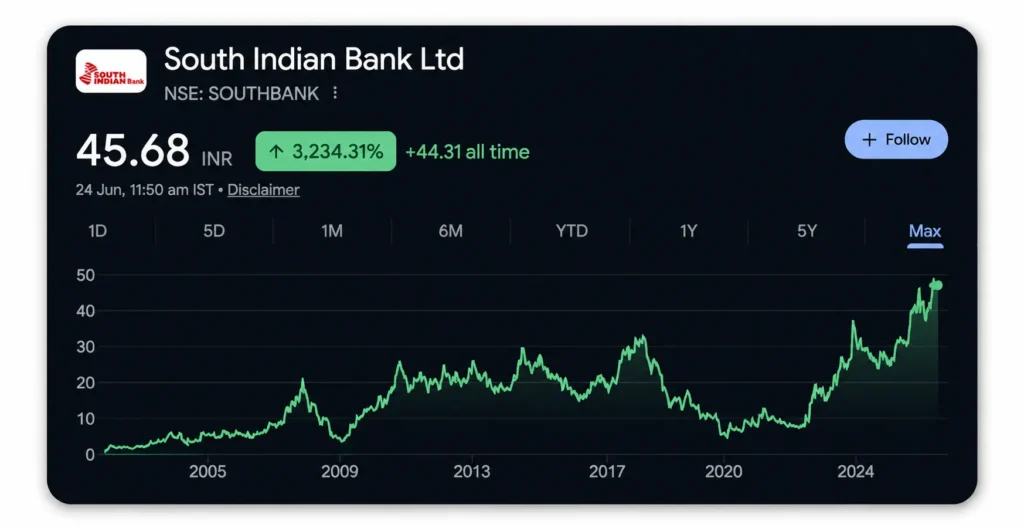
| Current Share Price | ₹46–48 |
| Market Capitalization | ₹12,000–13,000 Crore |
| P/E Ratio | ~6–7 |
| Book Value | ~₹43–45 |
| ROE | ~14–16% |
| Dividend Yield | ~2–3% |
| 52-Week High | ~₹47–48 |
| 52-Week Low | ~₹24–25 |
| Face Value | ₹1 |
| Industry | Private Banking |
What Does South Indian Bank Do?
South Indian Bank operates as a full-service private-sector bank offering a comprehensive range of financial products and services. The bank serves retail customers, small and medium enterprises, agricultural borrowers, and large corporate clients.
Its key business segments include retail banking, corporate banking, treasury operations, digital banking, and wealth management. Revenue is primarily generated through interest earned on loans and advances, service charges, treasury income, foreign exchange transactions, and commission-based services.
The bank has established a strong presence in South India while gradually expanding its reach across other regions of the country. Its focus on technology-driven banking solutions and prudent risk management has helped strengthen its competitive position in the private banking sector.
Historic Performance
- 1-Year Return: ~70–90%
- 3-Year Return: ~180–220%
- 5-Year Return: ~150–200%
- CAGR Performance: ~20–25%
The growing participation of institutional investors indicates increasing confidence in the bank’s turnaround story and future growth prospects.
Growth Factors
India’s banking sector is expected to experience strong growth over the coming years, supported by economic expansion, rising credit demand, and greater financial inclusion across the country. These trends are creating new opportunities for banks to expand their customer base and strengthen their lending businesses.
To capitalize on this growth, South Indian Bank is focusing on expanding its retail lending, MSME financing, and digital banking capabilities. The bank is also investing in technology infrastructure to enhance customer experience, improve operational efficiency, and support its long-term digital transformation strategy.
Future growth is expected to be supported by the introduction of digital lending products, enhanced mobile banking solutions, and wealth management services, helping the bank meet evolving customer needs. In addition, government initiatives such as Digital India, financial inclusion programs, and increased infrastructure spending could create a favorable environment for the banking industry.
Key demand drivers for the sector include increasing banking penetration, a growing middle-class population, rising retail credit demand, the continued expansion of digital payments, and ongoing economic growth and urbanization. These factors are expected to support sustained demand for banking and financial services in the years ahead.
Risks and Challenges
While South Indian Bank has strengthened its financial position, investors should be aware of certain risks. The bank operates in a highly competitive environment, facing pressure from large private-sector banks, public-sector banks, and fintech companies, which can affect market share and growth opportunities. Additionally, changes in RBI regulations and banking policies may influence profitability and business operations.
The bank’s performance is also closely linked to the quality of its loan portfolio. Any deterioration in asset quality could lead to higher provisioning requirements and lower earnings. Furthermore, an economic slowdown may reduce credit demand and increase the risk of loan defaults. Like the broader banking sector, South Indian Bank is also exposed to interest rate fluctuations and liquidity-related challenges, which can impact overall profitability and financial performance.
South Indian Bank Share Price Target 2026 To 2050
| Year | Minimum Target | Average Target | Maximum Target |
|---|---|---|---|
| 2026 | ₹33 | ₹43 | ₹65 |
| 2027 | ₹74 | ₹79 | ₹87 |
| 2028 | ₹90 | ₹82 | ₹71 |
| 2029 | ₹78 | ₹85 | ₹113 |
| 2030 | ₹125 | ₹148 | ₹176 |
| 2035 | ₹325 | ₹368 | ₹415 |
| 2040 | ₹730 | ₹780 | ₹810 |
| 2050 | ₹1,280 | ₹1,390 | ₹1,455 |
South Indian Bank Share Price Target 2026
The 2026 target is based on assumptions of steady loan growth, stable asset quality, and continued profitability improvement. Strong retail lending demand, digital banking expansion, and favorable economic conditions could support earnings growth. If the bank maintains healthy return ratios and attracts more institutional investors, the stock may continue its positive momentum.
Monthly Target 2026
| Month | Estimated Target Price |
|---|---|
| January | ₹33 |
| February | ₹35.80 |
| March | ₹39.05 |
| April | ₹42.77 |
| May | ₹45.60 |
| June | ₹49.06 |
| July | ₹56.49 |
| August | ₹59.31 |
| September | ₹53.65 |
| October | ₹58.50 |
| November | ₹62.64 |
| December | ₹65 |
South Indian Bank Share Price Target 2030
The 2030 target assumes continued economic growth, expanding banking penetration, and successful execution of the bank’s transformation strategy. Increasing market share in retail and MSME lending, coupled with improving operational efficiency, could lead to substantial earnings growth.
Monthly Target 2030
| Month | Estimated Target Price |
|---|---|
| January | ₹125 |
| February | ₹136.06 |
| March | ₹140.85 |
| April | ₹146.73 |
| May | ₹151.04 |
| June | ₹156.44 |
| July | ₹160.83 |
| August | ₹163.94 |
| September | ₹166.42 |
| October | ₹169.01 |
| November | ₹172.84 |
| December | ₹176 |
South Indian Bank Share Price Target 2035
By 2035, the bank may benefit from sustained growth in the Indian banking sector, improved digital capabilities, and stronger customer relationships. Consistent profit growth and prudent risk management could support significant long-term appreciation.
Monthly Target 2035
| Month | Estimated Target Price |
|---|---|
| January | ₹325 |
| February | ₹337.21 |
| March | ₹342.06 |
| April | ₹349.75 |
| May | ₹356.32 |
| June | ₹379.05 |
| July | ₹387.11 |
| August | ₹392.75 |
| September | ₹385.90 |
| October | ₹393.43 |
| November | ₹399.20 |
| December | ₹415 |
South Indian Bank Share Price Target 2040
The 2040 projection assumes continued expansion in India’s financial services sector, larger loan books, and increasing profitability. Successful adoption of emerging technologies could further enhance operational efficiency.
Monthly Target 2040
| Month | Estimated Target Price |
|---|---|
| January | ₹730 |
| February | ₹741.60 |
| March | ₹754.81 |
| April | ₹759.22 |
| May | ₹765.01 |
| June | ₹774.38 |
| July | ₹781.79 |
| August | ₹793.29 |
| September | ₹775.39 |
| October | ₹788.14 |
| November | ₹794.17 |
| December | ₹810 |
South Indian Bank Share Price Target 2050
The 2050 estimate reflects a highly optimistic long-term scenario in which the bank successfully capitalizes on India’s economic growth, expanding financial markets, and technological advancements. Strong earnings growth and sustained market expansion could support substantial shareholder returns.
Monthly Target 2050
| Month | Estimated Target Price |
|---|---|
| January | ₹1,280 |
| February | ₹1,164.33 |
| March | ₹1,197.05 |
| April | ₹1,231.66 |
| May | ₹1,296.50 |
| June | ₹1,311.04 |
| July | ₹1,336.43 |
| August | ₹1,349.05 |
| September | ₹1,378.18 |
| October | ₹1,402.92 |
| November | ₹1,438.60 |
| December | ₹1,455 |
Also Check:
Bull Case
- Improving asset quality and lower NPAs
- Strong earnings growth trajectory
- Attractive valuation compared to peers
- Increasing institutional ownership
- Expanding digital banking ecosystem
Bear Case
- Economic slowdown affecting loan growth
- Rising competition from larger banks
- Unexpected deterioration in asset quality
- Regulatory changes impacting profitability
- Margin pressure from changing interest rates
Pros and Cons
Pros
- Strong turnaround in profitability
- Improving asset quality metrics
- Attractive valuation compared to private banking peers
Cons
- Smaller scale than major private-sector banks
- Highly competitive industry
- Earnings sensitive to economic conditions
Expert Opinion
South Indian Bank has transformed significantly over the past few years, emerging as a stronger and more profitable institution. The bank’s improving fundamentals, attractive valuation, and long-term growth potential make it an interesting candidate for investors seeking exposure to the banking sector. However, investors should continue monitoring asset quality, loan growth, and overall economic conditions before making investment decisions.
Future Outlook
The future outlook for South Indian Bank remains positive. Growing credit demand, digital banking adoption, financial inclusion initiatives, and a strengthening economy provide substantial opportunities for expansion. If management continues executing its strategy effectively, the bank could deliver consistent earnings growth and create long-term value for shareholders.
Conclusion
South Indian Bank has successfully strengthened its balance sheet, improved profitability, and enhanced operational efficiency. These developments have positioned the bank for long-term growth within India’s expanding banking sector. While risks such as competition, economic uncertainty, and regulatory changes remain, the bank’s improving fundamentals make it a stock worth monitoring for long-term investors.
Disclaimer: The share price targets mentioned in this article are based on assumptions, estimates, and market expectations. Actual stock performance may vary significantly due to market conditions, company performance, regulatory changes, and other unforeseen factors. This article is for educational purposes only and should not be considered investment advice.