
BHEL is one of India’s most followed capital goods and engineering companies. It works in power equipment, transmission, railways, defence, and many industrial projects. Investors track this stock because it is closely linked to India’s infrastructure spending, power demand, and government-led manufacturing growth. In recent years, the company has shown better execution, higher order inflow, and stronger profit recovery. That has again brought BHEL into focus for long-term investors. In this article, the goal is to understand BHEL in simple words, look at its latest financial position, check its shareholding and price history, and then build realistic BHEL share price target estimates from 2026 to 2050.
BHEL Share Price Target Quick Overview
| Company Essential | Value |
|---|---|
| Market Cap | ₹1,44,200 Cr. (Approx.) |
| Enterprise Value | ₹1,54,800 Cr. (Approx.) |
| No. Of Shares | 348.02 Cr. |
| P/E | 90.2 |
| P/B | 5.51 |
| Face Value | ₹2 |
| Book Value | ₹75.09 |
| Debt | ₹10,600 Cr. (Approx.) |
| Sales Growth | 18.0% |
| ROE | 6.29% |
| Dividend Yield | 0.34% |
The table above uses the latest public market data, BHEL’s FY2026 audited standalone results, and the March 2026 shareholding pattern.
What Does BHEL Do?
BHEL is a large engineering and manufacturing company that supplies products, systems, and services for power and infrastructure. Its work includes thermal, hydro, gas, nuclear, and solar-related equipment, along with transmission systems, rail transportation products, defence items, oil and gas equipment, battery energy storage systems, and EV charging solutions. BHEL earns revenue mainly from manufacturing, project execution, equipment supply, and service support. Its business broadly operates across power and industry segments. A key strength of BHEL is its long experience, strong manufacturing base, and deep link with national infrastructure programs. In the coming years, the company is trying to grow through power projects, rail systems, grid equipment, and newer areas such as renewable-linked transmission and energy transition opportunities.
Historic Share Price Performance
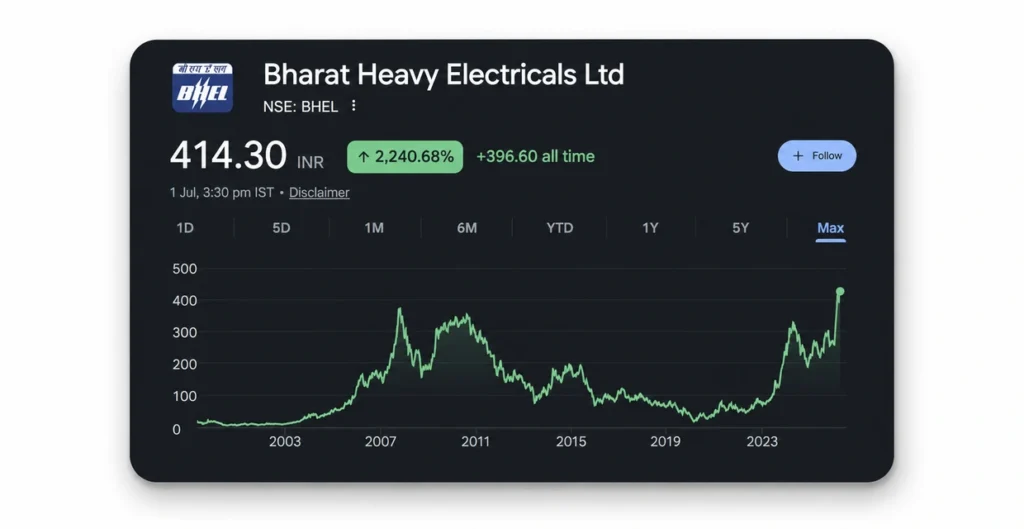
BHEL’s stock market journey has been long and cyclical. The company was listed on NSE in November 2003, and over the years its performance has usually moved with India’s power and capital expenditure cycle. For a long period, the stock stayed weak because of slow order execution, margin pressure, and limited private capex. The trend began improving when government infrastructure spending increased and fresh power, rail, and transmission opportunities started rising again. From 2023 onward, the stock saw a strong re-rating as investors started pricing in a recovery in revenue, profits, and order visibility. Even so, the stock has remained volatile because capital goods companies are sensitive to project delays, policy changes, competition, and valuation swings. Overall, the long-term trend has turned positive, but the path has not been smooth.
| Year | Opening Price | Closing Price | Return |
|---|---|---|---|
| 2022 | ₹60.70 | ₹79.20 | 30.5% |
| 2023 | ₹80.15 | ₹193.55 | 141.5% |
| 2024 | ₹198.15 | ₹229.40 | 15.8% |
| 2025 | ₹233.23 | ₹287.45 | 23.2% |
| 2026* | ₹291.45 | ₹414.10 | 42.1% |
Latest Shareholding Pattern
This split is based on the latest available official shareholding pattern for March 2026. The public portion above is the non-institutional public category after separating promoter, foreign institutional, and domestic institutional holdings.
Growth Factors
- Strong order book: BHEL ended FY2026 with its highest-ever outstanding order book of around ₹2.4 lakh crore, which gives strong revenue visibility for the coming years.
- Revenue and profit recovery: Revenue from operations rose to ₹33,782 crore in FY2026 from ₹28,339 crore in FY2025, while profit after tax rose to ₹1,578 crore from ₹513 crore. This shows improving execution and operating leverage.
- Power sector demand: India continues to need new thermal, transmission, and grid balancing investments. That supports BHEL because it remains an important domestic supplier in these areas.
- Renewable energy integration: The Bhadla-Fatehpur HVDC project connects directly with India’s renewable energy expansion and the national 500 GW renewable target by 2030.
- Railway opportunity: BHEL has entered deeper into rail propulsion and Vande Bharat Sleeper systems, which opens a long runway beyond pure power equipment.
- Make in India tailwind: Many of BHEL’s products fit well with India’s self-reliance push in power, transportation, and strategic manufacturing.
- Technology expansion: The company is moving into newer areas like BESS, EV chargers, advanced converters, and grid technologies, which can improve future relevance.
- Large manufacturing base: BHEL’s scale, installed capability, and long project experience remain difficult to replicate quickly. That gives it an edge in large national projects.
- Government-linked opportunities: Because BHEL is a major PSU engineering company, it may continue to benefit from public capex, energy transition projects, and infrastructure localization. This is an inference based on its order mix and recent project wins.
BHEL Share Price Target 2026 To 2050
| Year | Minimum Target | Average Target | Maximum Target |
|---|---|---|---|
| 2026 | ₹253 | ₹362 | ₹515 |
| 2027 | ₹528 | ₹582 | ₹631 |
| 2028 | ₹635 | ₹710 | ₹785 |
| 2029 | ₹748 | ₹784 | ₹810 |
| 2030 | ₹793 | ₹839 | ₹932 |
| 2035 | ₹1,143 | ₹1,210 | ₹1,273 |
| 2040 | ₹1,700 | ₹1,853 | ₹1,941 |
| 2050 | ₹3,464 | ₹3,663 | ₹3,811 |
These are estimated ranges, not guaranteed prices. They are built on current business momentum, order book visibility, margin improvement potential, sector growth, and the possibility that valuations may cool or expand over time, depending on execution and market sentiment. The current high P/E means future returns will depend heavily on earnings growth.
Also Check:
- Adani Power Share Price Target
- Adani Green Share Price Target
- Amara Raja Energy & Mobility Limited Share Price Target
- L&T Finance Share Price Target
- Filatex Fashions Limited Share Price Target
- Thyrocare Technologies Ltd Share Price Target
- Bajaj Housing Finance Share Price Target
- IOC Share Price Target
- ITC Hotels Share Price Target
BHEL Share Price Target 2026
BHEL’s 2026 outlook depends mainly on how the market values its FY2026 earnings recovery and whether execution remains strong in the second half of the year. If order wins continue and margins stay healthy, the stock can remain firm. But because valuation is already rich, short-term corrections are also possible. A realistic 2026 view is a broad range rather than a fixed number.
| Period | Estimated Target Price |
|---|---|
| Second Half (Jul–Dec) | ₹515 |
BHEL Share Price Target 2030
By 2030, BHEL’s performance may depend on three things: how much of the order book gets executed on time, whether the company expands in rail and transmission successfully, and whether return ratios improve from current levels. If earnings compound steadily and India’s infrastructure cycle remains strong, BHEL could move into a much higher price zone by the end of the decade.
| Period | Estimated Target Price |
|---|---|
| First Half | ₹793 |
| Second Half | ₹932 |
BHEL Share Price Target 2035
The 2035 estimate assumes BHEL becomes more diversified and less dependent on only traditional thermal projects. Better contribution from grid systems, transportation, industrial equipment, and energy transition businesses can improve quality of earnings. If the company also improves cash flow discipline and return on equity, the market may reward it with stronger long-term valuation support.
| Period | Estimated Target Price |
|---|---|
| First Half | ₹1,143 |
| Second Half | ₹1,273 |
BHEL Share Price Target 2040
The 2040 view is based on the idea that BHEL remains relevant in India’s long infrastructure story. If the company holds its place in power equipment, expands in renewable-linked transmission, and keeps adding value in rail and industrial systems, long-duration wealth creation is possible. Still, this depends on project execution, competition, and capital allocation staying disciplined over many years.
| Period | Estimated Target Price |
|---|---|
| First Half | ₹1,700 |
| Second Half | ₹1,941 |
BHEL Share Price Target 2050
The 2050 estimate is naturally the most uncertain. At that horizon, business quality matters more than short-term market mood. If BHEL continues to modernize, participates in future energy technologies, and grows with India’s industrialization, the stock can create meaningful long-term value. But any long forecast must be treated carefully because policy, technology, and competition can change a lot over decades.
| Period | Estimated Target Price |
|---|---|
| First Half | ₹3,464 |
| Second Half | ₹3,811 |
Bull Case
- Order book is at a record level, giving strong revenue visibility.
- FY2026 showed sharp improvement in revenue, EBITDA, and PAT.
- India’s power and transmission capex cycle remains supportive.
- BHEL is gaining traction in rail transportation through Vande Bharat-related work.
- Strong government and strategic sector linkages may help in project flow.
- New areas like HVDC, BESS, EV chargers, and advanced systems can improve future growth mix.
- If margins improve further, earnings growth can be faster than revenue growth.
- Market sentiment toward capital goods and infrastructure plays can remain positive if execution stays strong. This is an inference based on the recent re-rating trend.
Bear Case
- The stock is already trading at a high P/E, so valuation risk is real.
- Return on equity is still moderate, which shows the turnaround is not complete yet.
- Large projects can face delays, cost overruns, and payment cycle pressure. This is a sector risk inference.
- A big part of BHEL’s future depends on public capex and policy continuity. This is an inference based on business mix and order sources.
- Competition can rise in high-value power and transmission projects.
- Earnings quality must be watched carefully, especially in project-led businesses.
- Any slowdown in fresh order inflow can affect market sentiment quickly.
- Long-term estimates can fail if technology shifts faster than the company adapts.
Pros and Cons
Pros
- Record order book supports future growth visibility.
- Strong FY2026 improvement in revenue and profit.
- Well-known brand with long operating history.
- Presence across power, industry, rail, defence, and transmission.
- Benefits from India’s infrastructure and manufacturing push.
Cons
- Valuation is not cheap after the recent rally.
- ROE is still lower than top private-sector engineering peers.
- Project execution delays can hurt margins.
- Cash flow and working capital must stay under control.
- Heavy dependence on large contracts can increase volatility.
Expert Opinion
BHEL is no longer just a slow PSU story. The company has shown a visible improvement in FY2026, and its order book gives it a stronger base than before. At the same time, the stock is not inexpensive, so future upside will depend more on earnings growth than on easy re-rating. Long-term investors should keep an eye on execution quality, operating margin trend, order inflow, receivables, and return ratios. The stock may suit investors who understand cyclical businesses and can handle volatility. Those looking at BHEL should focus less on short-term noise and more on whether the company can convert its large order book into sustainable profit growth.
Conclusion
BHEL remains an important player in India’s engineering, power, and infrastructure ecosystem. The company has entered FY2026 with stronger financial momentum, a record order book, and new opportunities in transmission and rail systems. These factors support a constructive long-term view. However, the stock has already seen a major rerating, so execution, margins, and valuation discipline are now very important. For long-term investors, BHEL can remain an interesting stock to track, especially if India’s capex cycle stays strong. But this is still a cyclical business, and risks such as delays, competition, and policy changes should not be ignored.
Disclaimer: The share price targets mentioned in this article are estimates based on current market conditions, company fundamentals, and industry trends. They should not be considered investment advice. Investors should conduct their own research or consult a qualified financial advisor before making investment decisions.
Frequently Asked Questions (FAQs)
Is BHEL a good long-term investment?
BHEL can be considered for long-term tracking because it has a strong order book, a large manufacturing base, and direct exposure to India’s infrastructure growth. But it is a cyclical stock, so patience and risk understanding are necessary.
What are the major risks of investing in BHEL?
The major risks include high valuation, project delays, margin pressure, working capital issues, competition, and dependence on government-linked capex. These factors can create sharp ups and downs in the share price.