

Reliance Power Ltd is one of India’s recognized private-sector power generation companies and a part of the Anil Ambani-led Reliance Group. The company operates thermal power assets and has been actively pursuing opportunities in renewable energy and infrastructure development. Over the last decade, Reliance Power faced significant financial and operational challenges, including high debt levels and project-related issues. However, recent debt reduction efforts, improving profitability, and restructuring initiatives have renewed investor interest.
India’s power demand continues to grow due to rapid urbanization, industrial expansion, electric vehicle adoption, and digital infrastructure growth. As a result, investors are increasingly evaluating Reliance Power as a potential turnaround story. While the stock remains volatile and carries considerable risk, its improving financial profile and exposure to India’s long-term energy demand make it an attractive watchlist candidate for speculative and long-term investors.
Read Also :- RVNL Share Price Target 2025, 2035, 2030, 2040 To 2050
Company Overview
| Particular | Details |
|---|---|
| Company Name | Reliance Power Ltd |
| NSE Symbol | RPOWER |
| BSE Code | 532939 |
| Industry | Power Generation |
| Market Cap | ₹11,000–12,000 Crore (approx.) |
| Founded | 1995 |
| Headquarters | Mumbai, Maharashtra |
| Website | www.reliancepower.co.in |
What Does Reliance Power Do?
Reliance Power develops, owns, and operates power generation projects. Its portfolio includes coal-based thermal power plants and renewable energy initiatives. The company primarily earns revenue through the sale of electricity under long-term power purchase agreements (PPAs) and merchant power sales.
Its flagship asset is the Sasan Ultra Mega Power Project, one of India’s largest integrated coal-based power plants. The company benefits from India’s increasing electricity demand but faces competition from major players such as NTPC, Tata Power, Adani Power, and JSW Energy.
Reliance Power Share Price Market Overview
| Metric | Value |
|---|---|
| Current Share Price | ₹25–28 |
| Market Capitalization | ₹11,500 Crore (approx.) |
| P/E Ratio | ~42 |
| Book Value | ₹30+ (varies quarterly) |
| ROE | Improving |
| Dividend Yield | Nil |
| 52-Week High | Check latest market data |
| 52-Week Low | Check latest market data |
| Face Value | ₹10 |
| Industry | Power Generation |
Financial Performance
Revenue & Profit Performance
| Financial Year | Revenue (₹ Crore) | Net Profit (₹ Crore) |
|---|---|---|
| FY2022 | 7,503 | Loss |
| FY2023 | 7,514 | Loss |
| FY2024 | 7,893 | -2,242 |
| FY2025 | 7,583 | 2,947 |
| FY2026 | 7,620 | Mixed quarterly performance |
Revenue remained relatively stable between ₹7,500 crore and ₹7,900 crore during FY2022-FY2026, while profitability improved significantly during FY2025 due to lower finance costs and higher other income.
Debt Position
| Metric | Status |
|---|---|
| Total Debt | Significantly Reduced |
| Debt-to-Equity Ratio | Improving |
| Interest Cost | Declining |
| Financial Position | Stronger than previous years |
Recent restructuring and deleveraging efforts have substantially improved the company’s balance-sheet strength.
Historic Performance
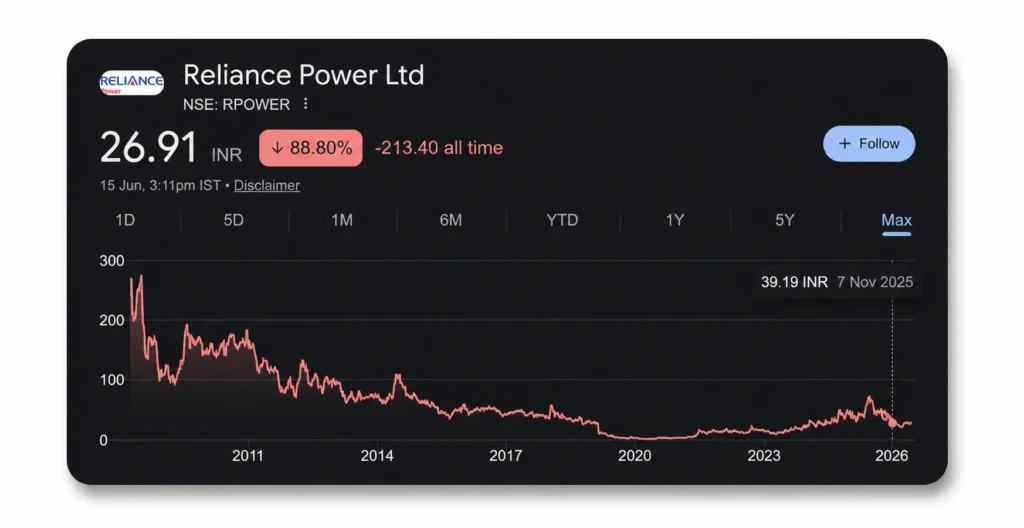
Reliance Power has experienced one of the most volatile journeys among Indian power stocks. After significant declines following its IPO era, the stock has recently witnessed renewed investor interest due to debt reduction and turnaround expectations.
Major Price-Moving Events
- Debt reduction initiatives.
- Return to profitability in FY2025.
- Renewable energy announcements.
- Improving operating margins.
- Strong retail investor participation.
Historical Performance Summary
| Period | Performance |
|---|---|
| 1-Year Return | Strongly Positive |
| 3-Year Return | Multi-bagger Returns |
| 5-Year Return | Significant Recovery |
| Volatility | Very High |
Shareholding Pattern (Latest Available)
| Shareholder Category | Holding |
|---|---|
| Promoters | 24.98% |
| FIIs | 14.13% |
| DIIs | 3.12% |
| Public | 57.77% |
The rising participation of foreign institutional investors indicates improving market confidence.
Growth Factors
Industry Growth
India is expected to remain one of the world’s fastest-growing electricity markets over the next two decades.
Expansion Plans
Reliance Power is exploring renewable energy opportunities and strategic partnerships.
Capacity Additions
Future solar and clean energy investments can support earnings growth.
Government Policies
Government initiatives focused on energy security, infrastructure, and renewable power are expected to benefit the sector.
Future Demand Drivers
- Electric vehicles
- Manufacturing expansion
- Data centers
- Smart cities
- Rising household consumption
Risks and Challenges
Competition
Competition remains intense from NTPC, Adani Power, Tata Power, and JSW Energy.
Regulatory Risks
Tariff regulations and environmental norms may impact profitability.
Debt Concerns
Although significantly reduced, investors continue to monitor leverage levels.
Economic Slowdown
Lower industrial activity could reduce power demand.
Sector Risks
Coal prices, fuel availability, and project execution risks remain key concerns of Reliance Power Share Price Target 2026–2050
Estimated Share Price Target Summary
| Year | Minimum Target | Average Target | Maximum Target |
|---|---|---|---|
| 2026 | ₹25.40 | ₹40 | ₹56.32 |
| 2030 | ₹104.21 | ₹85 | ₹141.55 |
| 2035 | ₹216 | ₹160 | ₹263.55 |
| 2040 | ₹317.75 | ₹275 | ₹490.22 |
| 2050 | ₹890.42 | ₹650 | ₹950.10 |
These are just calculation estimates based on earnings growth assumptions and should not be considered investment advice.
Reliance Power Share Price Target 2026
The 2026 target assumes continued debt reduction, stable electricity demand, and sustained profitability. If management maintains operational improvements and power demand remains robust, investor confidence may improve further. Strong quarterly earnings and positive sentiment toward turnaround stories could support valuation expansion. However, risks related to execution and sector regulations remain significant.
Monthly Target Table 2026
| Month | Target |
|---|---|
| Jan | ₹25.40 |
| Feb | ₹27.06 |
| Mar | ₹29.11 |
| Apr | ₹36.40 |
| May | ₹40.16 |
| Jun | ₹47.14 |
| Jul | ₹51.40 |
| Aug | ₹48.30 |
| Sep | ₹41.39 |
| Oct | ₹47.20 |
| Nov | ₹51.33 |
| Dec | ₹56.32 |
Reliance Power Share Price Target 2030
By 2030, India’s electricity demand could increase substantially due to industrialization and digital infrastructure expansion. If Reliance Power successfully strengthens its renewable energy portfolio and maintains profitability, the company may attract greater institutional investment. Long-term earnings growth could drive significant share price appreciation.
Monthly Target Table 2030
| Month | Target |
|---|---|
| Jan | ₹104.21 |
| Feb | ₹109.30 |
| Mar | ₹116.43 |
| Apr | ₹120.54 |
| May | ₹126.09 |
| Jun | ₹130.55 |
| Jul | ₹125.05 |
| Aug | ₹131.62 |
| Sep | ₹137.44 |
| Oct | ₹133.60 |
| Nov | ₹138.30 |
| Dec | ₹141.55 |
Reliance Power Share Price Target 2035
The 2035 projection assumes successful participation in India’s energy transition and continued balance-sheet improvement. Higher earnings visibility and lower financial risk could support a premium valuation.
Monthly Target Table 2035
| Month | Target |
|---|---|
| Jan | ₹216 |
| Feb | ₹223.05 |
| Mar | ₹234.19 |
| Apr | ₹242.77 |
| May | ₹248.05 |
| Jun | ₹253.44 |
| Jul | ₹259.01 |
| Aug | ₹249.60 |
| Sep | ₹238.52 |
| Oct | ₹246.91 |
| Nov | ₹257.11 |
| Dec | ₹263.55 |
Reliance Power Share Price Target 2040
If Reliance Power evolves into a diversified power and renewable energy company, it could benefit significantly from India’s rising energy consumption.
Monthly Target Table 2040
| Month | Target |
|---|---|
| Jan | ₹317.75 |
| Feb | ₹330.05 |
| Mar | ₹337.43 |
| Apr | ₹341.82 |
| May | ₹352.33 |
| Jun | ₹375.09 |
| Jul | ₹394.84 |
| Aug | ₹4166.22 |
| Sep | ₹436.51 |
| Oct | ₹450.50 |
| Nov | ₹474.11 |
| Dec | ₹490.22 |
Reliance Power Share Price Target 2050
The 2050 projection represents a highly optimistic scenario based on long-term economic growth, energy demand expansion, and successful business execution.
Monthly Target Table 2050
| Month | Target |
|---|---|
| Jan | ₹890.42 |
| Feb | ₹894.16 |
| Mar | ₹907.21 |
| Apr | ₹916.40 |
| May | ₹926.74 |
| Jun | ₹932.04 |
| Jul | ₹948.72 |
| Aug | ₹925.90 |
| Sep | ₹902.14 |
| Oct | ₹928.43 |
| Nov | ₹937.40 |
| Dec | ₹950.10 |
Bull Case
- Debt reduction improves financial stability.
- Strong power demand growth in India.
- Potential renewable energy expansion.
- Improved operating margins.
- Increasing institutional participation.
Bear Case
- Earnings remain inconsistent.
- Regulatory risks.
- High sector competition.
- Dependence on turnaround execution.
- Volatile stock price movements.
Pros and Cons
Pros
- Turnaround potential.
- Exposure to India’s power sector growth.
- Improving balance sheet.
Cons
- Historical financial challenges.
- High volatility.
- Regulatory and execution risks.
Expert Opinion
Reliance Power remains a high-risk, high-reward investment. Investors bullish on India’s energy sector and the company’s turnaround strategy may find long-term potential. However, conservative investors should carefully evaluate financial stability, earnings consistency, and sector risks before investing.
Future Outlook
India’s power demand is projected to grow steadily over the next two decades. Reliance Power’s future performance will depend on its ability to maintain profitability, manage debt effectively, and capitalize on renewable energy opportunities. If these objectives are achieved, the company could participate meaningfully in India’s long-term energy growth story.
Conclusion
Reliance Power has transformed from a heavily indebted company into a more financially stable business. While challenges remain, the company’s improving balance sheet and exposure to India’s expanding energy market create potential long-term opportunities. Investors should remember that the stock remains speculative and highly volatile.
Disclaimer: The share price targets discussed in this article are estimates based on assumptions and market conditions. They are not guaranteed and should not be considered investment advice. Always conduct independent research before investing.