
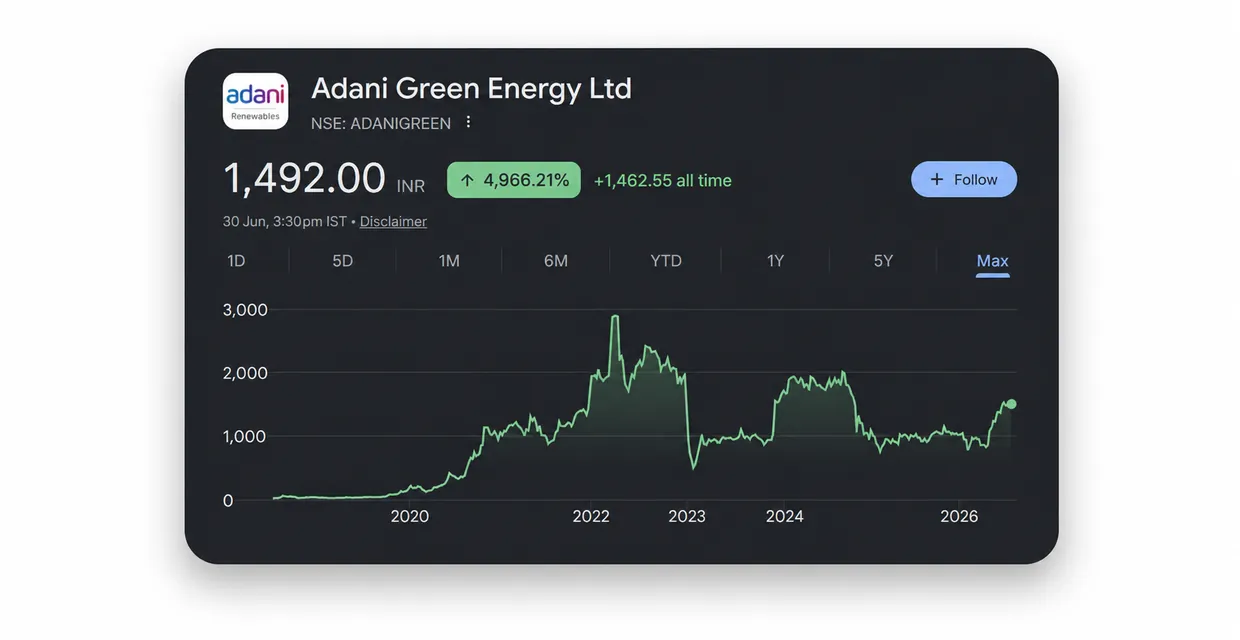
Adani Green Energy is one of the most watched renewable energy companies in India. Investors follow this stock closely because it operates in a sector that is expected to grow strongly for many years. As India increases its focus on solar power, wind power, hybrid energy, and clean energy storage, companies like Adani Green may benefit from this long-term shift. At the same time, the stock is known for sharp price movement, which makes long-term analysis very important. Many investors want to know whether the business growth can support future valuation. In this article, the full company profile, latest financial data, shareholding pattern, growth triggers, risks, and realistic Adani Green share price targets from 2026 to 2050 are explained in simple English.
Adani Green Company Overview
| Company Essential | Latest Value |
|---|---|
| Market Cap | ₹2,50,700 Cr. |
| Enterprise Value | ₹3,43,000 Cr. (Approx.) |
| No. Of Shares | 164.72 Cr. |
| P/E | 126.58 |
| P/B | 13.03 |
| Face Value | ₹10 |
| Book Value | ₹117.11 |
| Debt | ₹91,000 Cr. (Approx.) |
| Sales Growth | 36% (TTM) |
| ROE | 14.36% |
| Dividend Yield | 0.00% |
What Does Adani Green Energy Do?
Adani Green Energy is a renewable power company focused on building, owning, and operating clean energy assets. Its main business comes from generating electricity through solar, wind, and hybrid power projects. It sells electricity under long-term power purchase agreements, which gives better revenue visibility than many traditional businesses. The company is also expanding into battery energy storage and other supporting clean energy infrastructure. Its strong position comes from large-scale projects, long-term contracts, and a growing operational portfolio. One of its biggest future growth engines is the Khavda renewable energy project in Gujarat. The company’s long-term strategy is to keep increasing installed capacity, improve efficiency from existing plants, and become one of the largest integrated renewable energy platforms in India and globally.
Historic Share Price Performance
Adani Green Energy has had a very sharp and event-driven share price journey. After listing, the stock remained relatively less tracked in the early phase, but later it became one of the biggest wealth-creating renewable energy stocks during the clean energy boom. The company’s aggressive expansion plans, strong project wins, and sector interest helped the stock move up rapidly in earlier years. Later, the stock also faced major corrections due to valuation pressure, market sentiment, and group-related negative news. This shows that Adani Green is a high-growth stock, but also a high-volatility stock.
In the last few years, the stock has moved through both strong rallies and deep corrections. However, the long-term direction still depends on capacity growth, revenue expansion, debt control, and execution quality. Investors should understand that this stock can reward patience, but it may not move in a straight line.
| Year | Opening Price | Closing Price | Return |
|---|---|---|---|
| 2022 | ₹1,346.90 | ₹1,930.00 | 43.29% |
| 2023 | ₹1,888.70 | ₹1,570.00 | -16.87% |
| 2024 | ₹1,598.40 | ₹1,070.95 | -33.00% |
| 2025 | ₹1,046.40 | ₹1,013.00 | -3.19% |
| 2026 (YTD) | ₹1,025.90 | ₹1,502.50 | 46.46% |
Latest Shareholding Pattern
Growth Factors
- India’s renewable energy sector is expected to grow strongly over the next decade, which gives Adani Green a large long-term opportunity.
- Government support for solar, wind, hybrid projects, transmission infrastructure, and storage can help the company expand faster.
- The company has already built a large renewable portfolio and continues to add new capacity at a strong pace.
- Adani Green’s large-scale execution ability gives it an advantage over smaller players in utility-scale projects.
- The Khavda renewable energy park can become a major long-term revenue and valuation driver.
- Battery storage and hybrid power projects can improve energy supply stability and create better business quality over time.
- Rising electricity demand in India supports long-term renewable power demand.
- The company benefits from long-term power purchase agreements, which improve revenue visibility.
- Technology, analytics, and better plant performance can improve efficiency and generation output.
- If profitability improves along with capacity growth, long-term investor confidence can become stronger.
Adani Green Share Price Target 2026 To 2050
The following targets are estimates based on current fundamentals, business scale, future expansion plans, earnings outlook, valuation risk, and the long-term renewable energy opportunity in India. These are not guaranteed prices. They are only realistic projections under different business and market conditions.
| Year | Minimum Target | Average Target | Maximum Target |
|---|---|---|---|
| 2026 | ₹772.58 | ₹1,425.30 | ₹1,847.05 |
| 2027 | ₹1,853.17 | ₹1,711.86 | ₹1,461.14 |
| 2028 | ₹1,104.07 | ₹1,231.15 | ₹1,394.87 |
| 2029 | ₹1,452.36 | ₹1,604.66 | ₹1,702.35 |
| 2030 | ₹2,590.75 | ₹2,625.80 | ₹2,714.66 |
| 2035 | ₹3,599.42 | ₹3,710.94 | ₹3,954.19 |
| 2040 | ₹5,200.26 | ₹5,931.53 | ₹6,788.03 |
| 2050 | ₹8,361.74 | ₹8,793.15 | ₹9,179.77 |
Also Read:
- Amara Raja Energy & Mobility Limited Share Price Target
- L&T Finance Share Price Target
- ITC Hotels Share Price Target
- BPCL Share Price Target
- IFCI Share Price Target
Adani Green Share Price Target 2026
The 2026 target depends mainly on the company’s execution speed, new project commissioning, revenue growth, and market valuation. Since the stock already trades at a premium valuation, the upside may continue only if business performance remains strong. If project growth stays on track and investor confidence remains positive, the stock can move higher. But if valuation pressure returns, price swings can remain sharp.
| Period | Estimated Target Price |
|---|---|
| First Half (Jan–Jun) | ₹772.58 |
| Second Half (Jul–Dec) | ₹1,847.05 |
Adani Green Share Price Target 2030
By 2030, Adani Green’s stock performance may depend on how close the company comes to its long-term renewable capacity goals. If it successfully expands generation assets, improves earnings quality, and manages debt better, the stock can remain strong. The renewable sector itself may become much larger by then, which can support better valuation. However, the company will need both scale and stronger financial efficiency.
| Period | Estimated Target Price |
|---|---|
| First Half | ₹2,590.75 |
| Second Half | ₹2,714.66 |
Adani Green Share Price Target 2035
The 2035 outlook assumes that Adani Green remains one of India’s biggest renewable power players and benefits from a mature clean energy ecosystem. By that time, investors may focus more on stable cash flow, return ratios, and balance sheet quality instead of just capacity addition. If the company shows strong operating quality along with growth, the stock can compound well over time. If debt stays high, gains may be slower.
| Period | Estimated Target Price |
|---|---|
| First Half | ₹₹3,599.42 |
| Second Half | ₹3,954.19 |
Adani Green Share Price Target 2040
The 2040 target is built on a long-term renewable energy transformation story in India. Solar, wind, storage, and hybrid energy solutions are likely to be much bigger by then. A company that already has large scale today may benefit significantly in that environment. Still, future share price will not depend on headlines alone. It will depend on earnings growth, efficient capital use, asset quality, and long-term financial discipline.
| Period | Estimated Target Price |
|---|---|
| First Half | ₹5,200.26 |
| Second Half | ₹6,788.03 |
Adani Green Share Price Target 2050
The 2050 target is a very long-term estimate, so it should be viewed carefully. Over such a long period, many things can change, including competition, technology, regulations, interest rates, and energy demand patterns. If Adani Green builds a large and financially stable clean energy platform, it can create strong long-term value. But this type of projection is best seen as a broad future range, not a fixed expected number.
| Period | Estimated Target Price |
|---|---|
| First Half | ₹8,361.74 |
| Second Half | ₹9,179.77 |
Bull Case
- The company operates in one of the fastest-growing sectors in India.
- It already has strong scale in renewable power generation.
- Large future projects can support multi-year revenue growth.
- Long-term power purchase agreements provide business visibility.
- Khavda and other expansion plans can improve long-term valuation.
- Storage and hybrid energy projects can improve business strength.
- If debt management improves, investor confidence can rise sharply.
- Strong execution can help the stock outperform expectations.
Bear Case
- The stock trades at a high valuation compared with many other power stocks.
- High debt and funding needs remain important risks.
- Profit growth may not always match revenue growth.
- Delays in project execution can affect investor sentiment.
- Renewable energy output may vary due to weather conditions.
- Policy or tariff changes can impact returns.
- The stock is sensitive to negative headlines and market mood.
- A sharp correction is possible if growth slows or valuation cools.
Pros and Cons
Pros
- Strong position in India’s renewable energy sector
- Large operational capacity and expansion pipeline
- Long-term contracts support revenue visibility
- Growth linked with clean energy demand in India
- Potential long-term beneficiary of energy transition
Cons
- Premium valuation leaves less margin for error
- Debt remains an important factor to monitor
- High volatility can worry conservative investors
- No dividend support for income-focused investors
- Sensitive to execution and sentiment risk
Expert Opinion
Adani Green Energy is a strong long-term thematic stock, but it is not a simple value stock. The company has scale, sector leadership, and a large future growth runway. These are powerful positives. But investors should not ignore the risks that come with high valuation and debt-heavy expansion. For long-term tracking, the most important factors are capacity addition, revenue growth, net profit improvement, debt reduction, and return ratios like ROE. The stock may suit investors who understand business cycles and can handle large ups and downs. It is better viewed as a growth-oriented renewable energy story rather than a low-risk defensive investment.
Conclusion
Adani Green Energy stands out as one of the most important renewable energy companies in India. Its strengths come from scale, sector opportunity, long-term demand for clean power, and a large project pipeline. If the company continues to execute well, it can remain a major long-term player in India’s green energy story. At the same time, investors must remember that future returns will depend not only on growth but also on profitability, debt control, and valuation discipline. So the long-term outlook looks promising, but the path may remain volatile. Investors should study both the opportunity and the risk before taking any long-term decision.
Disclaimer: The share price targets mentioned in this article are estimates based on current market conditions, company fundamentals, and industry trends. They should not be considered investment advice. Investors should conduct their own research or consult a qualified financial advisor before making investment decisions.
Frequently Asked Questions (FAQs)
Is Adani Green a good long-term investment?
Adani Green can be considered a strong long-term renewable energy growth stock, but it also carries valuation and debt-related risks. It may suit investors with a long time horizon and good risk tolerance.
What are the major risks of investing in Adani Green?
The major risks include high valuation, debt burden, execution delays, policy changes, margin pressure, and stock price volatility.
Can Adani Green reach new all-time highs by 2030?
Yes, it is possible if the company continues strong capacity growth, improves earnings quality, and benefits from rising renewable energy demand. But it will depend on both business performance and market sentiment.
Should beginners invest in Adani Green stock?
Beginners should be careful because the stock can be very volatile. It is better for those who understand market risk and are willing to stay invested for the long term.