

IFCI Limited is one of India’s oldest financial companies and is well known among stock market investors. It was started to provide financial support to industries but now offers many services, including business loans, financial advisory, asset monetisation, debt recovery, and government project management. Because of its different business activities, the stock attracts both long-term investors and short-term traders.
Many investors follow IFCI because it is backed by the Government of India and has a long business history. The company can benefit from higher infrastructure spending, industrial growth, and increased project financing. In the past, IFCI’s share price has shown strong movements, making it popular among traders. However, the company also faces challenges such as lower profitability and execution risks. In this article, we discuss IFCI’s business, financial performance, shareholding pattern, growth opportunities, risks, and expected share price targets from 2026 to 2050 based on its current business performance.
Company Overview & Financial Highlights
| Company Essential | Value |
|---|---|
| Market Cap | ₹23,098.36 Cr. |
| Enterprise Value | ₹24,520 Cr. |
| No. Of Shares | 269.52 Cr. |
| P/E | 125.00 |
| P/B | 2.58 |
| Face Value | ₹10 |
| Book Value | ₹33.20 |
| Debt | ₹3,415 Cr. |
| Sales Growth | -0.13% |
| ROE | 2.09% |
| Dividend Yield | 0.00% |
What Does IFCI Limited Do?
IFCI Limited is a public sector non-banking financial company (NBFC) that offers more than just loans. It was originally established to provide long-term financial support to industries, but today its business includes advisory services, project management, government scheme implementation, investments, and asset recovery. The company provides financial assistance to businesses in sectors such as infrastructure, manufacturing, and services. It also works as a project advisor and nodal agency for various government projects, which helps it earn income from sources other than lending.
IFCI has several subsidiaries and associate companies that operate in areas like venture funding, consultancy, and other financial services. Another important part of its business is recovering and selling stressed assets, which helps improve its financial position. Although IFCI is smaller than leading private financial institutions in terms of profits and business size, it benefits from government ownership, strong credibility, and involvement in government-related projects. The company is now focused on improving asset quality, increasing advisory and fee-based income, and strengthening its overall business instead of only expanding its loan portfolio.
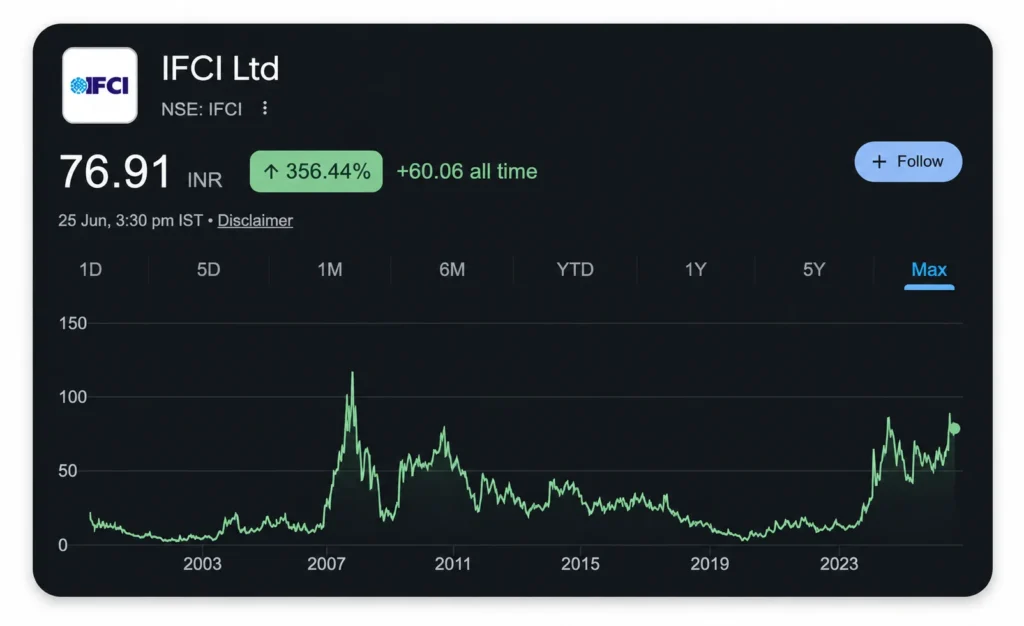
Historic Share Price Performance
IFCI’s share price has been very volatile over the years. Although the company has been operating for many decades, its stock has mostly moved based on government support, restructuring plans, financial recovery, and investor sentiment rather than steady business growth. For a long time, the stock remained weak because the company struggled to generate consistent profits and strong returns. This made IFCI more popular among short-term traders than long-term investors.
The stock has also seen sharp rallies when investors expected better financial performance, asset monetisation, or positive government decisions. In recent years, IFCI has gained attention whenever earnings improved or restructuring plans progressed. However, the stock has also experienced quick declines when expectations became too high. Overall, IFCI has the potential for strong short-term gains, but it needs more consistent business growth and profitability to achieve stable long-term performance.
| Year | Opening Price | Closing Price | Return |
|---|---|---|---|
| 2022 | ₹9.90 | ₹13.70 | 38.38% |
| 2023 | ₹13.80 | ₹28.85 | 109.06% |
| 2024 | ₹29.30 | ₹59.20 | 102.05% |
| 2025 | ₹62.03 | ₹50.84 | -18.04% |
Growth Factors
Infrastructure Growth: If India continues to invest in roads, manufacturing, and industrial projects, IFCI can benefit because of its long experience in project financing and advisory services.
Government Projects: IFCI is working on more government-related projects and policy implementation. These projects can provide stable income and reduce its dependence on interest earnings.
Asset Recovery: Recovering old loans, settling pending cases, and selling non-core assets can improve IFCI’s profits and strengthen investor confidence.
Better Business Operations: If IFCI improves its group structure, reduces unnecessary costs, and uses capital more efficiently, the company may receive a higher market valuation.
Digital Transformation: Using modern technology can improve loan processing, project monitoring, compliance, and overall operational efficiency, helping the company work faster and more effectively.
Strong Government Support: The government’s large shareholding provides financial stability and long-term support. If this backing leads to higher profits, better return on equity (ROE), and efficient capital allocation, IFCI’s long-term growth potential could improve.
IFCI Share Price Target 2026–2050
| Year | Minimum Target | Average Target | Maximum Target |
|---|---|---|---|
| 2026 | ₹47 | ₹80 | ₹98 |
| 2027 | ₹93 | ₹87 | ₹74 |
| 2028 | ₹78 | ₹95 | ₹120 |
| 2029 | ₹124 | ₹106 | ₹152 |
| 2030 | ₹160 | ₹118 | ₹210 |
| 2035 | ₹380 | ₹148 | ₹466 |
| 2040 | ₹763 | ₹176 | ₹840 |
| 2050 | ₹1,280 | ₹220 | ₹1,405 |
Also Check:
These estimates assume that IFCI continues improving profitability gradually rather than suddenly transforming into a high-ROE financial compounder. The upside case depends on stronger execution, better recovery outcomes, rising fee-based income, and a cleaner balance sheet. The downside case reflects the possibility that weak returns on equity and inconsistent business momentum may continue.
IFCI Share Price Target 2026
The 2026 outlook for IFCI depends largely on how the market interprets its latest earnings trajectory and whether the company can maintain confidence around recovery-led profitability. The stock has already seen large price movements in recent periods, so 2026 may be more about consolidation than uninterrupted rerating. If earnings stay stable and sentiment toward public sector financial names remains constructive, IFCI can continue trading in a healthy band. However, because return ratios are still modest, valuation expansion may remain limited unless operational quality visibly improves.
| Period | Estimated Target Price |
|---|---|
| First Half (Jan–Jun) | ₹47 |
| Second Half (Jul–Dec) | ₹98 |
IFCI Share Price Target 2030
By 2030, IFCI’s share price will likely depend on whether it can convert its institutional strength into a more durable earnings model. Investors will watch for better asset quality, a stronger advisory and project-management franchise, and steadier profitability. If the company demonstrates better capital efficiency and improved visibility of income streams, the stock may receive a stronger market multiple than it does today. But if progress remains slow, upside could still be capped despite government backing and legacy relevance.
| Period | Estimated Target Price |
|---|---|
| First Half | ₹160 |
| Second Half | ₹210 |
IFCI Share Price Target 2035
The 2035 target assumes that IFCI remains relevant in India’s financial and policy ecosystem and continues to derive benefits from advisory, asset monetisation, and public-sector-linked assignments. This is not a projection of explosive growth. Instead, it reflects the possibility of a slow but meaningful rerating if the company’s net worth, profitability quality, and business mix strengthen over time. Investors will expect better ROE by this stage. Without that, even a profitable IFCI may struggle to command a premium valuation.
| Period | Estimated Target Price |
|---|---|
| First Half | ₹380 |
| Second Half | ₹466 |
IFCI Share Price Target 2040
A 2040 estimate for IFCI is necessarily long-range and should be treated as scenario-based rather than precise. If India’s financial system continues deepening and IFCI successfully preserves a niche role in specialised finance and institutional advisory, the stock could benefit from longevity, balance sheet clean-up, and stable earnings. The main question is whether IFCI can transition from a legacy turnaround narrative into a mature, consistent business model. If it does, the stock can deliver moderate long-term appreciation.
| Period | Estimated Target Price |
|---|---|
| First Half | ₹763 |
| Second Half | ₹840 |
IFCI Share Price Target 2050
The 2050 target reflects a conservative long-term framework. It does not assume that IFCI becomes a sector leader by profitability or scale. Instead, it assumes survival, relevance, moderate business expansion, stronger capital structure, and gradual compounding over decades. Because the company currently operates with low return metrics, a very aggressive 2050 forecast would be unrealistic. Long-term upside exists, but it is more likely to come from steady restructuring and institutional value creation than from fast-growth financial performance.
| Period | Estimated Target Price |
|---|---|
| First Half | ₹1,280 |
| Second Half | ₹1,405 |
Pros and Cons
Pros
- Government-controlled institution with long operating history
- Strong promoter holding
- Improvement in consolidated profitability
- Multiple revenue levers beyond plain lending
- Scope for value unlocking through recoveries and restructuring
Cons
- Low ROE
- No dividend yield support
- Highly volatile stock behavior
- Business model still lacks the clarity of top financial peers
- Long-term rerating needs stronger execution than currently visible
Expert Opinion
At the current market level, IFCI appears to be a stock where valuation is influenced as much by expectations as by present-day operating quality. The company is profitable on a consolidated basis and continues to hold strategic relevance in parts of the financial and policy ecosystem, but its core challenge remains the same: investors want to see stronger, cleaner, and more repeatable returns. A stock with a modest ROE and no dividend generally needs a convincing turnaround or structural growth narrative to sustain a premium.
From a long-term perspective, IFCI is more suitable for investors who understand balance sheet stories, public sector rerating themes, and the difference between business improvement and speculative momentum. It is not the kind of stock that can be judged only by headline profit growth. Net worth strength, asset quality movement, recovery success, fee-based income share, and capital efficiency all matter.
The most important metrics to monitor over time are consolidated profit sustainability, return on equity, book value growth, recovery-led gains versus recurring income, and any concrete progress on group consolidation or strategic restructuring. If these indicators improve together, IFCI’s long-term market position can strengthen meaningfully.
Conclusion
IFCI is an interesting company, but it is not a simple investment. Its biggest strengths are government support, a long history in the financial sector, high promoter holding, and the potential to grow through business recovery, advisory services, and future restructuring. As India continues to invest in infrastructure and industrial development, IFCI can still play an important role. However, the company needs to improve its profitability, use its capital more efficiently, and deliver stable earnings to attract more investors. Because of this, IFCI should be seen as a company with gradual improvement potential rather than a fast-growing financial stock.
Investors looking for steady and predictable returns may prefer other companies, while those interested in turnaround opportunities may continue to watch IFCI closely. The long-term outlook is cautiously positive, but investors should keep realistic expectations. If the company improves its business performance, increases regular income, and maintains a healthier balance sheet, it can create value for shareholders over time. However, regular monitoring is important because the stock still carries risks.
Disclaimer: The share price targets mentioned in this article are estimates based on current market conditions, company fundamentals, and industry trends. They should not be considered investment advice. Investors should conduct their own research or consult a qualified financial advisor before making investment decisions.
Frequently Asked Questions (FAQs)
What is the IFCI Share Price Target for 2026?
The estimated IFCI share price target for 2026 ranges from ₹68 to ₹92, with an average target of around ₹80.
What is the IFCI Share Price Target for 2030?
The estimated IFCI share price target for 2030 ranges from ₹95 to ₹140, with an average target of about ₹118.
Is IFCI a good long-term investment?
IFCI can be considered a long-term monitoring stock for investors interested in turnaround and policy-linked financial businesses, but it also carries execution and valuation risks.
What are the major risks of investing in IFCI?
Major risks include weak ROE, earnings volatility, legacy balance sheet concerns, and the possibility that improvement may remain slower than expected.