
IRB Infrastructure Developers Limited is one of India’s leading companies in the road and highway sector. The company is mainly involved in building highways, collecting tolls, developing road projects, and maintaining completed roads. It also uses Infrastructure Investment Trusts (InvITs) to raise funds and invest in new projects. Because of its wide range of businesses, IRB Infra is not just seen as a construction company but also as a long-term infrastructure company that can benefit from increasing traffic, higher toll collections, and India’s growing investment in roads and highways.
Many investors keep an eye on IRB Infra because the Indian government continues to spend heavily on improving road and transport infrastructure. The company also has a diversified business model, earning income from construction projects, toll collection, road maintenance, and asset monetisation. In addition, IRB Infra often remains in the news due to new highway projects, InvIT transactions, stake sales, and changes in toll revenue.
In this article, we will explore the company’s business model, financial performance, shareholding pattern, historical share price performance, future growth opportunities, and realistic IRB Infra share price targets from 2026 to 2050.
Company Overview & Financial Highlights
| Company Essential | Value |
|---|---|
| Market Cap | ₹25,593 Cr. |
| Enterprise Value | ₹43,184 Cr. |
| No. of Shares | 1,207.23 Cr. |
| P/E | 29.10 |
| P/B | 1.22 |
| Face Value | ₹1 |
| Book Value | ₹17.30 |
| Debt | ₹17,591 Cr. |
| Sales Growth | 7.62% |
| ROE | 4.31% |
| Dividend Yield | 0.73% |
What Does IRB Infrastructure Developers Do?
IIRB Infrastructure Developers is one of India’s leading road and highway infrastructure companies. It develops, builds, operates, and maintains highways across the country. The company works on different project models such as BOT, TOT, HAM, and EPC, allowing it to earn income from multiple sources instead of depending only on construction work.
After completing a project, IIRB earns money through toll collections, construction contracts, and the operation and maintenance of its road assets. This creates a steady flow of revenue over the long term. The company also uses Infrastructure Investment Trusts (InvITs) to sell mature projects and invest the money in new opportunities. This strategy helps improve cash flow and reduces debt.
IIRB generates revenue from construction, toll income, project-related earnings, and maintenance services. Its strong experience in highway development, successful project execution, and large portfolio of road assets make it one of the well-known private toll road companies in India. In the future, the company plans to focus on growing toll revenue, improving existing projects, and making smart investments for sustainable growth.
Historic Share Price Performance
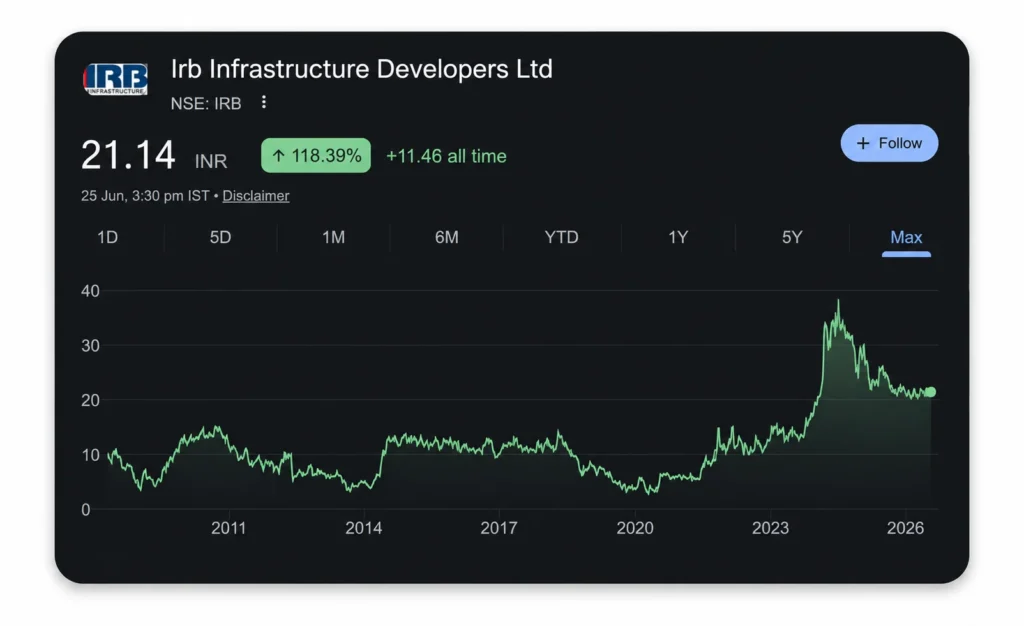
IRB Infra’s share price has gone through many ups and downs since it was listed. At times, the stock performed poorly because of high debt, delays in projects, and weak market sentiment toward infrastructure companies. However, it also saw strong growth when toll road assets became more valuable, the company improved its financial position, and the Indian government’s focus on roads and infrastructure increased. The stock’s performance depends more on traffic growth, toll collections, cash flow, and the value of its assets than on revenue alone.
During 2023 and 2024, IRB Infra’s shares rose sharply as investors became positive about infrastructure stocks. In 2025, the stock corrected even though the business continued to grow. This shows that infrastructure stocks can fall quickly when investors become worried about high debt, expensive valuations, or lower future returns.
The table below uses broad year-opening and year-end market levels to summarise the stock trend.
| Year | Opening Price | Closing Price | Return |
|---|---|---|---|
| 2022 | ₹12.70 | ₹14.52 | 14.33% |
| 2023 | ₹14.31 | ₹20.76 | 45.07% |
| 2024 | ₹33.05 | ₹28.61 | -13.43% |
| 2025 | ₹28.67 | ₹21.03 | -26.64% |
| 2026* | ₹20.76 | ₹21.31 | 2.65% |
Growth Factors
- India’s road development: The government is spending heavily on highways and expressways, creating more business opportunities for IRB Infra.
- Higher toll collections: As more vehicles use highways and toll rates increase over time, the company can earn more revenue.
- Asset monetisation: IRB sells or transfers completed road projects to InvITs, which helps it raise money for new projects without taking too much debt.
- Diversified business model: The company works in BOT, TOT, HAM, EPC, and O&M projects. This reduces risk because if one segment slows down, other segments can support growth.
- Government support: Continuous investment in roads, logistics parks, and transport infrastructure provides long-term growth opportunities.
- Better financial performance: If IRB improves its profits, reduces debt, and generates stronger cash flow, investors may value the stock more highly.
- Strong experience: IRB has many years of experience in building and operating highways, giving it an advantage over many competitors.
- Long-term potential: Although the stock may move up and down in the short term, India’s growing infrastructure sector supports IRB’s long-term growth.
IRB Infra Share Price Target 2026–2050
| Year | Minimum Target | Average Target | Maximum Target |
|---|---|---|---|
| 2026 | ₹19 | ₹24.70 | ₹27.40 |
| 2027 | ₹21.50 | ₹28.70 | ₹32.54 |
| 2028 | ₹24.10 | ₹29 | ₹36.40 |
| 2029 | ₹30.65 | ₹535.05 | ₹39.70 |
| 2030 | ₹42 | ₹48.30 | ₹55.30 |
| 2035 | ₹80.30 | ₹84 | ₹88.10 |
| 2040 | ₹120.50 | ₹127.40 | ₹135.70 |
| 2050 | ₹280 | ₹338.50 | ₹392.66 |
Also Check:
IRB Infra Share Price Target 2026
For 2026, the stock is likely to remain more valuation-sensitive than momentum-driven. The market will closely watch toll revenue trends, project monetisation progress, and whether the company can translate scale into stronger return ratios. Since the stock is trading near the lower half of its recent range, any positive surprise in earnings quality or asset monetisation can support recovery. At the same time, limited ROE and leverage-related caution may cap upside. That is why 2026 looks more like a stabilisation year than a breakout year.
| Period | Estimated Target Price |
|---|---|
| First Half (Jan–Jun) | ₹19–₹23 |
| Second Half (Jul–Dec) | ₹23.60–₹27.40 |
IRB Infra Share Price Target 2030
By 2030, the story becomes more dependent on execution consistency. If IRB continues to monetise mature assets, adds economically attractive projects, and grows toll-linked cash flows without overstretching the balance sheet, the market may re-rate the stock more meaningfully. A stronger infrastructure cycle and better private-sector participation in road assets would also help. However, this target range assumes only moderate valuation expansion, not a euphoric rerating.
| Period | Estimated Target Price |
|---|---|
| First Half | ₹42–₹47.40 |
| Second Half | ₹48.05–₹55.30 |
IRB Infra Share Price Target 2035
The 2035 outlook depends on whether IRB evolves into a more efficient capital allocator rather than remaining just a project-heavy infrastructure developer. If the company improves free cash generation, maintains portfolio quality, and benefits from mature traffic assets, the stock can sustain a healthier long-term rating. Still, infrastructure businesses rarely move in a straight line, so volatility should be expected.
| Period | Estimated Target Price |
|---|---|
| First Half | ₹80.30–₹75.47 |
| Second Half | ₹79.40–₹88.10 |
IRB Infra Share Price Target 2040
A 2040 projection requires a long view. At that horizon, the stock’s value will be shaped less by one or two quarterly results and more by the durability of the business model. If IRB remains relevant in India’s toll roads, expressway, and monetisation ecosystem, it can create substantial compounding through recurring cash flows and strategic asset recycling. But investors should remember that infrastructure valuation depends heavily on regulation, capital cost, and concession quality.
| Period | Estimated Target Price |
|---|---|
| First Half | ₹120.50–₹128.90 |
| Second Half | ₹122–₹135.70 |
IRB Infra Share Price Target 2050
The 2050 estimate is a very long-duration scenario, not a near-certainty. Reaching the higher end of this band would require decades of disciplined balance-sheet management, continued relevance in India’s highway ecosystem, and healthy reinvestment economics. It would also require IRB to avoid the common pitfall of many infrastructure developers: scale without shareholder returns. That makes the long-term upside attractive, but highly execution-dependent.
| Period | Estimated Target Price |
|---|---|
| First Half | ₹280–₹325.60 |
| Second Half | ₹330.10–₹392.66 |
Pros and Cons
Pros
- Strong brand and long operating history in road infrastructure
- Diversified business mix across development, construction, tolling, and O&M
- Asset monetisation route provides strategic flexibility
- Institutional ownership remains significant
- Benefits from India’s multi-year transport infrastructure push
Cons
- ROE is still on the lower side
- Balance-sheet quality remains a key market concern
- Earnings visibility can be affected by asset transactions
- The sector is capital-intensive and execution heavy
- Stock performance can remain volatile despite stable operations
Expert Opinion
IRB Infra is a stock that sits between an operating business and an asset platform. That makes it interesting, but also more complex than many retail investors initially assume. The current valuation suggests the market sees value in the asset base and long-term opportunity, but is still unwilling to assign a premium reserved for companies with consistently high return ratios and cleaner balance sheets.
From a long-term perspective, IRB remains relevant because India’s roads and highway infrastructure cycle is far from over. The company has experience, scale, and a monetisation pathway that can create value over time. But this is not the kind of business where revenue growth alone is enough. Investors need to monitor toll collection trends, asset transfers, leverage, interest burden, project quality, and the gap between accounting profit and shareholder value creation.
The stock may suit investors who understand cyclical infrastructure businesses and are comfortable with periods of sideways movement. It is less suitable for those looking only for clean, predictable compounding. The most important metrics to track over time are revenue quality, profit sustainability, ROE improvement, debt discipline, and the company’s ability to unlock value from mature assets without diluting future growth potential.
Conclusion
IRB Infrastructure Developers remains one of the important listed names in India’s road infrastructure space. The company has clear strengths: project execution capability, operating experience, exposure to toll-linked assets, and a model that can benefit from both construction activity and long-term asset ownership. It also has a strategic advantage in capital recycling through InvIT-related structures, which can support future growth if used efficiently.
The long-term opportunity is tied closely to India’s continuing transport and highway expansion. Better road connectivity, logistics demand, and toll monetisation can all support the business over the next decade and beyond. That is why IRB Infra continues to attract investor attention even after periods of stock price correction.
Disclaimer: The share price targets mentioned in this article are estimates based on current market conditions, company fundamentals, and industry trends. They should not be considered investment advice. Investors should conduct their own research or consult a qualified financial advisor before making investment decisions.
Frequently Asked Questions (FAQs)
What is the IRB Infra Share Price Target for 2026?
The estimated IRB Infra share price target for 2026 is ₹19 on the lower side, ₹23 as an average case, and ₹27 on the higher side.
What is the IRB Infra Share Price Target for 2030?
The estimated IRB Infra share price target for 2030 ranges from ₹27 to ₹42, with an average expectation of around ₹35.
Is IRB Infra a good long-term investment?
IRB Infra can be considered a long-term infrastructure-focused stock, but it suits investors who understand project cycles, toll assets, and balance-sheet risks.
What are the major risks of investing in IRB Infra?
The major risks include leverage, lower return ratios, execution delays, regulatory changes, and volatility linked to project monetisation and traffic assumptions.