

Canara Bank is one of India’s oldest and largest public sector banks, playing a significant role in the country’s banking and financial services sector. Established in 1906, the bank has built a strong nationwide presence through thousands of branches, digital banking platforms, and a diverse portfolio of retail, corporate, agricultural, and MSME banking services. Following the merger with Syndicate Bank, Canara Bank significantly expanded its customer base, business operations, and market share, making it one of the leading PSU banks in India.
The Indian banking sector has undergone a remarkable transformation over the past few years, driven by rapid digital adoption, stronger asset quality, improving credit demand, and government-led financial inclusion initiatives. These developments have attracted long-term investors toward fundamentally strong banking stocks such as Canara Bank.
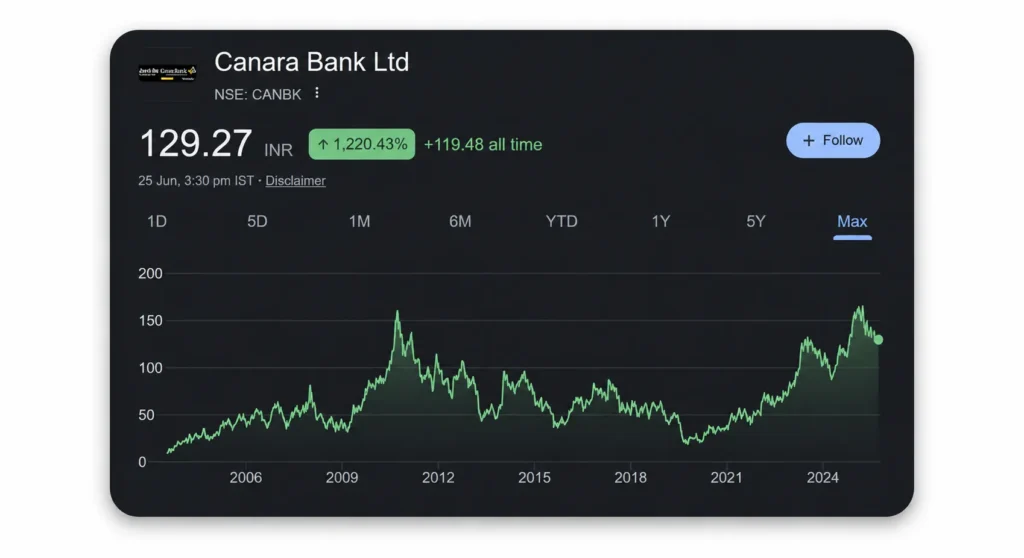
Long-term share price projections help investors understand how a company may perform under different economic and business scenarios. While no forecast is guaranteed, evaluating financial performance, asset quality, profitability, and industry trends provides valuable insights into future growth potential.
Company Overview & Financial Highlights
| Particular | Details |
|---|---|
| Company Name | Canara Bank |
| NSE Symbol | CANBK |
| BSE Code | 532483 |
| Industry | Public Sector Banking |
| Market Capitalization | ₹1.15+ Lakh Crore (Approx.) |
| Headquarters | Bengaluru, Karnataka |
| Promoter Holding | 62.93% (Government of India) |
| Latest Annual Revenue | ₹1.45+ Lakh Crore (Latest Annual Results) |
| Latest Net Profit | ₹15,000+ Crore |
| Official Website | canarabank.com |
What Does Canara Bank Do?
Canara Bank is a full-service commercial bank offering a comprehensive range of financial products and banking services to individuals, businesses, government organizations, and institutional clients. Its operations are spread across retail banking, corporate lending, MSME financing, agriculture loans, treasury operations, and digital financial services.
Retail banking contributes a significant share of the bank’s business through home loans, vehicle loans, education loans, gold loans, personal loans, savings accounts, current accounts, and fixed deposits. The bank has also strengthened its digital offerings with mobile banking, internet banking, UPI services, and AI-enabled customer support.
Corporate banking remains another major revenue contributor. Canara Bank finances large infrastructure projects, manufacturing companies, exporters, renewable energy businesses, and public sector enterprises. The bank also provides working capital facilities, project financing, trade finance, and cash management services.
Agriculture and MSME lending continue to be strategic focus areas due to government-backed schemes and increasing rural credit demand. These segments help diversify the loan portfolio while supporting financial inclusion.
The bank generates revenue primarily through interest income from loans, treasury investments, fee-based income, commissions, foreign exchange services, insurance distribution, and wealth management products.
One of Canara Bank’s biggest competitive advantages is its strong government backing, extensive branch network, healthy deposit franchise, improving asset quality, and consistent focus on digital transformation. Management continues to prioritize better risk management, lower NPAs, higher profitability, improved CASA ratio, and sustainable credit growth, positioning the bank for long-term expansion.
Share Price Market Overview
| Metric | Value |
|---|---|
| Current Share Price | Approximately ₹125–135* |
| P/E Ratio | Around 6–8 |
| Book Value | ₹165+ |
| ROE | Around 20% |
| Dividend Yield | Around 2.5–3.0% |
| 52-Week High | Approximately ₹138 |
| 52-Week Low | Approximately ₹82 |
| Face Value | ₹2 |
Historic Share Price Performance
Canara Bank has experienced multiple market cycles since its stock market listing. Like many public sector banks, the stock witnessed prolonged underperformance between 2011 and 2020 due to rising non-performing assets (NPAs), weak credit growth, and profitability pressures across the banking sector.
A major turning point came after banking reforms, improved provisioning, stronger recovery mechanisms, and the merger of Syndicate Bank with Canara Bank in 2020. The merger enhanced the bank’s scale, operational efficiency, customer base, and business reach.
During the post-pandemic economic recovery, credit demand improved significantly while the Reserve Bank of India’s monetary policies supported banking profitability through better net interest margins. As a result, Canara Bank reported record profits, declining gross NPAs, higher return on equity, and stronger capital adequacy.
Investor confidence also increased because of improved asset quality, consistent dividend payouts, digital banking expansion, and the government’s continued emphasis on strengthening public sector banks.
Over the last few years, the stock has generated impressive returns, outperforming many traditional PSU banking peers. Although short-term volatility remains common due to interest rate cycles and macroeconomic conditions, the long-term trend has remained positive as the bank continues to strengthen its balance sheet.
Historic Share Price Performance
| Year | Opening Price | Closing Price | Return |
|---|---|---|---|
| 2021 | ₹108 | ₹202 | 87% |
| 2022 | ₹205 | ₹304 | 48% |
| 2023 | ₹304 | ₹429 | 41% |
| 2024 | ₹430 | ₹612* | 42% |
| 2025* | ₹118** | ₹130** | — |
Growth Factors
Several structural factors support Canara Bank’s long-term growth outlook.
India remains one of the fastest-growing major economies, and rising credit demand across housing, infrastructure, manufacturing, MSMEs, and consumer finance creates significant lending opportunities for large commercial banks. As economic activity expands, banks with strong balance sheets are expected to benefit from higher loan growth and improved profitability.
Government initiatives such as Digital India, financial inclusion programs, infrastructure investment, production-linked incentive (PLI) schemes, and increased capital expenditure are expected to generate sustained demand for banking services. Canara Bank is well-positioned to participate in these opportunities due to its nationwide presence and diversified customer base.
Digital banking continues to be another important growth driver. Investments in artificial intelligence, mobile banking, internet banking, and digital payment infrastructure help reduce operating costs while improving customer experience. Higher adoption of digital channels can also enhance fee-based income and operational efficiency.
The bank has also made significant progress in improving asset quality. Lower gross and net NPAs reduce provisioning requirements and allow a larger portion of earnings to flow into net profit. Stronger recoveries under insolvency mechanisms and disciplined underwriting further strengthen the loan portfolio.
Another positive factor is the bank’s healthy CASA franchise, which provides access to relatively low-cost deposits. Stable funding helps improve net interest margins and supports long-term profitability even during changing interest rate environments.
Management continues to focus on sustainable credit growth rather than aggressive expansion. This balanced strategy, combined with strong capital adequacy, diversified revenue streams, better risk management, and ongoing technology investments, positions Canara Bank for steady long-term growth.
In addition, India’s increasing financial penetration, rising retail borrowing, expanding middle-class population, and continued formalization of the economy are expected to create long-term opportunities for leading public sector banks.
Canara Bank Share Price Target 2026–2050
The following projections are estimates based on Canara Bank’s financial performance, earnings growth potential, asset quality improvements, India’s banking sector outlook, and expected valuation multiples. These targets are not guaranteed future prices.
| Year | Minimum Target | Average Target | Maximum Target |
|---|---|---|---|
| 2026 | ₹123 | ₹140 | ₹180 |
| 2027 | ₹161 | ₹175 | ₹225 |
| 2028 | ₹255 | ₹280 | ₹310 |
| 2029 | ₹290 | ₹250 | ₹215 |
| 2030 | ₹224 | ₹298 | ₹372 |
| 2035 | ₹524 | ₹586 | ₹635 |
| 2040 | ₹858 | ₹893 | ₹937 |
| 2050 | ₹1,575 | ₹1,644 | ₹1,732 |
Also Check:
Canara Bank Share Price Target 2026
Canara Bank is expected to benefit from steady loan growth, healthy net interest margins, improving asset quality, and continued demand for retail and corporate credit. If interest rates remain stable and credit demand stays strong, earnings growth could continue at a healthy pace. Investor sentiment toward public sector banks will also play an important role. However, market volatility and macroeconomic conditions could lead to short-term fluctuations despite strong fundamentals.
| Period | Estimated Target Price |
|---|---|
| First Half (Jan–Jun) | ₹123–135 |
| Second Half (Jul–Dec) | ₹160–180 |
Canara Bank Share Price Target 2030
By 2030, Canara Bank may benefit from India’s expanding economy, deeper financial inclusion, higher digital banking adoption, and a larger retail lending portfolio. Continued improvements in operational efficiency and asset quality could support stronger profitability. If the bank maintains disciplined lending and capital allocation, long-term valuation may improve further compared to current levels.
| Period | Estimated Target Price |
|---|---|
| First Half | ₹224–280 |
| Second Half | ₹295–372 |
Canara Bank Share Price Target 2035
The banking sector is expected to become increasingly technology-driven over the next decade. Canara Bank’s investments in digital infrastructure, analytics, and customer experience could improve efficiency and profitability. Continued economic growth, infrastructure financing, and rising household credit demand may create additional growth opportunities for the bank.
| Period | Estimated Target Price |
|---|---|
| First Half | ₹524–570 |
| Second Half | ₹500–635 |
Canara Bank Share Price Target 2040
If Canara Bank continues expanding its loan book while maintaining strong risk controls, it could emerge as one of India’s strongest public sector banks. Stable profitability, improving return ratios, and consistent dividend payments may support long-term shareholder value. The bank’s ability to adapt to technological and regulatory changes will remain an important factor.
| Period | Estimated Target Price |
|---|---|
| First Half | ₹858–890 |
| Second Half | ₹893–937 |
Canara Bank Share Price Target 2050
Projecting share prices over such a long period involves significant uncertainty. By 2050, Canara Bank’s performance will depend on economic growth, banking sector reforms, digital innovation, competition from private banks and fintech companies, and management execution. If the bank successfully adapts to future industry changes while maintaining healthy profitability, long-term value creation could remain attractive.
| Period | Estimated Target Price |
|---|---|
| First Half | ₹1,575–1,620 |
| Second Half | ₹1,650–1,732 |
Pros and Cons
Pros
- Strong government backing.
- Extensive nationwide branch network.
- Improving asset quality.
- Attractive valuation metrics.
- Healthy dividend-paying record.
Cons
- Lower operational flexibility than many private banks.
- Earnings remain sensitive to interest rate movements.
- High competition in retail lending.
- Dependence on economic growth.
- Regulatory requirements can affect profitability.
Expert Opinion
Canara Bank has undergone a significant transformation over the last few years. Improved asset quality, stronger profitability, higher return on equity, and disciplined credit growth have strengthened investor confidence. Compared with several peers, the bank continues to trade at reasonable valuation multiples while maintaining healthy earnings momentum.
Long-term investors should closely monitor credit growth, net interest margin, CASA ratio, gross and net NPAs, capital adequacy, provisioning levels, and return on assets. These indicators provide a clearer picture of the bank’s financial health than short-term share price movements.
Although public sector banks can experience periods of volatility, Canara Bank appears well-positioned to benefit from India’s long-term economic expansion and increasing demand for financial services. Future returns will largely depend on management execution, asset quality discipline, and the overall banking environment rather than short-term market sentiment.
Conclusion
Canara Bank has established itself as one of India’s leading public sector banks with a diversified business model, strong government support, improving financial performance, and a growing digital banking presence. Its consistent progress in reducing non-performing assets, improving profitability, and expanding credit growth has strengthened its long-term investment profile.
India’s expanding economy, rising financial inclusion, infrastructure development, and growing retail lending market provide significant opportunities for the banking sector over the coming decades. If Canara Bank continues executing its strategy while maintaining healthy asset quality and operational efficiency, it has the potential to create sustainable long-term value for shareholders.
Disclaimer: The share price targets mentioned in this article are estimates based on current market conditions, company fundamentals, and industry trends. They should not be considered investment advice. Investors should conduct their own research or consult a qualified financial advisor before making investment decisions.
Frequently Asked Questions (FAQs)
What is the Canara Bank Share Price Target for 2026?
Based on current assumptions, the estimated target range for 2026 is ₹123–₹180.
What is the Canara Bank Share Price Target for 2030?
The estimated target range for 2030 is ₹224–₹372, depending on earnings growth and market conditions.
Is Canara Bank a good long-term investment?
Canara Bank has strengthened its financial position through improved profitability, better asset quality, and digital expansion. Long-term performance will depend on future business execution and economic conditions.
What are the major risks of investing in Canara Bank?
Major risks include economic slowdowns, rising NPAs, regulatory changes, interest rate fluctuations, and increased competition within the banking sector.