

Alok Industries Limited is one of India’s well-known integrated textile companies. It operates across several stages of the textile value chain, including spinning, weaving, knitting, processing, home textiles, garments, and polyester products. The company remains closely watched because of its large manufacturing base, strong promoter support, textile-sector recovery potential, and exposure to both domestic and export markets.
However, Alok Industries is also a high-risk stock because the company has reported losses in recent years and faces pressure from debt, weak margins, and changing global textile demand. Long-term price projections are useful only when investors understand these risks. This article explains Alok Industries’ business, latest financial position, shareholding pattern, growth opportunities, risks, and estimated share price targets from 2026 to 2050.
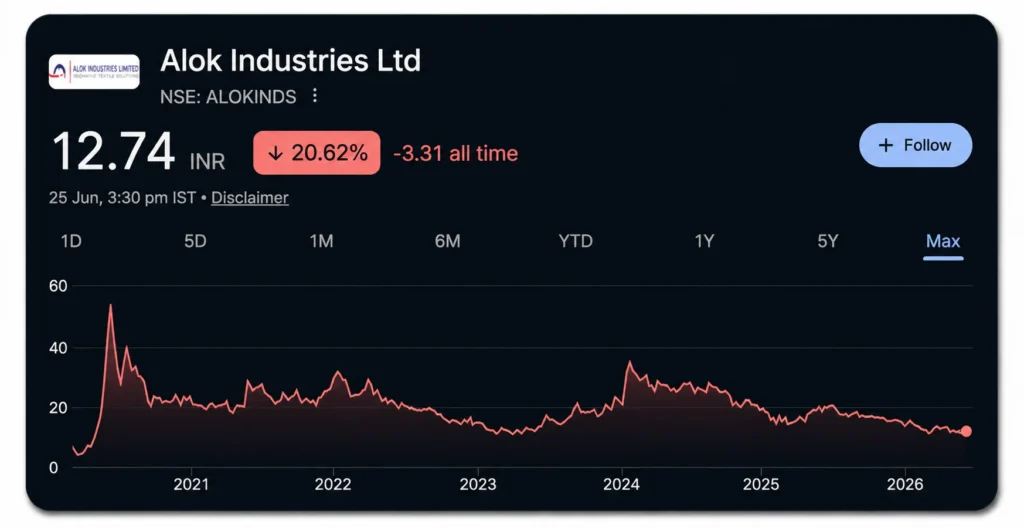
Alok Industries Share Price Overview
| Company Essential | Value |
|---|---|
| Market Cap | ₹6,395.23 Cr. |
| Enterprise Value | ₹9,690 Cr. (Approx.) |
| No. of Shares | 496.52 Cr. |
| P/E | -8.59 |
| P/B | -0.30 |
| Face Value | ₹1 |
| Book Value | -₹43.40 |
| Debt | ₹3,295 Cr. |
| Sales Growth | -1.90% |
| ROE | 0.00% |
| Dividend Yield | 0.00% |
What Does Alok Industries Do?
Alok Industries is an integrated textile manufacturer. This means the company handles several production stages instead of depending only on outside suppliers. Its operations include cotton yarn, polyester yarn, woven fabrics, knitted fabrics, garments, home textiles, bedding products, towels, and polyester-related products.
The company earns revenue by selling textile products in India and overseas markets. Its customers include apparel brands, retailers, wholesalers, exporters, and institutional buyers. Alok Industries has a strong presence in home textiles, fabrics, and polyester products.
A major advantage is its wide product range and large manufacturing infrastructure. The company can serve multiple textile segments instead of depending on one product category. Its future strategy is likely to focus on improving plant utilisation, controlling costs, increasing value-added textile sales, and strengthening export demand.
Historic Share Price Performance
Alok Industries has had a very volatile market journey. The company was once considered a major textile growth story, but financial stress and debt problems affected its business performance and stock price. The company later went through insolvency resolution, after which Reliance Industries and JM Financial Asset Reconstruction Company became major promoters.
The stock saw strong rallies whenever investors expected textile-sector recovery, higher exports, or operational turnaround. It also faced sharp corrections when losses increased or when the company reported weak revenue and margins.
In recent years, the share price has remained highly sensitive to quarterly earnings, textile demand, cotton prices, export conditions, and market expectations around promoter-led turnaround. The stock has moved between strong rallies and deep corrections, making it unsuitable for investors who cannot handle volatility.
| Year | Opening Price | Closing Price | Return |
|---|---|---|---|
| 2021 | ₹22.00 | ₹25.30 | Positive |
| 2022 | ₹25.30 | ₹21.60 | Negative |
| 2023 | ₹21.60 | ₹23.10 | Positive |
| 2024 | ₹23.10 | ₹18.60 | Negative |
| 2025 | ₹18.60 | ₹13.50 | Negative |
| 2026* | ₹13.50 | Around ₹12.80–₹13.20 | Volatile |
Latest Shareholding Pattern
The promoter group includes Reliance Industries Limited and JM Financial Asset Reconstruction Company Limited. High promoter ownership gives the company strategic backing, but investors should still track operational performance, debt levels, and profitability improvements.
Growth Factors
- Textile industry recovery: India’s textile sector can benefit from rising domestic consumption, export opportunities, and demand from apparel, home furnishing, and lifestyle brands.
- Integrated manufacturing model: Alok Industries operates across several textile stages. This can help reduce dependency on external suppliers and improve control over quality and production costs.
- Large production capacity: The company has a large manufacturing base in spinning, weaving, processing, garments, home textiles, and polyester products.
- Promoter support: Reliance Industries is an important promoter. Its presence may improve market confidence and support long-term business restructuring.
- Export opportunity: Global demand for Indian textiles may grow if buyers diversify sourcing away from other countries.
- Value-added products: Home textiles, finished fabrics, garments, and branded textile products can provide better margins compared with basic commodity textile products.
- Government support: Government initiatives related to textile parks, production-linked incentives, export promotion, and manufacturing may support the sector over time.
- Operational turnaround possibility: If the company improves capacity utilisation, reduces costs, and controls debt-related pressure, losses may reduce gradually.
- Demand from organised retail: Growth in Indian retail, e-commerce, fashion brands, and home furnishing demand can support future sales.
- Polyester and synthetic textile demand: Demand for polyester-based products can rise with growth in sportswear, affordable fashion, technical textiles, and mass-market clothing.
Alok Industries Share Price Target 2026 To 2050
The following Alok Industries share price targets are estimates based on business recovery assumptions, textile demand, revenue growth, promoter support, financial improvement, and market valuation conditions. These are not guaranteed prices.
| Year | Minimum Target | Average Target | Maximum Target |
|---|---|---|---|
| 2026 | ₹11.60 | ₹14.11 | ₹18.04 |
| 2027 | ₹19.66 | ₹17.30 | ₹16.10 |
| 2028 | ₹15.32 | ₹13.64 | ₹12.84 |
| 2029 | ₹11.14 | ₹18.30 | ₹21.53 |
| 2030 | ₹22.54 | ₹29,01 | ₹35.80 |
| 2035 | ₹54.09 | ₹58 | ₹62.71 |
| 2040 | ₹87.20 | ₹91 | ₹96.50 |
| 2050 | ₹180.55 | ₹208.43 | ₹243.03 |
Also Check:
These targets assume that the company gradually improves its financial performance. If losses continue for many years or debt pressure rises, the actual share price may remain lower than these estimates.
Alok Industries Share Price Target 2026
The 2026 outlook depends mainly on textile demand, quarterly losses, capacity utilisation, and market confidence in the company’s turnaround strategy. Alok Industries may continue to remain volatile because profitability is still weak. A meaningful recovery in margins or reduction in losses can support the stock, while poor results may create pressure.
| Period | Estimated Target Price |
|---|---|
| First Half (Jan–Jun) | ₹12 – ₹14.50 |
| Second Half (Jul–Dec) | ₹14.80 – ₹18.04 |
Alok Industries Share Price Target 2030
By 2030, Alok Industries may benefit from a stronger Indian textile market, better export demand, and possible improvements in operational efficiency. The key assumption is that the company successfully reduces recurring losses and improves cash generation. Growth in home textiles, garments, polyester products, and organised retail demand can support the business.
| Period | Estimated Target Price |
|---|---|
| First Half | ₹22.54 – ₹26.09 |
| Second Half | ₹26.80 – ₹35.80 |
Alok Industries Share Price Target 2035
The 2035 target assumes that Alok Industries becomes financially stronger than it is today. For this to happen, the company must improve margins, lower financial stress, increase value-added product sales, and benefit from India’s role in global textile supply chains. A stable turnaround could help the company receive better market valuation.
| Period | Estimated Target Price |
|---|---|
| First Half | ₹54.09 – ₹57.65 |
| Second Half | ₹58.03 – ₹62.71 |
Alok Industries Share Price Target 2040
The 2040 projection is based on the possibility of India becoming a stronger manufacturing and export hub for textiles, garments, polyester products, and home furnishings. Alok Industries can benefit if it maintains modern plants, increases exports, and improves its financial structure. However, this target requires a major improvement in profitability.
| Period | Estimated Target Price |
|---|---|
| First Half | ₹87.20 – ₹89.59 |
| Second Half | ₹94.11 – ₹96.50 |
Alok Industries Share Price Target 2050
The 2050 target is highly long-term and should be viewed only as a broad scenario, not a prediction. By that period, the company’s value will depend on whether it becomes a profitable integrated textile leader with stable cash flow and strong market share. If the turnaround succeeds, the stock may create value. If losses remain, these estimates may not be achieved.
| Period | Estimated Target Price |
|---|---|
| First Half | ₹180.55 – ₹198.19 |
| Second Half | ₹220.06 – ₹243.03 |
Bull Case
- Textile demand improves in India and export markets.
- The company reduces losses through better cost control.
- Capacity utilisation increases across textile plants.
- Reliance-backed business strategy improves market confidence.
- Home textile and garment sales grow faster than basic textile products.
- India gains global textile export market share.
- Debt-related pressure reduces over time.
- The company returns to stable profitability and improves cash flow.
Bear Case
- Losses continue for a longer period than expected.
- Global textile demand remains weak.
- Cotton, crude oil, and polyester raw-material prices rise sharply.
- Export demand falls due to global slowdown.
- Competition from Bangladesh, Vietnam, China, and other textile markets increases.
- Negative book value and weak financial ratios continue.
- Higher interest cost or financial stress affects operations.
- The stock remains volatile because market confidence stays weak.
Pros and Cons
Pros
- Large integrated textile manufacturing business.
- Presence across yarn, fabrics, garments, home textiles, and polyester products.
- Strong promoter holding of 75%.
- Exposure to domestic and export textile markets.
- Potential turnaround opportunity if profitability improves.
Cons
- The company has reported net losses in recent years.
- Negative book value creates financial concern.
- Dividend income is not available for investors.
- Textile business is highly cyclical and competitive.
- Share price can remain volatile during weak earnings periods.
Expert Opinion
Alok Industries is not a simple long-term compounder at present. It is a turnaround-focused textile stock with high risk and high uncertainty. The company has a large business platform, integrated manufacturing capacity, and strong promoter ownership, but investors should not ignore the weak profitability and negative book value.
The long-term outlook may improve if revenue grows, margins recover, and annual losses reduce. Important factors to monitor include quarterly revenue, EBITDA margin, net loss, debt levels, cash flow, export performance, and utilisation of manufacturing capacity. This stock may be more suitable for investors who understand turnaround businesses and can handle high price volatility.
Conclusion
Alok Industries has a strong industrial base and operates in important textile segments such as fabrics, home textiles, garments, polyester, and yarn. The company can benefit from future growth in Indian consumption, organised retail, exports, and value-added textile products.
However, the financial position remains the biggest concern. The company is still reporting losses, and its negative book value shows that the turnaround is not complete. Long-term investors should track earnings recovery carefully instead of focusing only on share price movement. The stock may offer upside if profitability improves, but the risks remain significant.
Disclaimer: The share price targets mentioned in this article are estimates based on current market conditions, company fundamentals, and industry trends. They should not be considered investment advice. Investors should conduct their own research or consult a qualified financial advisor before making investment decisions.
Frequently Asked Questions
What is the Alok Industries Share Price Target for 2026?
The estimated Alok Industries share price target for 2026 is between ₹12.10 and ₹18.04, with an average target of around ₹16. Actual price movement will depend on quarterly results, textile demand, and turnaround progress.
What is the Alok Industries Share Price Target for 2030?
The estimated Alok Industries share price target for 2030 is between ₹22.54 and ₹35.80. This target assumes improvement in profitability, better capacity utilisation, and stronger textile demand.
Is Alok Industries a good long-term investment?
Alok Industries can be considered a high-risk turnaround stock. It may offer long-term potential if the company improves profitability and reduces financial stress, but investors should understand that losses and volatility remain major concerns.
What are the major risks of investing in Alok Industries?
The major risks include continued losses, negative book value, weak textile demand, global competition, raw-material price changes, export slowdown, and high share price volatility.