
AWL Agri Business Ltd, earlier known as Adani Wilmar, is one of India’s important food and FMCG companies. The company is mainly known for edible oils, packaged food products, rice, wheat flour, pulses, sugar, and industry essentials. Investors follow AWL because it works in daily-use products, where demand stays steady in most market cycles. The food and agri-business sector has long-term growth potential because of rising branded food consumption, urban demand, quick commerce, and organised retail. Long-term projections help investors understand possible future value, business risks, and expected growth path. This article covers AWL fundamentals, financial data, shareholding, growth factors, risks, and AWL Agri Business share price target from 2026 to 2050.
AWL Agri Business Ltd Financial Highlights
| Particular | Details |
|---|---|
| Company Name | AWL Agri Business Ltd |
| Former Name | Adani Wilmar Ltd |
| NSE Symbol | AWL |
| BSE Code | 543458 |
| Industry | Food FMCG, Edible Oil, Agri Business |
| Market Capitalization | Around ₹23,500–₹24,100 crore |
| Headquarters | Ahmedabad, Gujarat |
| Promoter Holding | 56.94% |
| Latest Annual Revenue | ₹74,731 crore, FY2026 consolidated |
| Latest Net Profit | ₹1,045 crore, FY2026 consolidated |
| Official Website | awl.in |
What Does AWL Agri Business Ltd Do?
AWL Agri Business Ltd operates in essential food and agri-based products. Its main business is edible oil, where the company sells products under well-known brands such as Fortune. The company also sells food and FMCG items like wheat flour, rice, pulses, sugar, soya chunks, ready-to-cook products, and packaged staples. It also has an industry essentials business, which includes oleochemicals and other B2B products.
The company earns revenue from retail consumers, institutional buyers, HoReCa, exports, e-commerce, quick commerce, and modern trade. AWL’s major advantage is its strong brand recall, large distribution network, product range, sourcing capability, and scale in edible oils. Its future strategy is focused on food portfolio expansion, premium products, exports, alternate channels, and better operating efficiency.
Historic Share Price Performance
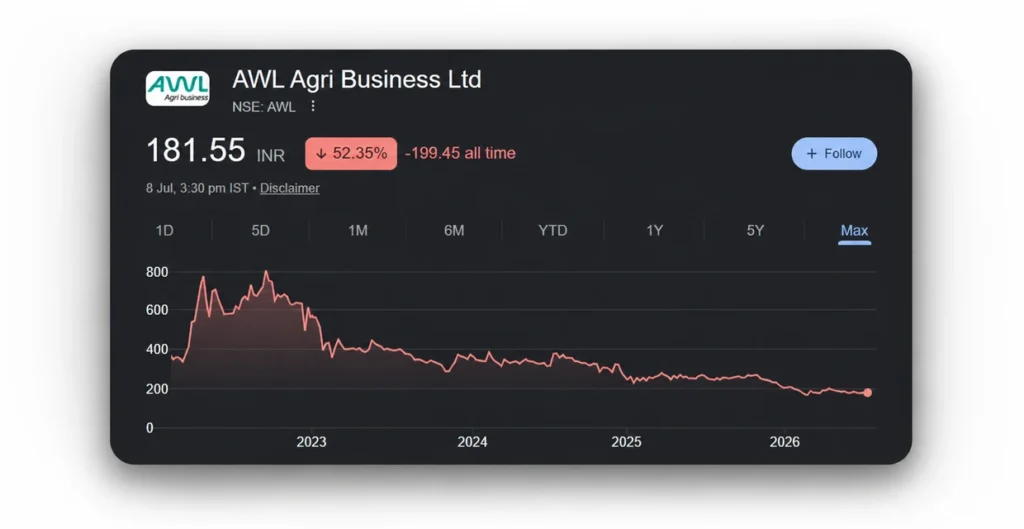
AWL listed on the stock exchanges in February 2022. After listing, the stock saw a very strong rally because of high interest in food FMCG, Adani Group-related stocks, and the company’s leadership in edible oils. The stock later corrected sharply from its high levels as valuations became expensive and market sentiment changed.
In 2023 and 2024, the share price remained under pressure due to weak investor sentiment, high commodity volatility, and corporate ownership-related developments. The Adani Group’s exit from the company also became an important event for the stock. In 2025 and 2026, the stock continued to trade below its earlier peak, but the business remained large in revenue terms. The overall trend shows a strong listing rally followed by a long correction and valuation reset.
| Year | Opening Price | Closing Price | Return |
|---|---|---|---|
| 2022 | Around ₹227 | Around ₹618 | Around 172% |
| 2023 | Around ₹618 | Around ₹355 | Around -43% |
| 2024 | Around ₹357 | Around ₹308 | Around -14% |
| 2025 | Around ₹308 | Around ₹238 | Around -23% |
| 2026 YTD | Around ₹238 | Around ₹181 | Around -24% |
Latest Shareholding Pattern
Growth Factors
- Industry growth: India’s packaged food, edible oil, and staples market has long-term growth scope because more households are moving from loose products to branded products.
- Government initiatives: Food processing, agricultural supply chain improvement, and formalisation of food markets can support organised players like AWL.
- Capacity expansion: The company already has a large manufacturing and refining base, and better utilisation can improve margins without very high capex.
- Future demand: Edible oil, atta, rice, pulses, sugar, and packaged staples are daily-use products, so demand can remain stable over the long term.
- Technology adoption: Automation, process improvement, quick commerce, e-commerce, and better distribution tools can support faster sales growth.
- Financial improvements: If food and FMCG margins improve, AWL can become less dependent on edible oil price cycles.
- Management strategy: The focus on premium products, exports, HoReCa, modern trade, and quick commerce can help improve revenue quality.
- Competitive strengths: Strong brands, wide reach, large sourcing ability, and scale give AWL an advantage over smaller regional players.
- Long-term opportunities: Packaged staples, premium edible oils, branded exports, and food portfolio expansion can support future earnings growth.
AWL Agri Business Ltd Share Price Target 2026–2050
| Year | Minimum Target | Average Target | Maximum Target |
|---|---|---|---|
| 2026 | ₹170 | ₹205 | ₹233 |
| 2027 | ₹196 | ₹230 | ₹268 |
| 2028 | ₹240 | ₹282 | ₹315 |
| 2029 | ₹288 | ₹319 | ₹382 |
| 2030 | ₹375 | ₹405 | ₹441 |
| 2035 | ₹664 | ₹620 | ₹785 |
| 2040 | ₹1,150 | ₹1,270 | ₹1,380 |
| 2050 | ₹2,462 | ₹2,742 | ₹2,941 |
Also Check:
- Tata Steel Ltd Share Price Target
- NMDC Ltd Share Price Target
- Mazagon Dock Shipbuilders Share Price Target
- NALCO Share Price Target
- KPIT Technologies Share Price Target
- IRCTC Share Price Target
- ICICI Bank Share Price Target
- BSE Share Price Target
- Hindustan Aeronautics Ltd Share Price Target
- Exide Industries Share Price Target
AWL Agri Business Ltd Share Price Target 2026
AWL’s 2026 target depends on margin stability, commodity price movement, ownership clarity, and recovery in market sentiment. The stock is already trading far below its earlier high, so downside may reduce if earnings stay stable. However, strong upside needs better profit growth and improved valuation confidence. For 2026, the target range remains moderate because the company is still going through a valuation reset phase.
| Period | Estimated Target Price |
|---|---|
| Second Half | ₹233 |
AWL Agri Business Ltd Share Price Target 2030
By 2030, AWL may benefit from higher branded food demand, premium edible oil products, and growth in e-commerce and quick commerce. If the food and FMCG segment becomes more profitable, the market may give a better valuation to the stock. A steady revenue base and better return ratios can support long-term compounding.
| Period | Estimated Target Price |
|---|---|
| First Half | ₹375 |
| Second Half | ₹441 |
AWL Agri Business Ltd Share Price Target 2035
For 2035, the main assumption is that AWL successfully reduces dependence on low-margin edible oil cycles and builds a stronger packaged food business. If the company improves ROE, maintains healthy working capital, and expands exports, the stock can move higher. The target remains realistic and assumes steady, not aggressive, growth.
| Period | Estimated Target Price |
|---|---|
| First Half | ₹525 |
| Second Half | ₹785 |
AWL Agri Business Ltd Share Price Target 2040
By 2040, AWL’s long-term value will depend on brand strength, food portfolio scale, margins, and capital efficiency. If the company becomes a stronger food FMCG player with stable profits, the stock can command better investor interest. However, commodity price risk and competition will remain important factors even in the long term.
| Period | Estimated Target Price |
|---|---|
| First Half | ₹1,150 |
| Second Half | ₹1,380 |
AWL Agri Business Ltd Share Price Target 2050
For 2050, the estimate assumes that AWL continues to grow with India’s food consumption market, expands into higher-margin categories, and maintains strong distribution. A long-term price near this range will need consistent profit growth, better ROE, and disciplined capital use. These targets are possible only under favourable business and market conditions.
| Period | Estimated Target Price |
|---|---|
| First Half | ₹2,462 |
| Second Half | ₹2,941 |
Bull Case
- AWL’s food and FMCG segment grows faster than edible oils and improves overall margins.
- Quick commerce, e-commerce, and modern trade become strong growth channels.
- The company gains market share from unorganised and regional players.
- Premium edible oils and branded food products improve profit per unit.
- Export business expands in more international markets.
- Commodity prices remain stable, helping predictable margins.
- Working capital improves and debt cost reduces over time.
- Investor confidence improves after ownership-related uncertainty reduces.
Bear Case
- Edible oil prices remain highly volatile and hurt margins.
- Food and FMCG growth remains slower than expected.
- Competition from large FMCG companies and regional brands increases.
- Raw material, packaging, freight, and currency costs rise sharply.
- ROE remains low compared with better-quality FMCG companies.
- Share price remains under pressure due to valuation concerns.
- Promoter or institutional stake changes create supply pressure.
- Regulatory changes in import duties or food pricing affect profitability.
Pros and Cons
Pros
- Strong brand presence in edible oil and food staples.
- Large revenue base and wide distribution network.
- Daily-use product portfolio with steady demand.
- Growing presence in food, FMCG, exports, HoReCa, and quick commerce.
- Scope for margin improvement as branded foods scale up.
Cons
- Profit margins are lower compared with pure FMCG companies.
- Edible oil business depends heavily on commodity prices.
- ROE is moderate and needs improvement.
- Stock has corrected sharply from earlier high levels.
- Strong competition from national and regional brands.
Expert Opinion
AWL Agri Business is a large consumer food company, but its valuation should be judged differently from high-margin FMCG stocks. The company has strong revenue, brand reach, and scale, but profitability is still sensitive to edible oil prices, raw material costs, and working capital needs. Long-term investors should monitor revenue growth, EBITDA per ton, PAT margin, ROE, debt level, food segment growth, and market share. The stock may suit investors who understand cyclical commodity-linked businesses and can wait for gradual business improvement. It is not a risk-free FMCG stock, so valuation comfort is important.
Conclusion
AWL Agri Business Ltd has strong business foundations because it operates in essential food categories used by Indian households every day. Its major strengths are brand recall, scale, distribution, edible oil leadership, and growing food portfolio. Long-term opportunities are present in packaged staples, quick commerce, exports, premium products, and organised food consumption. At the same time, investors should not ignore risks such as commodity price volatility, low margins, competition, and moderate return ratios. The stock can perform better if profit growth becomes more stable and valuation confidence improves.
Disclaimer: The share price targets mentioned in this article are estimates based on current market conditions, company fundamentals, and industry trends. They should not be considered investment advice. Investors should conduct their own research or consult a qualified financial advisor before making investment decisions.
Frequently Asked Questions (FAQs)
Is AWL Agri Business Ltd a good long-term investment?
AWL can be considered a long-term watchlist stock because it operates in essential food categories. However, investment decisions should depend on valuation, profit growth, ROE improvement, and risk appetite.
What are the major risks of investing in AWL Agri Business Ltd?
The major risks are edible oil price volatility, low margins, high competition, raw material cost pressure, currency movement, working capital needs, and slower-than-expected food segment growth.
Should beginners invest in AWL Agri Business Ltd stock?
Beginners should study the company carefully before investing. AWL is a large business, but its stock can be volatile because of commodity prices and market sentiment. A small allocation with proper research is safer than aggressive buying.