
Indian Oil Corporation Limited, also known as IOC or IndianOil, is one of the biggest public sector energy companies in India. The company has a major role in refining crude oil, selling petrol and diesel, supplying LPG cylinders, operating fuel pipelines, and running IndianOil petrol pumps across the country.
IOC share is popular among investors because it is a large government-backed company with a strong brand, regular dividend history, and an important role in India’s energy security. The company can benefit from rising fuel demand, new highways, airport growth, industrial expansion, and increasing vehicle use.
However, IOC is also affected by crude oil prices, refining margins, government fuel policies, and the shift towards electric vehicles. This article explains IOC’s business, financial position, growth outlook, risks, and share price targets from 2026 to 2050 in simple words.
IOC Share Overview And Financial Highlights
IOC is generally considered a value stock because its valuation is often lower than many private-sector companies. The company also attracts investors looking for dividend income.
However, IOC’s earnings can change sharply from year to year. When refining margins are high and crude oil prices are stable, profits can rise strongly. When fuel marketing margins weaken or crude prices rise sharply, profits may fall.
| Company Essential | Value |
|---|---|
| Market Cap | ₹2,03,190 Cr. |
| Enterprise Value | ₹3,37,650 Cr. (Approx.) |
| No. Of Shares | 1,411.21 Cr. |
| P/E | 4.83 |
| P/B | 0.93 |
| Face Value | ₹10 |
| Book Value | ₹155.00 |
| Debt | ₹1,34,466 Cr. (Approx.) |
| Sales Growth | -0.52% |
| ROE | 20.70% |
| Dividend Yield | 4.86% |
What Does Indian Oil Corporation Do?
Indian Oil Corporation is an integrated energy company. It buys crude oil from India and foreign countries, processes it in refineries, and sells useful fuel products across the country.
Its main products include petrol, diesel, LPG gas cylinders, aviation turbine fuel, lubricants, bitumen, naphtha, petrochemicals, and industrial fuels. IOC also supplies fuel to airports, factories, transport companies, defence services, and households.
The company earns money through refining crude oil, fuel marketing, pipeline transportation, LPG distribution, lubricant sales, gas business, and petrochemicals. IndianOil petrol pumps are one of the company’s biggest business strengths.
IOC is also expanding into green hydrogen, electric vehicle charging, compressed biogas, solar energy, biofuels, and renewable energy. This can help the company remain important even when the world slowly moves towards cleaner energy.
Historic Share Price Performance
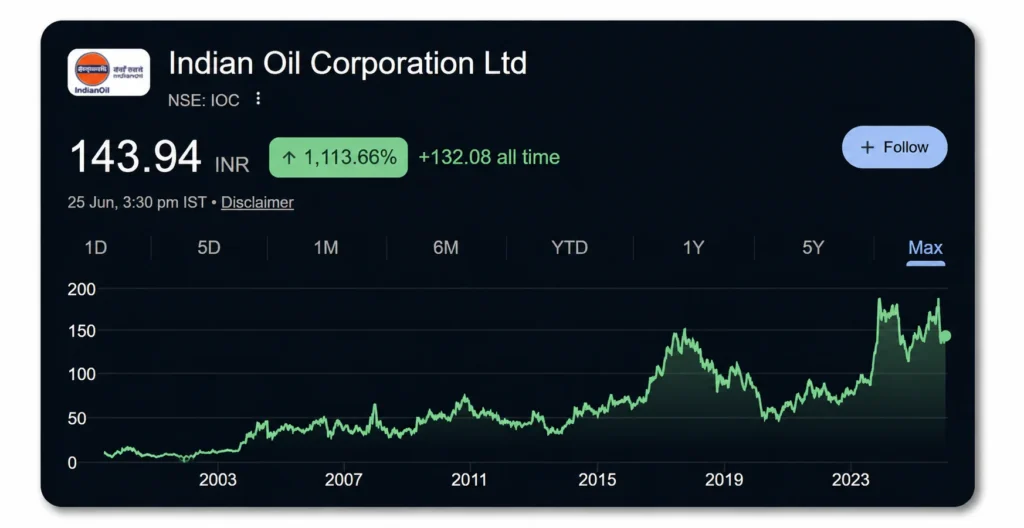
IOC has been listed in the stock market for many years and has remained one of the most important government-owned energy shares. The stock has delivered both strong rallies and major corrections over time.
Its price movement depends on many factors such as crude oil prices, refining margins, fuel demand, government policies, dividends, international conflicts, and overall stock market conditions.
IOC shares performed well during periods when fuel demand increased and refining margins remained strong. The stock also gained support from investors looking for public sector company shares with regular dividend income.
However, the stock has also corrected during weak oil marketing conditions, higher crude oil prices, and lower refining margins. IOC should therefore be seen as a cyclical stock. It may not move up every year, but it can create value over a long period if the company continues to improve earnings and expand its business.
| Year | Opening Price | Closing Price | Return |
|---|---|---|---|
| 2021 | ₹88 | ₹112 | 27% |
| 2022 | ₹112 | ₹82 | -27% |
| 2023 | ₹82 | ₹131 | 60% |
| 2024 | ₹131 | ₹136 | 4% |
| 2025 | ₹136 | ₹178 | 31% |
| 2026* | ₹178 | Around ₹146 | Negative so far |
*The 2026 figure can change before the end of the year.
Latest Shareholding Pattern
The Government of India is the main promoter of IOC. This gives the company strong strategic importance because fuel supply and energy security are important for the country.
Foreign investors have also increased their interest in IOC in recent quarters. Institutional buying can be positive, but investors should not make decisions only on the basis of shareholding changes.
Growth Factors
- Rising fuel demand: India’s growing population, higher income levels, more vehicles, highways, airports, and industrial activity can increase demand for petrol, diesel, LPG, and aviation fuel.
- Large petrol pump network: IOC has one of the largest fuel retail networks in India. This gives the company strong brand visibility and direct access to customers.
- Refinery expansion: IOC is expanding and upgrading refinery capacity. Higher refining capacity can improve production and support future revenue growth.
- Pipeline strength: The company has a large pipeline network that helps transport crude oil and petroleum products at lower cost compared to road transport.
- Petrochemical business: IOC is increasing its focus on petrochemicals. This can help reduce dependence on only petrol and diesel sales.
- Growing aviation fuel demand: India’s aviation sector is expanding. More airports and air travel can support IOC’s aviation fuel business.
- Green energy opportunities: IOC is investing in green hydrogen, electric vehicle charging, solar energy, compressed biogas, and biofuels.
- Government support: IOC is a strategic public sector company. Its role in fuel supply, LPG distribution, and energy security gives it importance in the Indian economy.
- Dividend income: IOC has a history of paying dividends. This can attract investors who want income along with long-term capital growth.
IOC Share Price Target 2026 To 2050
The following IOC share price targets are estimates. They are based on possible revenue growth, refining margins, fuel demand, dividend support, oil prices, expansion plans, and future valuation levels.
| Year | Minimum Target | Average Target | Maximum Target |
|---|---|---|---|
| 2026 | ₹131.86 | ₹165 | ₹190.20 |
| 2027 | ₹164.04 | ₹185 | ₹228.60 |
| 2028 | ₹231.05 | ₹210 | ₹297.40 |
| 2029 | ₹311.20 | ₹240 | ₹390.85 |
| 2030 | ₹400.53 | ₹275 | ₹530.20 |
| 2035 | ₹731.85 | ₹430 | ₹820.05 |
| 2040 | ₹1,280.05 | ₹650 | ₹1,450.40 |
| 2050 | ₹3,184.60 | ₹1,200 | ₹3,684.55 |
Also Check:
IOC Share Price Target 2026
IOC’s 2026 share price may depend mainly on crude oil prices, refining margins, fuel demand, LPG subsidy decisions, and marketing margins on petrol and diesel.
If crude oil prices remain under control and refining margins stay healthy, IOC may report better profitability. A good dividend announcement can also support investor confidence.
However, the stock may remain volatile because global oil prices can change quickly due to geopolitical events. IOC’s strong business network and government backing may provide support during market corrections.
| Period | Estimated Target Price |
|---|---|
| First Half, Jan–Jun | ₹140.85 – ₹150.40 |
| Second Half, Jul–Dec | ₹159.64 – ₹190.20 |
IOC Share Price Target 2030
By 2030, IOC may benefit from higher fuel demand, more vehicles, infrastructure projects, refinery expansion, pipeline growth, and increasing aviation fuel consumption.
The company may also earn more from petrochemicals, lubricants, gas, and non-fuel businesses. These segments can help IOC reduce its dependence on only petrol and diesel sales.
The main challenge will be the increasing use of electric vehicles and cleaner energy. IOC’s investment in green hydrogen, EV charging, and biofuels will be important for future growth.
| Period | Estimated Target Price |
|---|---|
| First Half | ₹400.53 – ₹449 |
| Second Half | ₹455.90 – ₹530.20 |
IOC Share Price Target 2035
IOC’s 2035 performance may depend on how successfully it changes from a traditional oil company into a wider energy company.
Petrol and diesel may remain important in India, but renewable energy, electric mobility, natural gas, green hydrogen, and biofuels may become larger business areas by that time.
If IOC manages its large investments properly and earns good returns from expansion projects, the company may maintain strong long-term value. The stock may also benefit from rising dividends and stable earnings.
| Period | Estimated Target Price |
|---|---|
| First Half | ₹731.85 – ₹785 |
| Second Half | ₹787.40 – ₹820.05 |
IOC Share Price Target 2040
By 2040, IOC may have a more diversified business model. Traditional fuels may continue to provide revenue, while petrochemicals, gas, renewable energy, green hydrogen, and EV-related businesses may add new growth opportunities.
The company’s success will depend on whether its new energy projects become profitable. Large capital expenditure can create future growth, but it can also increase debt if returns are weak.
IOC’s strong infrastructure, trusted brand, and nationwide distribution system can help it remain a major energy company in India.
| Period | Estimated Target Price |
|---|---|
| First Half | ₹1,280.05 – ₹1,354.60 |
| Second Half | ₹1,360.80 – ₹1,450.40 |
IOC Share Price Target 2050
The 2050 IOC share price estimate has the highest uncertainty because the energy industry may change significantly over the next 25 years.
Electric vehicles, renewable power, hydrogen fuel, battery storage, and cleaner transport may reduce the growth of traditional petrol and diesel sales. However, India may still need large volumes of fuel, LPG, aviation fuel, petrochemicals, and industrial energy.
IOC can remain relevant if it successfully builds profitable businesses in renewable energy, biofuels, hydrogen, charging infrastructure, and petrochemicals.
| Period | Estimated Target Price |
|---|---|
| First Half | ₹3,184.60 – ₹3,250 |
| Second Half | ₹3,270 – ₹3,684.55 |
Bull Case
- India’s fuel demand grows faster than expected.
- Crude oil prices remain stable or decline.
- Refining margins stay strong for many years.
- IOC expands refinery and petrochemical capacity successfully.
- Government compensation supports LPG and fuel marketing margins.
- Dividend payouts remain attractive.
- Green hydrogen and EV charging businesses become profitable.
- IOC improves earnings from pipelines, lubricants, gas, and aviation fuel.
Bear Case
- Crude oil prices rise sharply for a long period.
- Refining margins fall due to global oversupply.
- Government fuel pricing policies reduce profitability.
- LPG under-recoveries increase without proper compensation.
- Large expansion projects increase debt levels.
- Electric vehicle adoption grows faster than expected.
- Renewable energy projects generate low returns.
- Global recession reduces industrial and transport fuel demand.
Pros and Cons
Pros
- One of India’s largest energy companies.
- Strong government ownership and strategic importance.
- Large refinery, pipeline, LPG, and petrol pump network.
- Regular dividend-paying history.
- Growing investment in green energy and petrochemicals.
Cons
- Profits depend heavily on crude oil prices.
- Refining margins can change quickly.
- Government policies can affect marketing margins.
- Large capital expenditure may increase debt.
- Electric vehicle adoption can affect long-term fuel demand.
Expert Opinion
IOC is a large public sector energy company with strong nationwide infrastructure and a major role in India’s fuel supply system. The company may be suitable for investors who understand cyclical shares and are comfortable with short-term volatility.
Its valuation can look attractive during periods of high profitability, but earnings may reduce when refining margins weaken. Investors should monitor crude oil prices, gross refining margins, marketing margins, LPG under-recoveries, debt levels, dividend payout, refinery expansion, and green energy investments.
IOC may be more suitable for long-term investors looking for dividends and exposure to India’s energy sector rather than investors expecting very fast share price growth every year.
Conclusion
Indian Oil Corporation is one of the strongest public sector companies in India’s energy sector. Its large fuel retail network, refinery capacity, pipelines, LPG distribution system, and trusted IndianOil brand give it a strong business base.
The company can benefit from rising fuel demand, infrastructure development, aviation growth, petrochemicals, renewable energy, and green hydrogen projects. At the same time, investors should understand the risks from crude oil volatility, government policies, lower refining margins, rising debt, and electric vehicle growth.
IOC may offer long-term opportunities, but returns can be uneven because the oil and gas industry is cyclical.
Disclaimer: The share price targets mentioned in this article are estimates based on current market conditions, company fundamentals, and industry trends. They should not be considered investment advice. Investors should conduct their own research or consult a qualified financial advisor before making investment decisions.
Frequently Asked Questions
What is the IOC Share Price Target for 2026?
IOC share price target for 2026 is estimated between ₹135 and ₹190. The average estimated target is around ₹165.
What is the IOC Share Price Target for 2030?
IOC share price target for 2030 is estimated between ₹220 and ₹330. The average estimated target is around ₹275.
Is IOC a good long-term investment?
IOC may be considered by long-term investors who want exposure to India’s energy sector and regular dividend income. However, the stock can be volatile because profits depend on crude oil prices and refining margins.
What are the major risks of investing in IOC?
Major risks include crude oil price volatility, weak refining margins, government pricing policies, LPG under-recoveries, high capital expenditure, debt increase, and faster electric vehicle adoption.
Can IOC reach new all-time highs by 2030?
IOC can reach new all-time highs by 2030 if fuel demand grows, refining margins remain healthy, expansion projects perform well, and green energy investments become profitable.
Should beginners invest in IOC stock?
Beginners should understand that IOC is a cyclical stock. It may be suitable only after checking personal financial goals, risk level, portfolio diversification, and investment time horizon.