
Indian Energy Exchange, widely known as IEX, is one of the most important companies in India’s power market. It runs an electronic platform where electricity is traded between buyers and sellers in a transparent way. Many investors follow this stock because it is connected with India’s rising power demand, clean energy growth, and power sector reforms. The company is also known for its strong profit margin, low-cost business model, and steady cash generation. At the same time, this stock is sensitive to regulatory decisions, which can affect investor confidence. In this article, we will understand IEX’s business, latest financial position, shareholding pattern, growth drivers, risks, and realistic share price target estimates from 2026 to 2050 in simple and easy English.
IEX Share Overview & Financial Highlights
| Company Essential | Latest Value |
|---|---|
| Market Cap | ₹11,130 Cr. |
| Enterprise Value | ₹9,900 Cr. (Approx.) |
| No. Of Shares | 89.37 Cr. |
| P/E | 23.5 |
| P/B | 8.2 |
| Face Value | ₹1 |
| Book Value | ₹14.6 |
| Debt | ₹0 Cr. (Debt Free) |
| Sales Growth | 13.0% (TTM Approx.) |
| ROE | 39.4% |
| Dividend Yield | 2.8% |
What Does Indian Energy Exchange Do?
Indian Energy Exchange is a technology-based platform for electricity trading in India. It helps power producers, distribution companies, commercial users, and industrial buyers to buy and sell electricity in an efficient and transparent way. The company mainly earns revenue from transaction charges on electricity trades done on its platform. It also earns from related products such as renewable energy certificates and green market products. IEX has built a strong position in India because its business model is asset-light and scalable. It does not need heavy capital investment like traditional power companies. As India moves toward a more market-driven power system and cleaner energy mix, IEX plans to grow by increasing trading volumes, expanding product offerings, and strengthening its presence in the wider energy marketplace.
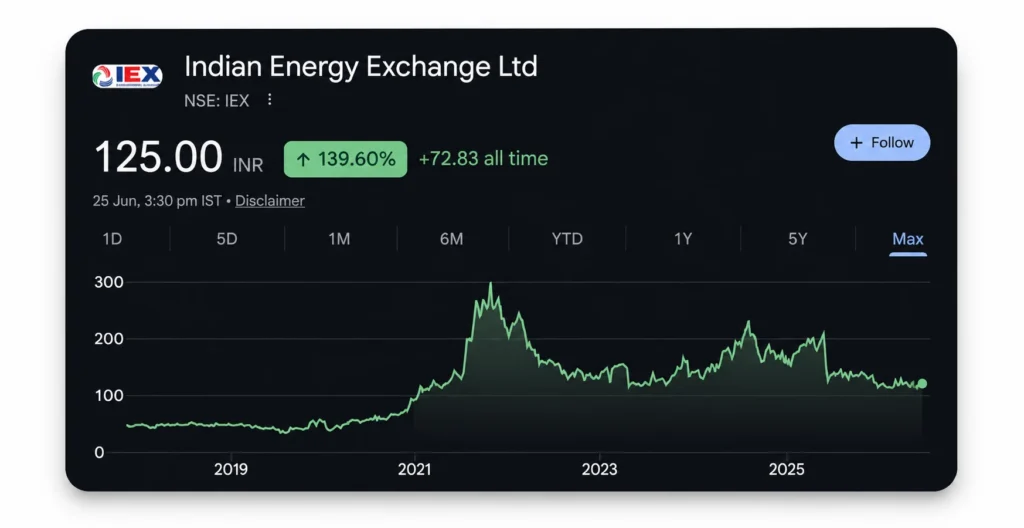
Historic Share Price Performance
IEX has seen both strong rallies and sharp corrections since listing. In its early years, the stock gained investor attention because it was a unique company in the listed power sector. Its strong business model, high profitability, and low capital requirement made it attractive for long-term investors. The share price performed well during periods when investors preferred platform businesses with high return ratios. However, the stock also faced heavy corrections when concerns around regulation and market structure became stronger. One of the biggest negative triggers was the discussion around market coupling, which created fear about future business growth and pricing power. Even after these corrections, IEX remains a stock to watch because the company still has healthy fundamentals, high profit margins, and strong cash generation capacity.
| Year | Opening Price | Closing Price | Return |
|---|---|---|---|
| 2021 | ₹185 | ₹267 | 44.3% |
| 2022 | ₹268 | ₹140 | -47.8% |
| 2023 | ₹141 | ₹152 | 7.8% |
| 2024 | ₹153 | ₹191 | 24.8% |
| 2025 | ₹191 | ₹129 | -32.5% |
Shareholding Pie Chart
Growth Factors
- India’s power demand is increasing due to industrial growth, urbanisation, digitalisation, and rising energy use.
- More electricity demand can lead to higher power trading volumes on exchange platforms like IEX.
- Government reforms in the power sector support better price discovery and more transparent market-based trading.
- Renewable energy capacity is rising fast in India, and this increases the need for balancing and short-term electricity trading.
- IEX has an asset-light model, so revenue growth can improve profits without heavy capital spending.
- The company has strong margins, low debt, and high return ratios, which support long-term financial strength.
- Green market products and related energy segments can become additional growth drivers in the future.
- Technology adoption in energy markets is increasing, and IEX already has strong brand recognition in this segment.
- If more states, industries, and buyers use exchange-based procurement, the company can benefit from stronger network effects.
Indian Energy Exchange Share Price Target 2026 To 2050
| Year | Minimum Target | Average Target | Maximum Target |
|---|---|---|---|
| 2026 | ₹114.75 | ₹136.50 | ₹155 |
| 2027 | ₹157.40 | ₹165.30 | ₹184.09 |
| 2028 | ₹187.20 | ₹197.14 | ₹220.54 |
| 2029 | ₹228.75 | ₹257.30 | ₹286.82 |
| 2030 | ₹290.05 | ₹362.49 | ₹376.10 |
| 2035 | ₹690.82 | ₹745.03 | ₹790.05 |
| 2040 | ₹1,583.22 | ₹1,795.11 | ₹1,985.20 |
| 2050 | ₹3,874.20 | ₹4,120.08 | ₹4,492.43 |
Also Check:
IEX Share Price Target 2026
The 2026 outlook for IEX may remain mixed. The company continues to report healthy profits and strong return ratios, which support the stock. But investor confidence may still depend on regulatory clarity and market structure changes. If trading volumes improve and sentiment becomes more positive, the stock can recover gradually. A strong re-rating may happen only when the market feels more confident about long-term growth visibility.
| Period | Estimated Target Price |
|---|---|
| First Half (Jan–Jun) | ₹130 |
| Second Half (Jul–Dec) | ₹155 |
IEX Share Price Target 2030
By 2030, IEX can benefit from India’s larger power market, higher electricity demand, and growing share of exchange-based transactions. If the company protects its strong business position and keeps margins healthy, earnings may grow steadily. New products related to green energy can also support future growth. However, the upside may remain limited if regulation reduces transaction pricing power.
| Period | Estimated Target Price |
|---|---|
| First Half | ₹290.05 |
| Second Half | ₹376.10 |
IEX Share Price Target 2035
The 2035 target depends on how India’s energy system develops over the next decade. Rising renewable energy, flexible power demand, and better market participation can increase the need for exchange-based trading. If IEX remains one of the key market platforms, it can continue to create strong value. Long-term growth will depend not just on volume growth, but also on its ability to adapt to industry and policy changes.
| Period | Estimated Target Price |
|---|---|
| First Half | ₹690.82 |
| Second Half | ₹790.05 |
IEX Share Price Target 2040
By 2040, India may have a much bigger and more dynamic energy market. In such a situation, energy exchanges can play a larger role in balancing supply and demand. If IEX keeps its relevance in this system and expands beyond its core segments, the stock may deliver solid long-term value. Still, investors should remember that such long-term estimates depend on many uncertain future factors.
| Period | Estimated Target Price |
|---|---|
| First Half | ₹1,583.22 |
| Second Half | ₹1,985.20 |
Indian Energy Exchange Share Price Target 2050
The 2050 target is a very long-term estimate and should be viewed only as a broad projection. Over such a long period, changes in regulation, competition, technology, and energy market structure can completely change the business environment. If IEX continues to stay important in India’s electricity and energy trading system, it may create strong long-term wealth. But this is not a guaranteed outcome and should be treated carefully.
| Period | Estimated Target Price |
|---|---|
| First Half | ₹3,874.20 |
| Second Half | ₹4,492.43 |
Bull Case
- IEX has a strong and scalable business model.
- The company operates with high margins and low capital needs.
- India’s power demand is expected to rise for many years.
- Electricity trading volumes can grow faster than overall electricity demand.
- The company has low debt and strong cash generation.
- Renewable energy growth can create more demand for short-term power trading.
- New products can support future revenue diversification.
- Current valuation may look attractive if long-term business growth remains strong.
Bear Case
- Regulatory risk remains the biggest concern for the stock.
- Market coupling may reduce IEX’s pricing power.
- Competition from other exchanges can affect future market share.
- Valuation can remain under pressure if business growth slows.
- Revenue still depends strongly on transaction fees and trading volume.
- Policy uncertainty can keep investor sentiment weak.
- Product diversification is still limited compared to the core business.
- Any pressure on margins can affect earnings expectations.
Pros and Cons
Pros
- Strong market position in electricity exchange business
- Asset-light and profitable business model
- Healthy balance sheet with low debt
- High ROE and strong cash generation
- Benefits from India’s long-term power demand growth
Cons
- High dependence on regulatory decisions
- No promoter holding
- Market coupling concerns can impact future valuation
- Stock can remain volatile for long periods
- Growth outlook can change quickly after policy announcements
Expert Opinion
IEX is one of the most unique businesses in India’s listed energy space. It offers a combination of high profitability, low capital needs, and exposure to long-term growth in electricity demand. However, this stock should not be judged only on profit numbers. Regulation plays a major role here, and even a strong company can face pressure if policy changes are not favourable. Investors who follow IEX should watch traded volumes, revenue growth, profit growth, margins, dividend trend, and any new regulatory developments. For long-term investors, the stock may remain interesting, but only if they can handle policy risk, valuation changes, and short-term price volatility.
Conclusion
Indian Energy Exchange has many strengths that make it an important company in India’s energy market. It has a scalable model, strong profit margin, low debt, and good long-term business relevance. The company can benefit from rising electricity demand, renewable energy growth, and more market-based power trading in India. At the same time, investors must understand that IEX is highly sensitive to regulation, which can affect both growth and valuation. This makes the stock attractive but also risky. For long-term investors, IEX can remain a strong stock to track, but expectations should stay realistic and based on business performance as well as policy direction.
Disclaimer: The share price targets mentioned in this article are estimates based on current market conditions, company fundamentals, and industry trends. They should not be considered investment advice. Investors should conduct their own research or consult a qualified financial advisor before making investment decisions.
Frequently Asked Questions (FAQs)
What is the Indian Energy Exchange Share Price Target for 2026?
The estimated IEX share price target for 2026 is around ₹138 on average. The broader expected range is ₹130 to ₹155.
What is the Indian Energy Exchange Share Price Target for 2030?
The average estimated share price target for 2030 is around ₹340. The expected range is ₹290.05 to ₹376.10.
Is Indian Energy Exchange a good long-term investment?
IEX can be a strong long-term stock because of its profitable business model and exposure to India’s power market growth. But it also carries regulatory risk.
What are the major risks of investing in Indian Energy Exchange?
The main risks are regulatory changes, market coupling, competition from other exchanges, lower transaction fees, and slower growth in trading volumes.
Can Indian Energy Exchange reach new all-time highs by 2030?
It is possible if the company delivers steady earnings growth, protects its market position, and gets a favourable regulatory environment.
Should beginners invest in Indian Energy Exchange stock?
Beginners should be careful because this stock can react sharply to policy changes. It may be better for investors who understand sector and regulatory risk.