Heritage Foods Limited is a well-known Indian dairy company. It sells milk, curd, paneer, butter, ghee, buttermilk, cheese, flavoured milk, ice cream and other dairy products. The company has a strong presence in South India and is gradually expanding into more markets.
Investors follow Heritage Foods because dairy products are used every day in Indian homes. Milk, curd, paneer and buttermilk have regular demand, which can make the business more stable than many other sectors.
The company is also increasing its focus on value-added dairy products. These products can give better profit margins than normal liquid milk. This article explains Heritage Foods’ business, financial position, shareholding pattern, past stock performance, future growth opportunities and estimated share price targets from 2026 to 2050.
Heritage Foods is mainly engaged in the dairy business. The company buys milk from farmers, processes it in dairy plants, and sells packaged dairy products through its distribution network.
Its main products include fresh milk, curd, paneer, ghee, butter, buttermilk, cheese, flavoured milk, ice cream, milkshakes, and yoghurt products. Fresh milk remains an important part of the business, but the company is increasing its focus on higher-margin products.
Heritage Foods has a large milk procurement network that connects farmers with dairy processing centres. It also has cold storage, transport, and retail distribution systems.
The company’s long-term strategy is to increase value-added dairy product sales, enter more cities, improve supply-chain efficiency, and strengthen brand visibility in the organised dairy market.
Historic Share Price Performance
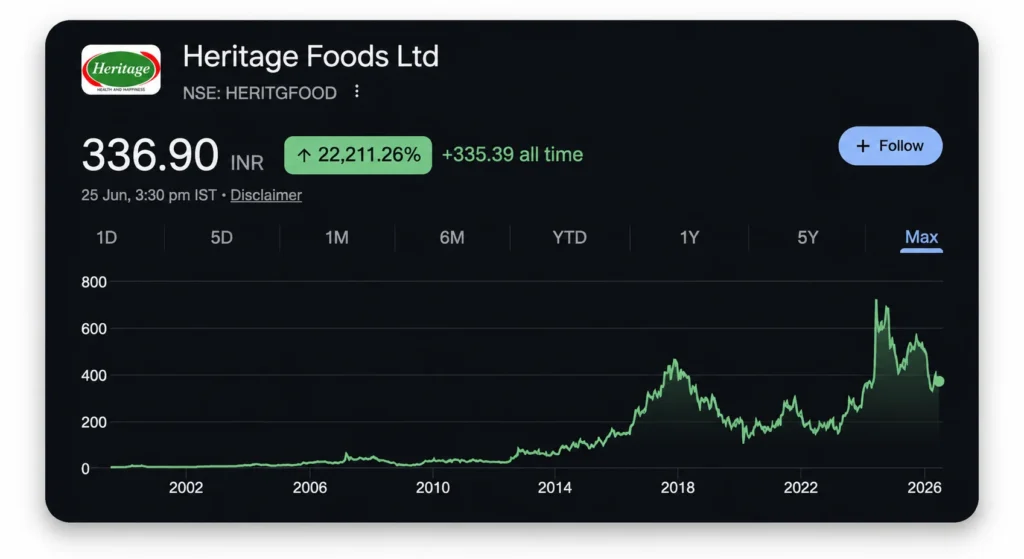
Heritage Foods has been listed in the Indian stock market for many years. The company was founded in 1992 and became a recognised dairy brand in southern India.
The stock has seen both strong rallies and sharp corrections. During periods when milk demand remained strong and raw milk costs were controlled, Heritage Foods delivered better earnings growth. The share price also moved up when investors expected higher contribution from value-added products.
However, the dairy business can face pressure when milk procurement prices rise. Higher prices paid to farmers can reduce margins if the company cannot fully increase product prices.
The stock performed strongly in 2024 but corrected in 2025 and early 2026. The long-term trend will depend on revenue growth, profit margin improvement, demand for packaged dairy products and expansion into new markets.
Year
Opening Price
Closing Price
Return
2021
₹286
₹435
52%
2022
₹435
₹270
-38%
2023
₹270
₹309
14%
2024
₹309
₹537
74%
2025
₹537
₹395
-26%
2026*
₹395
Around ₹330
-16%
*2026 figures are based on available share price levels and may change by the end of the year.
Latest Shareholding Pattern
Shareholding Pattern
Promoters
41.30%
FIIs
2.21%
DIIs
6.20%
Public
50.29%
Others
Small Balance
Promoter holding in Heritage Foods has remained stable. Stable promoter ownership is generally seen as a positive point because it shows continued promoter participation in the company.
Foreign institutional investor holding has reduced in recent quarters. Domestic institutional investors and mutual funds continue to hold a part of the company’s shares.
Growth Factors
Regular dairy demand: Milk, curd, paneer and buttermilk are daily-use products in many Indian homes.
Value-added product growth: Products such as paneer, cheese, curd, ghee, butter and flavoured milk can give better margins than normal milk.
Strong brand value: Heritage Foods has a trusted brand name, especially in southern India.
Expansion into new markets: The company can increase sales by entering more cities and states.
Growing packaged food demand: More consumers are shifting from loose dairy products to branded packaged products.
Better distribution network: More retail stores, supermarkets, online platforms and local shops can improve product availability.
Farmer procurement system: A strong milk collection network helps the company maintain regular raw milk supply.
Cold-chain improvement: Better storage and transportation can reduce product wastage.
Urban population growth: Rising urbanisation can increase demand for ready-to-use dairy products.
Health-focused products: Demand for protein-based, low-fat, premium and functional dairy products can create future opportunities.
Heritage Foods Share Price Target 2026 To 2050
The following Heritage Foods share price targets are estimated values. They are based on expected revenue growth, profit improvement, dairy sector demand, market conditions, valuation levels and future business expansion.
These targets are not guaranteed. Actual share prices can be higher or lower depending on company performance and overall market conditions.
Heritage Foods may continue to see stable sales growth in 2026 because dairy demand remains regular. However, profit growth may depend on milk procurement prices, employee costs, transport costs and product pricing.
If the company controls raw material costs and improves margins from value-added dairy products, the share price can move towards the higher range. Market sentiment and quarterly financial results will also play an important role.
Period
Estimated Target Price
First Half (Jan–Jun)
₹345.63
Second Half (Jul–Dec)
₹465.10
Heritage Foods Share Price Target 2030
By 2030, Heritage Foods may benefit from higher demand for branded milk, paneer, curd, cheese, ghee and packaged dairy products. Rising income levels and urban lifestyle changes can support this growth.
The company’s success will depend on how quickly it expands value-added product sales. Better margins, more retail coverage and improved brand presence can support earnings growth.
If Heritage Foods continues to grow steadily and maintains healthy finances, the stock may trade near the estimated target range by 2030.
Period
Estimated Target Price
First Half
₹694.62
Second Half
₹804.61
Heritage Foods Share Price Target 2035
By 2035, packaged dairy demand in India may be much higher than current levels. Consumers may spend more on premium curd, cheese, butter, flavoured milk, high-protein dairy drinks and ready-to-eat food products.
Heritage Foods can benefit if it builds a stronger presence beyond its main southern markets. Higher sales from premium products can improve profit margins over time.
The company will also need to manage competition from large dairy brands. Strong execution, product innovation and better supply-chain management will be important for long-term growth.
Period
Estimated Target Price
First Half
₹1,380.05
Second Half
₹1,472.20
Heritage Foods Share Price Target 2040
The 2040 target depends on whether Heritage Foods becomes a larger national dairy and food company. India’s population growth, urbanisation and rising household income can support dairy consumption.
The company may also enter more premium dairy categories and health-focused products. However, long-term growth will depend on maintaining product quality, farmer relationships and cost control.
Investors should watch the company’s sales growth, profit margins, debt levels, market share and return on equity. These numbers can show whether Heritage Foods is creating long-term value.
Period
Estimated Target Price
First Half
₹2,460.30
Second Half
₹2,782.05
Heritage Foods Share Price Target 2050
The 2050 target is only a long-term estimate. Many things can change over such a long period, including inflation, consumer behaviour, dairy prices, competition and market conditions.
Heritage Foods can benefit from long-term demand for branded dairy products. But the company will need to keep growing its product range, improve margins and maintain quality standards.
The estimated price target assumes that Heritage Foods remains a growing dairy company and continues to expand its value-added product business. Actual results can be different because long-term market predictions are uncertain.
Period
Estimated Target Price
First Half
₹4,853.31
Second Half
₹5,395.50
Bull Case
Strong growth in packaged milk and dairy product demand.
Higher sales from paneer, cheese, curd, ghee and butter.
Better profit margins from value-added dairy products.
Expansion into more Indian cities and states.
Improved cold-chain and supply-chain systems.
Strong dairy brand recognition in key markets.
Higher consumer spending on branded food products.
Better earnings growth if milk prices remain stable.
Bear Case
Sharp increase in milk procurement prices.
Lower operating margin because of high raw material costs.
Strong competition from larger dairy companies.
Weak consumer demand in smaller towns and rural areas.
Higher marketing and distribution expenses.
Low growth in premium dairy product sales.
Poor monsoon affecting milk availability.
General stock market correction reducing valuation levels.
Pros and Cons
Pros
Well-known dairy brand in India.
Stable demand for milk and dairy products.
Strong farmer milk procurement network.
Growing value-added dairy portfolio.
Presence in multiple states.
Cons
Profit margins can change quickly.
High dependence on raw milk prices.
Strong competition in the dairy sector.
Cold-chain and distribution costs are high.
Share price can be volatile during margin pressure.
Expert Opinion
Heritage Foods has a stable dairy business and a recognised consumer brand. Its future growth will depend on higher sales of value-added products such as paneer, curd, cheese, butter and ghee.
The company can benefit from India’s growing packaged food market, but it also faces risks from milk procurement costs and competition. Revenue growth alone is not enough; profit margin improvement is equally important.
Important financial numbers to watch include sales growth, operating margin, net profit, debt, return on equity and contribution from premium dairy products. The stock may suit investors who understand consumer-sector risks and can remain patient for the long term.
Conclusion
Heritage Foods is a known dairy company with a strong presence in the Indian packaged dairy market. Its daily-use products, brand value, farmer network and expansion in value-added dairy categories provide long-term growth opportunities.
The company can benefit from increasing consumer demand for packaged milk, curd, paneer, butter, cheese and ghee. However, milk procurement prices, competition and lower margins remain key risks.
The company’s long-term success will depend on improving profitability, expanding into new markets and increasing the share of premium dairy products in total sales.
Disclaimer: The share price targets mentioned in this article are estimates based on current market conditions, company fundamentals, and industry trends. They should not be considered investment advice. Investors should conduct their own research or consult a qualified financial advisor before making investment decisions.
Frequently Asked Questions (FAQs)
What is the Heritage Foods Share Price Target for 2026?
The estimated Heritage Foods share price target for 2026 is around ₹345.63 on average. The expected range may remain between ₹293.95 and ₹465.10 depending on market conditions, earnings growth and milk procurement costs.
What is the Heritage Foods Share Price Target for 2030?
The estimated Heritage Foods share price target for 2030 is around ₹694.62 on average. The expected range may remain between ₹547and ₹804.61 if the company maintains revenue growth and improves profit margins.
Is Heritage Foods a good long-term investment?
Heritage Foods has a stable dairy business and regular product demand. Its long-term potential depends on value-added product growth, profit margin improvement, retail expansion and proper cost management.
What are the major risks of investing in Heritage Foods?
Major risks include rising milk procurement prices, lower profit margins, intense competition, weak demand, supply-chain costs, poor monsoon conditions and stock market volatility.