

Reliance Industries Limited (RIL) is India’s largest private-sector company and one of the country’s most influential conglomerates. Founded by Dhirubhai Ambani in 1958, the company has evolved from a textile manufacturer into a diversified business empire spanning energy, petrochemicals, telecommunications, retail, digital services, renewable energy, and financial services. Today, Reliance plays a vital role in India’s economic growth and serves millions of consumers through its various businesses.
Investors remain highly interested in Reliance Industries because of its diversified revenue streams, strong market leadership, and ambitious expansion plans. The company’s telecom arm, Jio, has transformed India’s digital landscape, while Reliance Retail has emerged as the country’s largest retailer. Simultaneously, Reliance continues to strengthen its traditional energy and petrochemical businesses while investing heavily in renewable energy and green hydrogen projects. These growth initiatives provide multiple long-term value creation opportunities. As India continues to urbanize, digitize, and expand economically, Reliance Industries is well-positioned to benefit from several high-growth sectors, making it one of the most closely followed stocks among long-term investors.
In this article, we will get a complete overview of Reliance Industries Share Price Target 2026 to 2050, with pros and cons, as well as company’s financial performance.
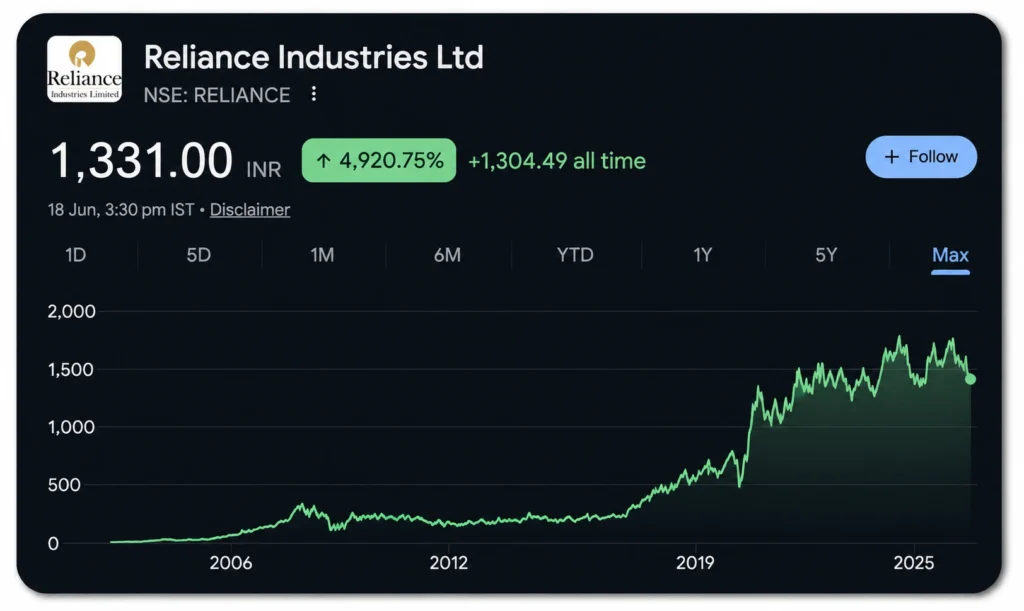
Company Overview
| Particular | Details |
|---|---|
| Company Name | Reliance Industries Limited |
| NSE Symbol | RELIANCE |
| BSE Code | 500325 |
| Industry | Conglomerate (Energy, Telecom, Retail, Digital Services) |
| Market Cap | ₹20–21 Lakh Crore |
| Founded | 1958 |
| Headquarters | Mumbai, Maharashtra, India |
| Website | www.ril.com |
What Does Reliance Industries Do?
Reliance Industries operates across multiple business segments, making it one of India’s most diversified corporations.
Major Business Segments
Oil-to-Chemicals (O2C)
Includes refining, petrochemicals, polymers, polyester, and fuel marketing operations.
Reliance Jio
India’s largest telecom operator offering:
- Mobile services
- Broadband internet
- Enterprise solutions
- Digital applications
- Cloud services
Reliance Retail
India’s largest organized retailer operating:
- Grocery stores
- Fashion outlets
- Electronics stores
- E-commerce platforms
- Wholesale businesses
New Energy
Investments in:
- Green hydrogen
- Solar manufacturing
- Battery storage
- Renewable energy infrastructure
Revenue Sources
- Refining and petrochemicals
- Telecom subscriptions
- Retail sales
- Digital services
- Energy products
- Financial and technology ventures
Reliance’s competitive advantage comes from its scale, integrated business model, strong cash flows, extensive customer base, and leadership across multiple industries.
Reliance Industries Share Price Market Overview
| Metric | Value |
|---|---|
| Current Share Price | ₹1,480–1,520 |
| Market Capitalization | ₹20.5 Lakh Crore |
| P/E Ratio | 28–30 |
| Book Value | ₹620 |
| ROE | 9–10% |
| Dividend Yield | 0.35% |
| 52-Week High | ₹1,608 |
| 52-Week Low | ₹1,115 |
| Face Value | ₹10 |
| Industry | Diversified Conglomerate |
Financial Performance
| Financial Year | Revenue | Net Profit | EPS |
|---|---|---|---|
| FY2022 | ₹7.93 Lakh Crore | ₹60,705 Crore | ₹89 |
| FY2023 | ₹8.77 Lakh Crore | ₹66,702 Crore | ₹98 |
| FY2024 | ₹9.75 Lakh Crore | ₹79,020 Crore | ₹117 |
| FY2025 | ₹10.75 Lakh Crore | ₹81,300 Crore | ₹120 |
Analysis
Reliance has consistently delivered strong revenue growth through expansion in telecom, retail, and energy businesses. Profitability remains robust despite cyclical fluctuations in refining margins.
Debt Position
| Metric | Value |
|---|---|
| Total Debt | ₹3.45 Lakh Crore |
| Debt-to-Equity Ratio | 0.42 |
| Interest Coverage Ratio | 7–8 Times |
The company maintains a manageable debt profile supported by strong cash generation and substantial operating cash flows.
Historic Performance
1-Year Return
Approximately 20%–25%
3-Year Return
Approximately 45%–55%
5-Year Return
Approximately 120%–140%
CAGR Performance
- 3-Year CAGR: ~13%
- 5-Year CAGR: ~18%
Major Price-Moving Events
- Jio subscriber growth
- Reliance Retail expansion
- Green energy investments
- Stake sales to global investors
- Refining margin fluctuations
- New telecom tariff hikes
- Quarterly earnings performance
Historical Share Price Performance Table
| Year | Opening Price | Closing Price | Return |
|---|---|---|---|
| 2021 | ₹1,980 | ₹2,360 | 19% |
| 2022 | ₹2,360 | ₹2,540 | 8% |
| 2023 | ₹2,540 | ₹2,650 | 4% |
| 2024 | ₹2,650 | ₹1,280* | Adjusted |
| 2025 | ₹1,280 | ₹1,500 | 17% |
Shareholding Pattern
Latest Available Quarter
| Shareholder Category | Holding |
|---|---|
| Promoters | 50.11% |
| FIIs | 19.10% |
| DIIs | 17.30% |
| Public | 12.20% |
| Others | 1.29% |
Growth Factors
- Industry Growth: Reliance operates in several rapidly growing sectors including telecom, retail, digital services, and renewable energy.
- Expansion Plans:
- Jio AirFiber expansion
- Retail network growth
- New energy giga factories
- Green hydrogen ecosystem
- Capacity Additions: Large investments in renewable energy manufacturing facilities.
- New Products:
- AI-powered digital services
- Green energy products
- Advanced telecom solutions
- Government Policies: Supportive policies for:
- Digital India
- Renewable energy
- Manufacturing expansion
- Infrastructure development
Future Demand Drivers
- Rising internet penetration
- Growing retail consumption
- Renewable energy adoption
- Urbanization
- Digital transformation
Risks and Challenges
Competition
Strong competition from:
- Bharti Airtel
- Adani Group
- Amazon
- Walmart-owned Flipkart
- Global energy companies
Regulatory Risks
Telecom regulations, environmental laws, and retail policy changes.
Debt Concerns
Large capital expenditure requirements may increase leverage.
Economic Slowdown
Consumer spending weakness could impact retail growth.
Sector Risks
- Commodity price volatility
- Regulatory interventions
- Technology disruptions
- Global economic uncertainty
Reliance Industries Share Price Target 2026 To 2050
| Year | Minimum Target | Average Target | Maximum Target |
|---|---|---|---|
| 2026 | ₹1,309 | ₹1,424 | ₹1,601 |
| 2030 | ₹2,142 | ₹2,387 | ₹2,593 |
| 2035 | ₹2,923 | ₹3,150 | ₹3,326 |
| 2040 | ₹3,711 | ₹3,942 | ₹4,179 |
| 2050 | ₹5,248 | ₹5,537 | ₹5,801 |
Also Check:
Reliance Industries Share Price Target 2026
Reliance’s 2026 outlook depends on continued growth in Jio, Retail, and New Energy businesses. Strong telecom tariff increases, retail expansion, and improving profitability could support earnings growth. Renewable energy projects may begin contributing meaningfully to valuation. Stable refining margins and continued digital transformation initiatives could further enhance investor confidence. Assuming healthy execution across business segments, the stock may trade between ₹1,312 and ₹1,981 during 2026.
Monthly Reliance Industries 2026 Share Price Target
| Month | Estimated Target Price |
|---|---|
| January | ₹1,312 |
| February | ₹1,364.50 |
| March | ₹1,389.20 |
| April | ₹1,432.68 |
| May | ₹1,370 |
| June | ₹1329.90 |
| July | ₹1,378.40 |
| August | ₹1,410.35 |
| September | ₹1,461.60 |
| October | ₹1,503.20 |
| November | ₹1,557.45 |
| December | ₹1,601 |
Reliance Industries Share Price Target 2030
By 2030, Reliance could become one of the world’s largest integrated digital and energy companies. Significant growth from Jio, Retail, and renewable energy businesses may reduce dependence on refining operations and improve valuation multiples.
Monthly Target 2030
| Month | Estimated Target Price |
|---|---|
| January | ₹2,142 |
| February | ₹2,189.60 |
| March | ₹2,227.40 |
| April | ₹2,263.76 |
| May | ₹2,296.83 |
| June | ₹2,329.52 |
| July | ₹2,385.23 |
| August | ₹2,409.50 |
| September | ₹2,458.61 |
| October | ₹2,491.10 |
| November | ₹2,547.90 |
| December | ₹2,593 |
Reliance Industries Share Price Target 2035
The 2035 projection assumes successful scaling of green hydrogen, solar manufacturing, battery storage, and digital ecosystem businesses. Continued growth in consumer-facing businesses may drive earnings expansion.
Monthly Target 2035
| Month | Estimated Target Price |
|---|---|
| January | ₹2,923 |
| February | ₹2,974.60 |
| March | ₹3,021.46 |
| April | ₹3,069.34 |
| May | ₹3,098.52 |
| June | ₹3,137.65 |
| July | ₹3,168.49 |
| August | ₹3,192.49 |
| September | ₹3,239.60 |
| October | ₹3,268.32 |
| November | ₹3,296.10 |
| December | ₹3,326 |
Reliance Industries Share Price Target 2040
By 2040, Reliance could derive a substantial portion of earnings from digital services, retail, renewable energy, artificial intelligence, and technology-driven businesses.
Monthly Target 2040
| Month | Estimated Target Price |
|---|---|
| January | ₹3,711 |
| February | ₹3,786.20 |
| March | ₹3,824.50 |
| April | ₹3,876.45 |
| May | ₹3,902.32 |
| June | ₹3,950.09 |
| July | ₹3,994.52 |
| August | ₹4,039.76 |
| September | ₹4,068.43 |
| October | ₹4,093.54 |
| November | ₹4,138.76 |
| December | ₹4,179 |
Reliance Industries Share Price Target 2050
Forecasting stock prices over 25 years involves significant uncertainty. The projection assumes successful execution of long-term energy transition plans, continued leadership in digital services, and sustained economic growth in India.
Monthly Target 2050
| Month | Estimated Target Price |
|---|---|
| January | ₹5,248 |
| February | ₹5,296.74 |
| March | ₹5,342.65 |
| April | ₹5,388.70 |
| May | ₹5,439.20 |
| June | ₹5,483.54 |
| July | ₹5,531.22 |
| August | ₹5,579.83 |
| September | ₹5,629.76 |
| October | ₹5,694.89 |
| November | ₹5,753.90 |
| December | ₹5,801 |
Bull Case
- Strong leadership across multiple sectors
- Rapid growth in Jio and Retail
- Renewable energy opportunity
- Strong cash flow generation
- Potential value unlocking through listings
- Dominant market positions
Bear Case
- Large capital expenditure requirements
- Regulatory challenges
- Telecom competition
- Commodity price fluctuations
- Slower retail growth
- Execution risks in green energy projects
Pros and Cons
Pros
- Highly diversified business model
- Market leadership across key sectors
- Strong long-term growth opportunities
Cons
- Capital-intensive operations
- Complex conglomerate structure
- Dependence on execution of future projects
Expert Opinion
Analysts generally view Reliance Industries as one of India’s strongest long-term investment opportunities due to its diversified business portfolio and leadership position. While the stock may experience periods of consolidation, long-term growth from telecom, retail, digital services, and renewable energy initiatives could support sustained value creation.
Future Outlook
Reliance Industries is expected to remain a key beneficiary of India’s economic growth. Expansion in digital services, retail consumption, clean energy, artificial intelligence, and advanced manufacturing could create substantial long-term opportunities. The company’s ability to adapt to changing industry dynamics and invest ahead of market trends may continue driving shareholder value.
Conclusion
Reliance Industries combines the stability of established energy operations with the growth potential of telecom, retail, digital services, and renewable energy businesses. Its diversified revenue streams, strong management, and ambitious expansion plans make it one of India’s most important companies. While risks remain, the long-term outlook appears favorable for investors seeking exposure to India’s economic growth story.
Disclaimer: The share price targets mentioned above are estimates based on historical performance, business fundamentals, industry trends, and future assumptions. Actual results may vary significantly. Investors should conduct independent research and consult a financial advisor before making investment decisions.
Frequently Asked Questions (FAQs)
What is the Reliance Industries Share Price Target for 2026?
The estimated target range for 2026 is ₹1,309 to ₹1,601.
What is the Reliance Industries Share Price Target for 2030?
The estimated target range for 2030 is ₹2,142 to ₹2,593.
Is Reliance Industries a good long-term investment?
Many investors consider Reliance a strong long-term investment due to its diversified business model and growth opportunities across telecom, retail, and renewable energy.
What are the risks of investing in Reliance Industries?
Key risks include regulatory changes, competition, capital expenditure requirements, and commodity price volatility.
Can Reliance Industries reach new all-time highs by 2030?
If earnings continue growing and expansion projects succeed, new all-time highs are possible before 2030.
Should beginners invest in Reliance Industries stock?
Reliance is often viewed as a relatively stable large-cap company suitable for investors seeking long-term exposure to India’s growth sectors.