
Oil and Natural Gas Corporation (ONGC) is India’s largest crude oil and natural gas exploration and production company. Established in 1956, the company plays a crucial role in India’s energy security by exploring, producing, refining, and marketing hydrocarbons. ONGC operates both domestic and international energy assets and contributes significantly to India’s oil and gas production.
Investors remain interested in ONGC because of its strong government backing, large reserve base, attractive dividend payouts, and strategic importance in the Indian energy sector. As India’s energy demand continues to grow alongside industrialization and economic expansion, ONGC is expected to benefit from increasing consumption of oil, gas, and related energy products. Additionally, the company’s investments in offshore exploration, petrochemicals, natural gas infrastructure, and renewable energy initiatives could support long-term growth. Despite challenges such as commodity price volatility and the global energy transition, ONGC remains one of India’s most closely watched energy stocks for long-term investors seeking value, income, and exposure to the energy sector.
Company Overview
| Particular | Details |
|---|---|
| Company Name | Oil and Natural Gas Corporation Limited (ONGC) |
| NSE Symbol | ONGC |
| BSE Code | 500312 |
| Industry | Oil & Gas Exploration and Production |
| Market Cap | ₹3.3+ Lakh Crore |
| Founded | 1956 |
| Headquarters | New Delhi, India |
| Website | www.ongcindia.com |
What Does ONGC Do?
ONGC is India’s largest upstream oil and gas company engaged primarily in the exploration, development, and production of crude oil and natural gas. The company operates major offshore and onshore oil fields across India, including the Mumbai High field.
The company generates revenue from:
- Crude oil production
- Natural gas production
- Oil refining operations through subsidiaries
- Petrochemical products
- LNG and gas transportation activities
- International oil and gas assets
ONGC enjoys a dominant market position due to its vast reserve base, government ownership, extensive infrastructure, and decades of technical expertise. The company also owns significant stakes in HPCL and ONGC Videsh, providing diversification beyond exploration activities.
ONGC Share Price Market Overview
| Metric | Value |
|---|---|
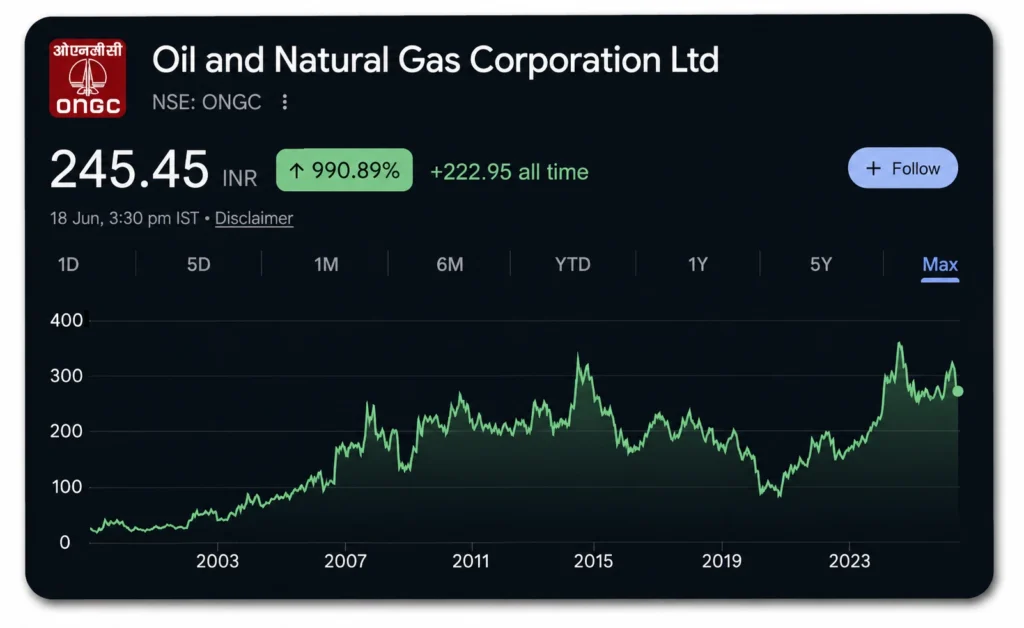
| Current Share Price | ₹260–270 |
| Market Capitalization | ₹3.3+ Lakh Crore |
| P/E Ratio | 8–9 |
| Book Value | ₹330+ |
| ROE | 10–11% |
| Dividend Yield | 4–5% |
| 52-Week High | ₹307.50 |
| 52-Week Low | ₹228.61 |
| Face Value | ₹5 |
| Industry | Energy / Oil & Gas |
Financial Performance
| Financial Year | Revenue | Net Profit | EPS |
|---|---|---|---|
| FY2022 | ₹5.5 Lakh Cr | ₹40,300 Cr | ₹32 |
| FY2023 | ₹6.4 Lakh Cr | ₹44,500 Cr | ₹35 |
| FY2024 | ₹6.55 Lakh Cr | ₹40,500 Cr | ₹32 |
| FY2025 | ₹6.76 Lakh Cr | ₹41,400 Cr | ₹33 |
Debt Position
| Metric | Value |
|---|---|
| Total Debt | ₹2.2–2.4 Lakh Crore |
| Debt-to-Equity Ratio | ~0.70 |
| Interest Coverage Ratio | 6–8 Times |
Historic Performance
1-Year Return
Approximately -5% to -10%
3-Year Return
Approximately 55% to 65%
5-Year Return
Approximately 90% to 110%
CAGR Performance
5-Year CAGR: Around 14%
Major Price-Moving Events
- Crude oil price fluctuations
- Government energy policy reforms
- Acquisition and integration of HPCL
- Gas pricing revisions
- Exploration discoveries
- Dividend announcements
- Global geopolitical developments
Historical Share Price Performance Table
| Year | Opening Price | Closing Price | Return |
|---|---|---|---|
| 2021 | ₹95 | ₹148 | 56% |
| 2022 | ₹148 | ₹151 | 2% |
| 2023 | ₹151 | ₹210 | 39% |
| 2024 | ₹210 | ₹255 | 21% |
| 2025 | ₹255 | ₹265 | 4% |
Shareholding Pattern
| Shareholder Category | Holding |
|---|---|
| Promoters | 58.89% |
| FIIs | 7.97% |
| DIIs | 19.30% |
| Public | 3.54% |
| Others | 10.30% |
Growth Factors
- Industry Growth: India remains one of the world’s fastest-growing energy markets.
- Expansion Plans: Continuous offshore and deep-water exploration projects.
- Capacity Additions: New gas fields and production enhancement projects.
- New Products: Focus on petrochemicals, gas infrastructure, and renewable energy.
- Government Policies: Supportive policies for domestic hydrocarbon production.
Future Demand Drivers
- Rising energy consumption
- Urbanization
- Industrial growth
- Natural gas adoption
- Strategic energy security initiatives
Risks and Challenges
- Sector Risks:
- Oil price volatility
- Energy transition toward renewables
- Environmental regulations
- Competition: Competition from private and global energy companies.
- Regulatory Risks: Government intervention in pricing policies.
- Debt Concerns: Large capital expenditure requirements.
- Economic Slowdown: Reduced industrial demand can impact earnings.
ONGC Share Price Target 2026 To 2050
| Year | Minimum Target | Average Target | Maximum Target |
|---|---|---|---|
| 2026 | ₹240 | ₹290 | ₹350 |
| 2030 | ₹641 | ₹710 | ₹790 |
| 2035 | ₹1,202 | ₹1,260 | ₹1,320 |
| 2040 | ₹2,330 | ₹2,566 | ₹2,809 |
| 2050 | ₹6,820 | ₹7,351 | ₹7,917 |
Also Read:
ONGC Share Price Target 2026
ONGC’s 2026 outlook depends largely on crude oil prices, production growth, natural gas demand, and government energy policies. Stable global oil markets and increasing domestic energy consumption could support revenue growth. Continued exploration success and operational efficiency improvements may further strengthen profitability. Strong dividend payouts are also expected to keep investor interest intact. Assuming favorable energy prices and moderate earnings growth, ONGC could trade in the ₹280–₹360 range during 2026.
Monthly Target 2026
| Month | Estimated Target Price |
|---|---|
| January | ₹240 |
| February | ₹246.05 |
| March | ₹257.19 |
| April | ₹265.04 |
| May | ₹274.26 |
| June | ₹289.63 |
| July | ₹297.02 |
| August | ₹315.33 |
| September | ₹331.64 |
| October | ₹338.20 |
| November | ₹346.31 |
| December | ₹350.80 |
ONGC Share Price Target 2030
By 2030, India’s energy demand is expected to be significantly higher. ONGC’s investments in exploration, natural gas, petrochemicals, and international assets may contribute to sustainable growth. Continued government support and strong energy demand could improve earnings visibility. Under favorable conditions, ONGC may achieve meaningful valuation expansion over the decade.
Monthly Target 2030
| Month | Estimated Target Price |
|---|---|
| January | ₹641 |
| February | ₹658.04 |
| March | ₹664.14 |
| April | ₹679.63 |
| May | ₹695.20 |
| June | ₹708.82 |
| July | ₹721.64 |
| August | ₹735.09 |
| September | ₹746.22 |
| October | ₹774.30 |
| November | ₹731.05 |
| December | ₹790.20 |
ONGC Share Price Target 2035
The 2035 projection assumes successful reserve replacement, increasing gas production, and diversification into cleaner energy segments. ONGC’s established infrastructure and financial strength could help it adapt to changing energy dynamics while maintaining profitability.
Monthly Target 2035
| Month | Estimated Target Price |
|---|---|
| January | ₹1,202 |
| February | ₹1,242.50 |
| March | ₹1,218 |
| April | ₹1,265.08 |
| May | ₹1,284.38 |
| June | ₹1,275.04 |
| July | ₹1,249.31 |
| August | ₹1,271.03 |
| September | ₹1,283.90 |
| October | ₹1,298.13 |
| November | ₹1,307.26 |
| December | ₹1,320.60 |
ONGC Share Price Target 2040
By 2040, ONGC may evolve into a broader energy company with significant exposure to natural gas, petrochemicals, hydrogen, and renewable energy projects. Long-term growth could be driven by technological advancements and expanding energy infrastructure.
Monthly Target 2040
| Month | Estimated Target Price |
|---|---|
| January | ₹2,330.40 |
| February | ₹2,374.31 |
| March | ₹2,440.50 |
| April | ₹2,416.02 |
| May | ₹2,460.39 |
| June | ₹2,507.00 |
| July | ₹2,553.49 |
| August | ₹2,601.22 |
| September | ₹2,689.50 |
| October | ₹2,743.29 |
| November | ₹2,769.01 |
| December | ₹2,809.05 |
ONGC Share Price Target 2050
Forecasting stock prices over such a long period involves substantial uncertainty. The projection assumes successful adaptation to the evolving global energy landscape, continued profitability, reserve replenishment, and participation in new energy technologies.
Monthly Target 2050
| Month | Estimated Target Price |
|---|---|
| January | ₹6,820.44 |
| February | ₹6,914.50 |
| March | ₹6,863.08 |
| April | ₹6,893.17 |
| May | ₹7,035.04 |
| June | ₹7,140.83 |
| July | ₹7,290.55 |
| August | ₹7,380.06 |
| September | ₹7,583.44 |
| October | ₹7,604.15 |
| November | ₹7,748.80 |
| December | ₹7,917.10 |
Bull Case
- Strong government backing
- Attractive dividend yield
- Dominant position in Indian energy sector
- Large proven reserves
- Growing natural gas demand
- Potential benefits from higher crude prices
Bear Case
- Oil price volatility
- Regulatory intervention
- Energy transition risks
- Production declines in mature fields
- Environmental compliance costs
- Lower global fossil fuel demand
Pros and Cons
Pros
- Market leader in India’s upstream energy sector
- Strong dividend-paying track record
- Attractive valuation compared to peers
Cons
- Earnings depend heavily on commodity prices
- Government ownership may impact flexibility
- Long-term renewable energy transition risks
Expert Opinion
Most analysts view ONGC as a value-oriented energy stock offering a combination of dividend income and moderate capital appreciation potential. The company’s low valuation multiples, strategic importance, and strong asset base make it attractive for long-term investors. However, future performance will largely depend on oil prices, production growth, and the company’s ability to adapt to changing energy trends.
Future Outlook
India’s rising energy demand should continue to support ONGC’s business over the coming decades. Growth in natural gas consumption, petrochemical demand, offshore exploration, and international projects may provide additional opportunities. Investments in renewable energy and emerging technologies could further diversify the company’s revenue streams and improve long-term sustainability.
Conclusion
ONGC remains one of India’s most important energy companies with a strong market position, substantial reserves, and attractive dividend yields. Long-term growth opportunities exist through increasing energy demand, exploration activities, and diversification efforts. While commodity price volatility and energy transition risks remain important considerations, ONGC continues to offer value for investors seeking exposure to India’s energy sector.
Disclaimer: Share price targets are estimates based on assumptions, historical performance, industry trends, and market conditions. Actual stock performance may differ significantly. Investors should conduct independent research and consult a qualified financial advisor before making investment decisions.
Frequently Asked Questions (FAQs)
What is the ONGC Share Price Target for 2026?
The estimated ONGC share price target for 2026 ranges between ₹240 and ₹350.80.
What is the ONGC Share Price Target for 2030?
The estimated ONGC share price target for 2030 ranges between ₹641and ₹790.20.
Is ONGC a good long-term investment?
ONGC can be considered a long-term investment for investors seeking dividend income, value investing opportunities, and exposure to India’s energy sector.
What are the risks of investing in ONGC?
Major risks include oil price volatility, regulatory changes, energy transition challenges, and fluctuations in global demand.
Can ONGC reach new all-time highs by 2030?
If energy demand remains strong and profitability improves, ONGC could potentially achieve new highs before 2030.
Should beginners invest in ONGC stock?
Beginners may consider ONGC for diversification and dividend income, but investment decisions should align with individual risk tolerance and financial goals.