
ITC Limited is one of India’s largest and most diversified conglomerates, with a strong presence across FMCG, cigarettes, hotels, paperboards, packaging, agri-business, and information technology. Established in 1910, the company has evolved from a tobacco-focused business into a multi-segment enterprise with several market-leading consumer brands. Today, ITC’s portfolio includes popular products such as Aashirvaad, Sunfeast, Bingo!, Yippee!, Classmate, Mangaldeep, and Fiama, making it a household name across India.
Investors are attracted to ITC because of its strong cash generation, consistent dividend payouts, diversified revenue streams, and leadership position in multiple industries. The company’s cigarette business remains highly profitable and provides significant cash flows that support expansion into fast-growing FMCG categories. Additionally, ITC continues to invest in premium products, digital capabilities, sustainability initiatives, and hospitality assets. As India’s consumer spending increases and the organized FMCG market expands, ITC is well-positioned to benefit from long-term growth trends. Its combination of stability, profitability, and shareholder-friendly policies makes it one of the most widely held stocks among long-term investors.
Company Overview
| Particular | Details |
|---|---|
| Company Name | ITC Limited |
| NSE Symbol | ITC |
| BSE Code | 500875 |
| Industry | FMCG, Cigarettes, Hotels, Paper & Packaging |
| Market Cap | ₹5.3–5.7 Lakh Crore |
| Founded | 1910 |
| Headquarters | Kolkata, West Bengal, India |
| Website | www.itcportal.com |
What Does ITC Do?
ITC operates through multiple business segments, creating a diversified revenue model that reduces dependence on any single industry.
Cigarettes Business
The cigarette segment remains ITC’s largest profit contributor and includes leading brands such as Gold Flake, Classic, Navy Cut, and Insignia.
FMCG Business
ITC’s FMCG portfolio includes:
- Aashirvaad Atta
- Sunfeast Biscuits
- Bingo! Snacks
- Yippee! Noodles
- Fiama Personal Care
- Savlon Healthcare Products
- Classmate Stationery
Hotels Business
ITC Hotels operates luxury and premium hotel properties across India.
Agri-Business
The company exports agricultural products and sources raw materials for its FMCG operations.
Paperboards & Packaging
ITC manufactures paperboards, specialty papers, and packaging materials for domestic and international markets.
Revenue Sources
- Cigarettes
- FMCG products
- Hotel operations
- Agri exports
- Packaging and paperboards
ITC’s competitive advantage lies in its strong brands, distribution network, cash-generating cigarette business, and diversified business model.
ITC Share Price Market Overview
| Metric | Value |
|---|---|
| Current Share Price | ₹430–460 |
| Market Capitalization | ₹5.5 Lakh Crore |
| P/E Ratio | 26–29 |
| Book Value | ₹63–68 |
| ROE | 27–30% |
| Dividend Yield | 3.0–3.5% |
| 52-Week High | ₹528 |
| 52-Week Low | ₹399 |
| Face Value | ₹1 |
| Industry | FMCG & Consumer Goods |
Financial Performance
| Financial Year | Revenue | Net Profit | EPS |
|---|---|---|---|
| FY2022 | ₹65,205 Crore | ₹15,058 Crore | ₹12.1 |
| FY2023 | ₹76,518 Crore | ₹19,446 Crore | ₹15.6 |
| FY2024 | ₹69,446 Crore | ₹20,422 Crore | ₹16.3 |
| FY2025 | ₹73,500 Crore | ₹21,800 Crore | ₹17.4 |
Analysis
ITC has maintained strong profitability despite fluctuations in commodity prices and consumer demand. The FMCG segment continues to gain market share while the cigarette business remains a major profit driver.
Debt Position
| Metric | Value |
|---|---|
| Total Debt | Near Zero / Negligible |
| Debt-to-Equity Ratio | Less than 0.05 |
| Interest Coverage Ratio | Extremely High |
ITC is effectively a debt-free company with substantial cash reserves and strong operating cash flow.
Historic Performance
1-Year Return
Approximately 5%–12%
3-Year Return
Approximately 80%–100%
5-Year Return
Approximately 140%–170%
CAGR Performance
- 3-Year CAGR: ~22%
- 5-Year CAGR: ~19%
Major Price-Moving Events
- FMCG business growth
- ITC Hotels demerger developments
- Cigarette taxation announcements
- Strong dividend declarations
- Quarterly earnings performance
- Commodity cost fluctuations
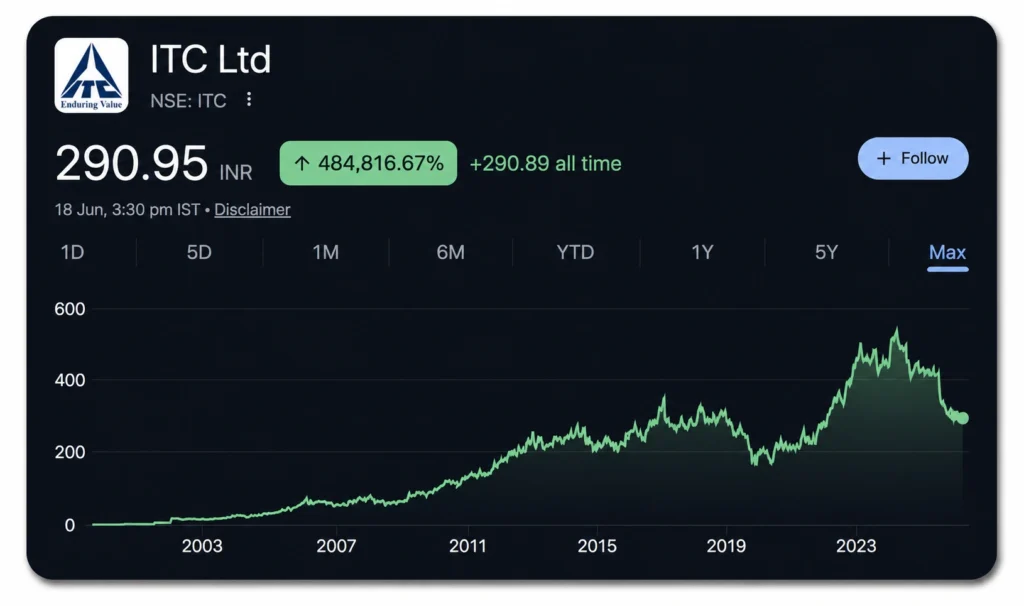
Historical Share Price Performance Table
| Year | Opening Price | Closing Price | Return |
|---|---|---|---|
| 2021 | ₹209 | ₹237 | 13% |
| 2022 | ₹237 | ₹337 | 42% |
| 2023 | ₹337 | ₹449 | 33% |
| 2024 | ₹449 | ₹470 | 5% |
| 2025 | ₹470 | ₹445 | -5% |
Shareholding Pattern
| Shareholder Category | Holding |
|---|---|
| Promoters | 0.00% |
| FIIs | 40.0% |
| DIIs | 44.5% |
| Public | 14.0% |
| Others | 1.5% |
ITC is a professionally managed company and does not have a traditional promoter group.
Growth Factors
- Industry Growth: India’s FMCG sector is expected to grow steadily due to rising incomes, urbanization, and premiumization trends.
- Expansion Plans:
- Expansion in packaged foods
- Growth in personal care products
- Hotel business expansion
- Premium product launches
- Capacity Additions: New manufacturing facilities and modernization initiatives across FMCG operations.
- New Products:
- Premium packaged foods
- Health-focused products
- Personal care innovations
- Sustainable packaging solutions
- Government Policies: Supportive policies for manufacturing, exports, and consumer goods industries.
Future Demand Drivers
- Growing middle class
- Rising rural consumption
- Premiumization
- Digital commerce growth
- Organized retail expansion
Risks and Challenges
Competition
Competition from:
- Hindustan Unilever
- Nestlé India
- Britannia
- Dabur
- Marico
- Godrej Consumer Products
Regulatory Risks
Higher taxation on cigarettes can affect profitability.
Debt Concerns
Minimal debt-related risk due to strong balance sheet.
Economic Slowdown
Can impact discretionary spending and hotel occupancy.
Sector Risks
- Regulatory changes
- Commodity inflation
- Intense FMCG competition
- Consumer preference shifts
ITC Share Price Target 2026 To 2050
| Year | Minimum Target | Average Target | Maximum Target |
|---|---|---|---|
| 2026 | ₹268 | ₹352 | ₹467 |
| 2030 | ₹634 | ₹741 | ₹829 |
| 2035 | ₹1,018 | ₹1,134 | ₹1,284 |
| 2040 | ₹1,409 | ₹1,548 | ₹1,680 |
| 2050 | ₹2,263 | ₹2,475 | ₹2,642 |
Also Check:
ITC Share Price Target 2026
The 2026 outlook for ITC is supported by steady growth in FMCG, strong cash generation from the cigarette segment, and continued margin expansion. The company’s debt-free balance sheet, attractive dividend yield, and strong brand portfolio provide stability during market volatility. Growth in packaged foods, personal care products, and hotels could further improve earnings. Assuming stable taxation policies and continued consumer demand, ITC could trade between ₹268 and ₹467 during 2026.
Monthly Target 2026
| Month | Estimated Target Price |
|---|---|
| January | ₹268 |
| February | ₹283 |
| March | ₹297.54 |
| April | ₹293.52 |
| May | ₹285.60 |
| June | ₹253.89 |
| July | ₹281.50 |
| August | ₹302.65 |
| September | ₹338.70 |
| October | ₹363.40 |
| November | ₹408.90 |
| December | ₹467 |
ITC Share Price Target 2030
By 2030, ITC could benefit significantly from the growing FMCG segment, which may contribute a larger share of profits. Strong cash flows, continued premiumization, and expansion of non-cigarette businesses could drive earnings growth and valuation re-rating.
Monthly Target 2030
| Month | Estimated Target Price |
|---|---|
| January | ₹634 |
| February | ₹669.50 |
| March | ₹698.40 |
| April | ₹726.02 |
| May | ₹758.10 |
| June | ₹783.60 |
| July | ₹775.80 |
| August | ₹763.29 |
| September | ₹772.40 |
| October | ₹794.90 |
| November | ₹813.43 |
| December | ₹829 |
ITC Share Price Target 2035
The 2035 projection assumes a stronger contribution from FMCG, hotels, and agri-business operations. If ITC successfully reduces dependence on cigarettes while maintaining profitability, the company could command higher valuation multiples.
Monthly Target 2035
| Month | Estimated Target Price |
|---|---|
| January | ₹1,018 |
| February | ₹1,041 |
| March | ₹1,078.50 |
| April | ₹1,103.56 |
| May | ₹1,128.86 |
| June | ₹1,152.70 |
| July | ₹1,168.30 |
| August | ₹1,184.35 |
| September | ₹1,201.50 |
| October | ₹1,227.98 |
| November | ₹1,247.10 |
| December | ₹1,284 |
ITC Share Price Target 2040
By 2040, ITC may operate as a predominantly consumer-focused conglomerate with strong FMCG, hospitality, and packaging businesses. Long-term earnings growth could support substantial shareholder returns.
Monthly Target 2040
| Month | Estimated Target Price |
|---|---|
| January | ₹1,409 |
| February | ₹1,437.30 |
| March | ₹1,452.50 |
| April | ₹1,478.20 |
| May | ₹1,496.46 |
| June | ₹1,512.70 |
| July | ₹1,534.50 |
| August | ₹1,567.80 |
| September | ₹1,593.90 |
| October | ₹1,623.40 |
| November | ₹1,657.10 |
| December | ₹1,680 |
ITC Share Price Target 2050
The 2050 forecast assumes successful execution of long-term diversification strategies, continued growth in consumer spending, and expansion of premium products. While long-term forecasts involve considerable uncertainty, ITC’s strong balance sheet and brand portfolio could support sustained growth.
Monthly Target 2050
| Month | Estimated Target Price |
|---|---|
| January | ₹2,263 |
| February | ₹2,292.40 |
| March | ₹2,341.20 |
| April | ₹2,363.90 |
| May | ₹2,387.37 |
| June | ₹,2411.09 |
| July | ₹2,449.05 |
| August | ₹2,497 |
| September | ₹2,528.30 |
| October | ₹2,561.20 |
| November | ₹2,594.90 |
| December | ₹2,642 |
Bull Case
- Strong cash-generating cigarette business
- Debt-free balance sheet
- Attractive dividend yield
- Growing FMCG portfolio
- Strong distribution network
- Potential valuation re-rating
Bear Case
- Regulatory risks in the tobacco business
- Higher cigarette taxes
- FMCG margin pressure
- Intense competition
- Slower-than-expected diversification
Pros and Cons
Pros
- Strong dividend-paying company
- Debt-free balance sheet
- Diversified business portfolio
Cons
- Regulatory dependence on tobacco segment
- Moderate FMCG margins
- Slower growth than some consumer peers
Expert Opinion
Analysts generally view ITC as a stable, cash-rich company offering a combination of dividends and moderate growth. The company’s strong balance sheet, leadership in cigarettes, and expanding FMCG business support a favorable long-term outlook. Valuation remains reasonable compared to many large consumer companies.
Future Outlook
The long-term outlook remains positive as ITC continues expanding its FMCG portfolio, strengthening hotel operations, and investing in sustainable growth initiatives. Rising consumer spending, premiumization, and organized retail growth could provide significant opportunities over the coming decades.
Conclusion
ITC remains one of India’s most established and financially strong companies. Its diversified business model, strong cash generation, and consistent dividend history make it attractive for long-term investors seeking stability and income. However, investors should monitor regulatory developments affecting the tobacco industry and the company’s ability to scale non-cigarette businesses.
Disclaimer: The share price targets mentioned above are estimates based on historical performance, industry trends, and future assumptions. Actual stock performance may differ significantly. Investors should conduct their own research and consult a qualified financial advisor before making investment decisions.
Frequently Asked Questions (FAQs)
What is the ITC Share Price Target for 2026?
The estimated target range for 2026 is ₹268 to ₹467.
What is the ITC Share Price Target for 2030?
The estimated target range for 2030 is ₹634 to ₹829.
Is ITC a good long-term investment?
ITC is often considered a strong long-term investment due to its cash generation, dividend yield, diversified business model, and strong market position.
What are the risks of investing in ITC?
Major risks include tobacco regulations, higher taxation on cigarettes, FMCG competition, and changing consumer preferences.
Can ITC reach new all-time highs by 2030?
If earnings continue growing and non-cigarette businesses expand successfully, ITC could potentially reach new highs by 2030.
Should beginners invest in ITC stock?
Many investors consider ITC suitable for beginners seeking a combination of stability, dividends, and moderate long-term growth potential.