
Ashok Leyland is one of India’s largest commercial vehicle manufacturers and a flagship company of the Hinduja Group. Founded in 1948, the company has built a strong reputation in the truck, bus, defense vehicle, and light commercial vehicle segments. Over the decades, Ashok Leyland has become a key player in India’s transportation and logistics ecosystem, serving industries such as construction, mining, infrastructure, public transportation, and defense.
Investors are increasingly interested in Ashok Leyland because of its strong market position, expanding product portfolio, and exposure to India’s economic growth. Rising infrastructure spending, increasing freight movement, urbanization, and government investments in roads and logistics are expected to drive demand for commercial vehicles. The company’s growing focus on electric vehicles, alternative fuel technologies, and exports also creates additional growth opportunities. With improving profitability, strong brand recognition, and a favorable outlook for the commercial vehicle industry, Ashok Leyland remains a popular stock among long-term investors looking to benefit from India’s industrial and infrastructure expansion.
Company Overview
| Particular | Details |
|---|---|
| Company Name | Ashok Leyland Limited |
| NSE Symbol | ASHOKLEY |
| BSE Code | 500477 |
| Industry | Commercial Vehicles |
| Market Cap | ₹75,000–85,000 Crore |
| Founded | 1948 |
| Headquarters | Chennai, Tamil Nadu, India |
| Website | www.ashokleyland.com |
What Does Ashok Leyland Do?
Ashok Leyland manufactures commercial vehicles and transportation solutions across multiple segments.
Major Business Segments
- Heavy Commercial Vehicles (HCVs)
- Medium Commercial Vehicles (MCVs)
- Light Commercial Vehicles (LCVs)
- Buses
- Defense Vehicles
- Electric Vehicles
- Power Solutions and Engines
Revenue Sources
- Truck sales
- Bus sales
- Defense contracts
- Export operations
- Spare parts and aftermarket services
- Vehicle financing and related services
Competitive Position
Ashok Leyland is India’s second-largest commercial vehicle manufacturer and competes with Tata Motors, Eicher Motors, BharatBenz, and Mahindra & Mahindra. The company enjoys a strong presence in the truck and bus segments with an extensive dealer network.
Ashok Leyland Share Price Market Overview
| Metric | Value |
|---|---|
| Current Share Price | ₹255–275 |
| Market Capitalization | ₹75,000–85,000 Crore |
| P/E Ratio | 24–30 |
| Book Value | ₹45–50 |
| ROE | 20–25% |
| Dividend Yield | 1.5–2.0% |
| 52-Week High | ₹295+ |
| 52-Week Low | ₹190+ |
| Face Value | ₹1 |
| Industry | Commercial Vehicles |
Financial Performance
Revenue & Profit Performance
| Financial Year | Revenue | Net Profit | EPS |
|---|---|---|---|
| FY2022 | ₹21,688 Cr | ₹542 Cr | ₹1.85 |
| FY2023 | ₹36,144 Cr | ₹1,361 Cr | ₹4.63 |
| FY2024 | ₹45,931 Cr | ₹2,696 Cr | ₹9.18 |
| FY2025 | ₹48,000+ Cr | ₹3,000+ Cr | ₹10.20+ |
Debt Position
| Metric | Value |
|---|---|
| Total Debt | ₹2,800–3,500 Cr |
| Debt-to-Equity Ratio | 0.15–0.20 |
| Interest Coverage Ratio | 10x+ |
The company maintains a comfortable debt profile supported by strong cash generation and improving profitability.
Historic Performance
Returns Analysis
| Period | Approximate Return |
|---|---|
| 1-Year Return | 25%+ |
| 3-Year Return | 180%+ |
| 5-Year Return | 450%+ |
| 5-Year CAGR | 40%+ |
Major Price-Moving Events
- Recovery in commercial vehicle demand
- Infrastructure and logistics growth
- Record quarterly earnings
- Expansion in defense business
- Growth in exports
- Launch of electric vehicle initiatives
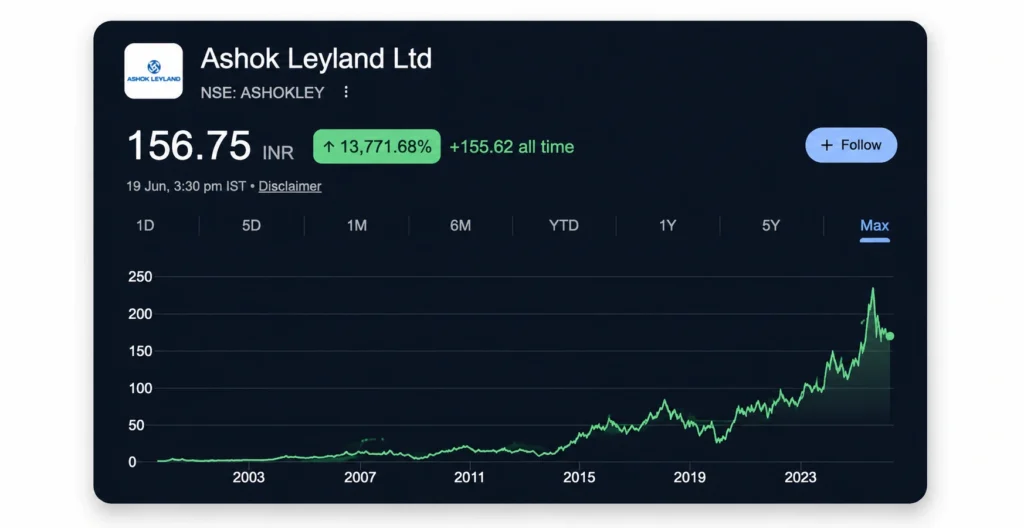
Historical Share Price Performance
| Year | Opening Price | Closing Price | Return |
|---|---|---|---|
| 2021 | ₹115 | ₹126 | 10% |
| 2022 | ₹126 | ₹150 | 19% |
| 2023 | ₹150 | ₹175 | 17% |
| 2024 | ₹175 | ₹242 | 38% |
| 2025 | ₹242 | ₹270 | 12% |
Shareholding Pattern
| Shareholder Category | Holding |
|---|---|
| Promoters | 51.5% |
| FIIs | 23% |
| DIIs | 17% |
| Public | 8% |
| Others | 0.5% |
Growth Factors
- Industry Growth: India’s commercial vehicle industry is expected to benefit from infrastructure development, industrial growth, and increased freight movement.
- Expansion Plans: The company continues investing in manufacturing facilities, electric mobility solutions, and export markets.
- Capacity Additions: Production capacity expansion supports growing domestic and international demand.
- New Products:
- Electric buses
- Electric trucks
- LNG-powered vehicles
- Advanced commercial vehicles
- Government Policies:
- PM Gati Shakti
- National Logistics Policy
- Make in India
- EV promotion policies
- Future Demand Drivers:
- Infrastructure spending
- Highway construction
- Urbanization
- E-commerce logistics growth
- Public transportation modernization
Risks and Challenges
Competition
Intense competition from Tata Motors, Eicher Motors, and global vehicle manufacturers.
Regulatory Risks
Changes in emission norms and vehicle regulations may increase costs.
Debt Concerns
Although manageable, rising interest rates can impact financing costs.
Economic Slowdown
Lower industrial activity may reduce demand for commercial vehicles.
Sector Risks
Commercial vehicle demand is cyclical and closely linked to economic conditions.
Ashok Leyland Share Price Target 2026–2050
| Year | Minimum Target | Average Target | Maximum Target |
|---|---|---|---|
| 2026 | ₹135.70 | ₹191.68 | ₹233.84 |
| 2030 | ₹421.07 | ₹573.80 | ₹680.20 |
| 2035 | ₹789.64 | ₹932.14 | ₹1,013.67 |
| 2040 | ₹1,260.20 | ₹1,523.90 | ₹1,842.50 |
| 2050 | ₹3,012.46 | ₹3,357.50 | ₹3,531.70 |
Also Check:
Ashok Leyland Share Price Target 2026
Ashok Leyland’s 2026 outlook is supported by healthy commercial vehicle demand, government infrastructure spending, and growth in logistics activity. The company is expected to benefit from replacement demand, expansion in exports, and rising adoption of alternative fuel vehicles. Strong order inflows from public transport and defense sectors may further support revenue growth. If margins remain stable and earnings continue to improve, the stock could witness moderate appreciation during 2026. However, fluctuations in raw material prices and economic conditions remain key variables for investors to monitor.
Monthly Target 2026
| Month | Estimated Target Price |
|---|---|
| January | ₹135.70 |
| February | ₹139.45 |
| March | ₹142.80 |
| April | ₹144.56 |
| May | ₹148.79 |
| June | ₹151.90 |
| July | ₹161.67 |
| August | ₹172.54 |
| September | ₹185.69 |
| October | ₹197.35 |
| November | ₹214.58 |
| December | ₹233.84 |
Ashok Leyland Share Price Target 2030
By 2030, Ashok Leyland could benefit from sustained infrastructure investment, expanding logistics networks, and increasing demand for commercial transportation. The company’s electric vehicle business and exports may emerge as important growth drivers. Strong earnings growth and improved operating leverage could support higher valuations over the long term.
Monthly Target 2030
| Month | Estimated Target Price |
|---|---|
| January | ₹421.07 |
| February | ₹453.57 |
| March | ₹487.69 |
| April | ₹503.20 |
| May | ₹532.21 |
| June | ₹568.32 |
| July | ₹589.40 |
| August | ₹602.54 |
| September | ₹624.11 |
| October | ₹641.50 |
| November | ₹669.15 |
| December | ₹680.20 |
Ashok Leyland Share Price Target 2035
The 2035 projection assumes continued leadership in commercial vehicles, growth in electric mobility, and expansion into international markets. Increased operating efficiency and stronger profitability could drive long-term shareholder returns.
Monthly Target 2035
| Month | Estimated Target Price |
|---|---|
| January | ₹789.64 |
| February | ₹807.15 |
| March | ₹833.70 |
| April | ₹856.15 |
| May | ₹874.11 |
| June | ₹896.14 |
| July | ₹917.10 |
| August | ₹935.83 |
| September | ₹958.90 |
| October | ₹972.10 |
| November | ₹997.29 |
| December | ₹1,013.67 |
Ashok Leyland Share Price Target 2040
The 2040 target assumes significant growth in electric commercial vehicles, exports, and transportation infrastructure. Continued investment in innovation and alternative fuel technologies may support future growth.
Monthly Target 2040
| Month | Estimated Target Price |
|---|---|
| January | ₹1,260.20 |
| February | ₹1,297.16 |
| March | ₹1,338.90 |
| April | ₹1,391.10 |
| May | ₹1,452.79 |
| June | ₹1,503.86 |
| July | ₹1,587.14 |
| August | ₹1,642.38 |
| September | ₹1,687.23 |
| October | ₹1,734.50 |
| November | ₹1,791.18 |
| December | ₹1,842.50 |
Ashok Leyland Share Price Target 2050
The 2050 projection is based on long-term assumptions regarding India’s economic growth, infrastructure development, electric mobility adoption, and the company’s ability to maintain its competitive position. These estimates are highly speculative and should be viewed cautiously.
Monthly Target 2050
| Month | Estimated Target Price |
|---|---|
| January | ₹3,012.46 |
| February | ₹3,068.14 |
| March | ₹3,090.67 |
| April | ₹3,143.74 |
| May | ₹3,189.17 |
| June | ₹3,211.52 |
| July | ₹3,288.21 |
| August | ₹3,329.87 |
| September | ₹3,386.20 |
| October | ₹3,438.18 |
| November | ₹3,479.24 |
| December | ₹3,531.70 |
Bull Case
- Strong commercial vehicle demand.
- Beneficiary of infrastructure growth.
- Expanding defense business.
- Growth in electric vehicles.
- Strong market position in buses and trucks.
- Improving profitability and cash flow.
Bear Case
- Cyclical industry demand.
- Economic slowdown risks.
- Rising raw material costs.
- Competitive pressure.
- Regulatory compliance costs.
- Weak freight demand.
Pros and Cons
Pros
- Strong brand and market position.
- Beneficiary of infrastructure and logistics growth.
- Growing EV and defense business opportunities.
Cons
- Highly cyclical industry.
- Sensitive to economic conditions.
- Margin pressure from commodity price fluctuations.
Expert Opinion
Analysts generally view Ashok Leyland as a strong commercial vehicle player with favorable long-term growth prospects. The company’s leadership in buses and trucks, improving profitability, and focus on electric mobility support its investment case. While the stock may experience cyclical fluctuations, long-term growth opportunities remain attractive for investors willing to tolerate industry-related volatility.
Future Outlook
Ashok Leyland is expected to benefit from India’s infrastructure expansion, logistics growth, fleet modernization, and increasing adoption of electric commercial vehicles. Government spending on transportation and industrial development could further strengthen demand for the company’s products over the coming decades.
Conclusion
Ashok Leyland remains one of India’s leading commercial vehicle manufacturers with strong exposure to infrastructure development, logistics growth, and transportation demand. Its diversified product portfolio, expanding electric vehicle business, and improving financial performance provide a solid foundation for long-term growth. However, investors should consider economic cycles, competition, and industry risks before investing.
Disclaimer: The share price targets discussed in this article are estimates based on assumptions and market expectations. They should not be considered investment advice. Investors should conduct independent research and consult a financial advisor before making investment decisions.
Frequently Asked Questions (FAQs)
What is Ashok Leyland Share Price Target for 2026?
The estimated Ashok Leyland share price target for 2026 ranges between ₹135.70 and ₹233.84.
What is Ashok Leyland Share Price Target for 2030?
The estimated target for 2030 ranges between ₹421.07 and ₹680.20.
Is Ashok Leyland a Good Long-Term Investment?
Ashok Leyland benefits from India’s infrastructure and logistics growth, making it a potentially attractive long-term investment for investors seeking exposure to the commercial vehicle sector.
What Are the Risks of Investing in Ashok Leyland?
Major risks include economic slowdowns, cyclical demand fluctuations, competition, rising raw material costs, and regulatory changes.
Can Ashok Leyland Reach New All-Time Highs by 2030?
If commercial vehicle demand remains strong and the company continues to improve profitability and expand its EV business, Ashok Leyland could potentially achieve new all-time highs by 2030.