
ICICI Bank is one of India’s largest private sector banks and a major name in the Indian financial services industry. The bank is followed closely by investors because of its strong loan growth, improving asset quality, rising profit, digital banking strength, and large presence across retail and corporate banking.
ICICI Bank has built a diversified business model that includes home loans, personal loans, business loans, credit cards, deposits, wealth management, insurance, and investment services. Its financial performance has remained strong in recent years, supported by healthy demand for credit in India.
This article explains ICICI Bank’s business, financial position, shareholding pattern, historic share price journey, growth opportunities, risks, and estimated ICICI Bank share price targets from 2026 to 2050.
ICICI Bank Share Overview And Financial Highlights
| Company Essential | Value |
|---|---|
| Market Cap | ₹10,04,234 Cr. |
| Enterprise Value | ₹10,04,234 Cr. (Approx.) |
| No. Of Shares | 717.35 Cr. |
| P/E | 17.33 |
| P/B | 2.82 |
| Face Value | ₹2 |
| Book Value | ₹497.10 |
| Debt | Not Applicable (Banking companies do not report debt like non-financial companies) |
| Sales Growth | 6.00% (TTM Revenue Growth) |
| ROE | 15.20% |
| Dividend Yield | 0.86% |
What Does ICICI Bank Do?
ICICI Bank provides banking and financial services to retail customers, businesses, corporates, small enterprises, and institutional clients. Its key services include savings accounts, fixed deposits, current accounts, home loans, vehicle loans, personal loans, business loans, credit cards, trade finance, wealth management, and digital banking.
The bank earns income mainly through interest on loans, fees from banking services, credit card charges, transaction income, treasury operations, and services offered through group companies.
Its main business segments include retail banking, business banking, rural banking, corporate banking, treasury, international banking, and financial services subsidiaries. ICICI Bank also benefits from businesses such as life insurance, general insurance, asset management, securities, and home finance.
Its large branch network, digital platforms, strong brand, risk management systems, and wide customer base give it a competitive advantage in the Indian banking industry.
Historic Share Price Performance
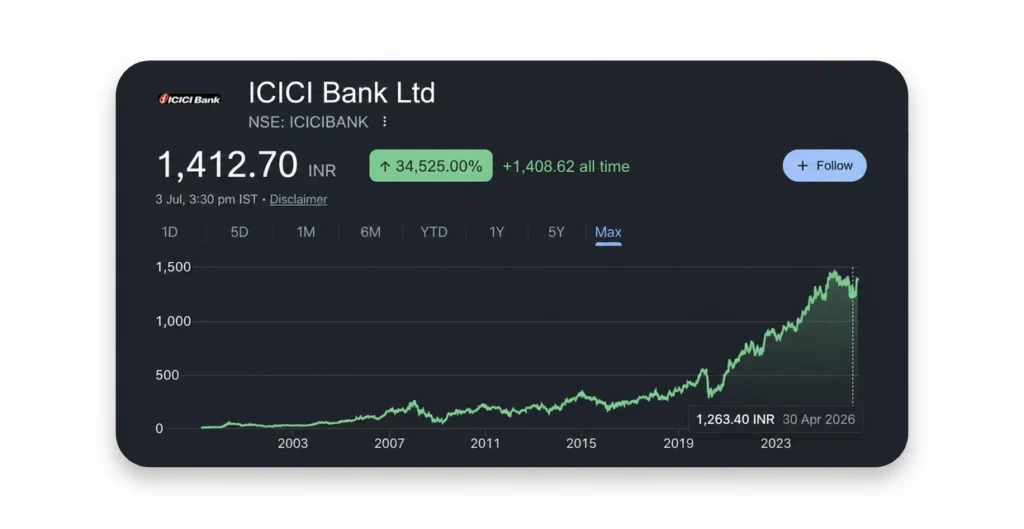
ICICI Bank has been listed in the Indian stock market for many years and has delivered strong long-term wealth creation despite periods of volatility. The stock has moved through several market cycles, including the global financial crisis, banking sector stress, the COVID-19 market fall, rising interest rates, and economic recovery phases.
The stock faced pressure during periods of higher bad loans and concerns around the banking sector. However, the bank improved its asset quality, strengthened provisions, increased retail loan growth, and maintained healthy capital levels. These improvements helped the stock regain investor confidence.
In recent years, ICICI Bank has benefited from stronger earnings, lower non-performing assets, higher digital adoption, and good growth in retail and business banking. The long-term trend has remained positive, although returns can be affected by interest rates, credit quality, foreign investor flows, and overall market conditions.
| Year | Opening Price | Closing Price | Return |
|---|---|---|---|
| 2021 | ₹536 | ₹766 | Around 43% |
| 2022 | ₹766 | ₹872 | Around 14% |
| 2023 | ₹872 | ₹1,019 | Around 17% |
| 2024 | ₹1,019 | ₹1,257 | Around 23% |
| 2025 | ₹1,257 | ₹1,370 | Around 9% |
| 2026* | ₹1,370 | Around ₹1,400 | Limited movement so far |
*2026 performance is based on the available market period and may change significantly by the end of the year.
Latest Shareholding Pattern
ICICI Bank has no promoter holding because it is widely held by domestic institutions, foreign investors, mutual funds, insurance companies, retail investors, and other public shareholders. Strong institutional participation is generally viewed as positive, but it can also create volatility when foreign investors sell Indian equities.
Growth Factors
- Strong Indian banking demand: India’s growing economy, rising income levels, urbanisation, and increasing consumption can support higher demand for loans, deposits, credit cards, and digital financial services.
- Retail loan growth: ICICI Bank has a large retail lending portfolio. Home loans, vehicle loans, personal loans, credit cards, and business loans can remain important growth drivers.
- Digital banking adoption: The bank has invested heavily in mobile banking, internet banking, payment systems, AI-based customer support, and digital loan processing.
- Healthy asset quality: ICICI Bank’s gross NPA ratio improved to around 1.40%, while net NPA remained near 0.33%. Better asset quality can reduce credit costs and support profit growth.
- Rising deposits: Deposit mobilisation remains important for banks. A growing deposit base allows ICICI Bank to lend more and maintain stable funding.
- Business banking opportunity: Small businesses, MSMEs, rural borrowers, and self-employed customers can provide strong long-term loan growth opportunities.
- Expansion in branches and ATMs: The bank added hundreds of branches during FY2026 and continues to improve its physical banking reach.
- Cross-selling opportunity: Insurance, mutual funds, wealth management, credit cards, and investment services can add non-interest income.
- Strong capital position: ICICI Bank’s capital adequacy ratio remains above regulatory requirements, giving the bank room to support business growth.
- Improving operating efficiency: Better use of technology may reduce operating costs per customer over time and improve profitability.
ICICI Bank Share Price Target 2026 To 2050
The following ICICI Bank share price targets are estimates and not guaranteed prices. These targets are based on possible earnings growth, loan growth, return on equity, valuation levels, banking sector demand, interest rate conditions, and India’s long-term economic growth.
| Year | Minimum Target | Average Target | Maximum Target |
|---|---|---|---|
| 2026 | ₹1,205 | ₹1,430 | ₹1,600 |
| 2027 | ₹1,640 | ₹1,780 | ₹1,970 |
| 2028 | ₹1,890 | ₹1,750 | ₹1,610 |
| 2029 | ₹1,570 | ₹1,739 | ₹1,830 |
| 2030 | ₹1,943 | ₹2,400 | ₹2,730 |
| 2035 | ₹3,850 | ₹3,895 | ₹3,975 |
| 2040 | ₹4,370 | ₹4,620 | ₹4,840 |
| 2050 | ₹8,805 | ₹8,721 | ₹8,745 |
These projections assume that ICICI Bank maintains healthy loan growth, stable margins, controlled bad loans, good capital management, and a strong market position. Actual results may be lower or higher depending on market conditions.
ICICI Bank Share Price Target 2026
ICICI Bank’s performance in 2026 may depend on credit growth, deposit mobilisation, interest rate changes, quarterly earnings, and foreign institutional investor activity. The bank has entered the year with strong profit growth, improving asset quality, and healthy capital levels. However, valuation movement may remain dependent on the wider banking sector and stock market sentiment.
| Period | Estimated Target Price |
|---|---|
| Second Half | ₹1,600 |
ICICI Bank Share Price Target 2030
By 2030, ICICI Bank could benefit from rising household income, higher credit penetration, more digital transactions, and expanding financial inclusion. The bank’s ability to maintain return on equity, manage bad loans, and grow deposits will be important. If earnings continue to grow at a healthy pace, ICICI Bank may trade at a higher valuation.
| Period | Estimated Target Price |
|---|---|
| First Half | ₹1,943 |
| Second Half | ₹2,730 |
ICICI Bank Share Price Target 2035
The 2035 outlook depends on whether ICICI Bank remains among the leading private banks in India. Long-term growth may be supported by banking penetration in smaller cities, increasing use of financial products, rising credit demand, and cross-selling of insurance and investment services.
The bank will also need to manage competition from private banks, public sector banks, fintech companies, and digital payment platforms.
| Period | Estimated Target Price |
|---|---|
| First Half | ₹3,850 |
| Second Half | ₹3,975 |
ICICI Bank Share Price Target 2040
By 2040, India’s banking sector could be much larger because of economic expansion, infrastructure investment, digital finance, higher consumer spending, and deeper access to formal credit. ICICI Bank may benefit if it maintains its customer trust, technology leadership, capital strength, and disciplined lending process.
However, the target assumes that the bank avoids major asset-quality problems and continues to earn healthy returns on equity.
| Period | Estimated Target Price |
|---|---|
| First Half | ₹4,370 |
| Second Half | ₹4,840 |
ICICI Bank Share Price Target 2050
The 2050 target is highly speculative because it covers a very long period. Over this time, banking technology, regulations, customer behaviour, competition, and the economy may change significantly. Still, ICICI Bank could remain a major beneficiary of India’s long-term growth if it continues to build deposits, lend responsibly, improve digital services, and maintain strong governance.
| Period | Estimated Target Price |
|---|---|
| First Half | ₹8,805 |
| Second Half | ₹8,745 |
Bull Case
- Loan growth remains above the industry average for many years.
- Asset quality improves further and credit costs stay under control.
- Deposit growth remains strong despite rising competition.
- Digital banking reduces costs and improves customer experience.
- Fee income from cards, wealth management, insurance, and payments rises steadily.
- India’s economic growth supports higher demand for credit.
- Return on equity improves due to better operating efficiency.
- Foreign and domestic institutional investors continue to support the stock.
Bear Case
- Higher interest rates reduce loan demand and increase stress on borrowers.
- Deposit competition increases funding costs for private banks.
- Bad loans rise due to economic slowdown or corporate stress.
- Margin pressure affects net interest income growth.
- Strong selling by FIIs may create stock price volatility.
- Competition from fintech firms affects customer acquisition and fee income.
- Regulatory changes may impact lending, provisioning, or capital requirements.
- Valuation may decline if earnings growth slows.
Pros and Cons
Pros
- Strong private sector banking franchise.
- Consistent profit growth in recent years.
- Healthy asset quality compared with many peers.
- Large retail and business banking customer base.
- Strong digital banking and payment ecosystem.
Cons
- Banking stocks are sensitive to interest rate changes.
- High institutional ownership can increase short-term volatility.
- Deposit growth needs constant monitoring.
- Competition is intense in private banking and fintech services.
- Long-term valuation may be affected by economic slowdowns.
Expert Opinion
ICICI Bank is considered one of the stronger private banking franchises in India because of its improved asset quality, stable profitability, diversified revenue base, and large digital presence. The stock’s valuation should be assessed using metrics such as price-to-book value, return on equity, net interest margin, credit cost, deposit growth, and loan growth.
For long-term investors, the key factors to monitor are bad loan ratios, growth in retail and business loans, CASA deposits, operating expenses, capital adequacy, and changes in interest rates. The stock may suit investors who understand banking sector cycles and can remain patient during market volatility.
Also Check:
- HFCL Share Price Target
- HCC Share Price Target
- BSE Share Price Target
- Hindustan Aeronautics Ltd Share Price Target
- GTL Infrastructure Share Price Target
- Exide Industries Share Price Target
- BHEL Share Price Target
Conclusion
ICICI Bank has built a strong position in India’s private banking sector through its retail banking reach, corporate banking services, digital platforms, improving loan quality, and diversified financial services ecosystem. The bank’s FY2026 profit, strong advances growth, improving NPA levels, and healthy capital position show a stable operating base.
Its long-term growth opportunity is linked to India’s rising credit demand, financial inclusion, digital banking adoption, and expansion of insurance and investment services. At the same time, investors should watch deposit growth, interest-rate changes, competition, market valuation, and asset quality.
Disclaimer: The share price targets mentioned in this article are estimates based on current market conditions, company fundamentals, and industry trends. They should not be considered investment advice. Investors should conduct their own research or consult a qualified financial advisor before making investment decisions.
Frequently Asked Questions
1. What is the ICICI Bank Share Price Target for 2026?
The estimated ICICI Bank share price target for 2026 is between ₹1,330 and ₹1,680. The average estimate is around ₹1,520, depending on earnings growth, banking sector performance, and market conditions.
2. What is the ICICI Bank Share Price Target for 2030?
The estimated ICICI Bank share price target for 2030 is between ₹2,350 and ₹3,100. This estimate assumes healthy loan growth, stable asset quality, improving digital banking income, and positive long-term economic conditions.
3. Is ICICI Bank a good long-term investment?
ICICI Bank has strong fundamentals, a large customer base, improving asset quality, and a diversified banking business. However, banking stocks can be volatile, so investors should study valuation, financial results, and risk factors before investing.
4. What are the major risks of investing in ICICI Bank?
Major risks include rising bad loans, slower deposit growth, higher funding costs, interest-rate changes, strong competition, regulatory changes, and foreign investor selling pressure.
5. Can ICICI Bank reach new all-time highs by 2030?
ICICI Bank can potentially reach new all-time highs by 2030 if its profit growth, loan growth, asset quality, and return on equity remain healthy. However, future prices depend on market sentiment and economic conditions.
6. Should beginners invest in ICICI Bank stock?
Beginners should first understand banking sector risks, valuation ratios, interest rate cycles, and stock market volatility. ICICI Bank may be suitable for long-term investors, but investment decisions should be based on personal financial goals and risk capacity.