
GTL Infrastructure Ltd is one of India’s telecom tower infrastructure companies. It provides shared telecom tower and energy-management services to telecom operators across multiple circles in the country. The company remains closely tracked by investors because of its low share price, large telecom infrastructure base, high trading volumes, and the potential benefit from rising mobile-data usage, 4G expansion, and 5G network requirements.
However, GTL Infrastructure is also a high-risk company because of its weak balance sheet, large historical losses, negative net worth, and debt-related pressure. Long-term share price projections for GTL Infrastructure must therefore be viewed carefully. This article explains the company’s business, financial condition, shareholding pattern, historical performance, opportunities, risks, and estimated GTL Infrastructure share price targets from 2026 to 2050.
GTL Infrastructure Company Overview
| Company Essential | Latest Value |
|---|---|
| Market Cap | ₹1,883 Cr. |
| Enterprise Value | ₹5,470 Cr. (Approx.) |
| No. Of Shares | 1,276.96 Cr. |
| P/E | 2.43 |
| P/B | -0.35 |
| Face Value | ₹10 |
| Book Value | -₹4.07 |
| Debt | ₹3,590 Cr. (Approx.) |
| Sales Growth | -0.54% (5-Year CAGR) |
| ROE | 0.00% |
| Dividend Yield | 0.00% |
What Does GTL Infrastructure Ltd Do?
GTL Infrastructure Ltd operates in the telecom infrastructure sector. The company owns and manages telecom towers that are used by mobile-network operators for placing antennas, transmission equipment, and related telecom systems.
Instead of every telecom company building separate towers, operators can share tower infrastructure. This reduces capital expenditure, improves network rollout speed, and lowers operating costs. GTL Infrastructure earns revenue mainly through tower-sharing arrangements, energy management, maintenance services, and telecom-site operations.
The company has tower presence across telecom circles in India. Its business can benefit from growing mobile internet consumption, rising data traffic, 4G network upgrades, and future 5G expansion. However, its financial recovery depends heavily on improving tower tenancy, managing debt, resolving claims, and maintaining stable collections from telecom operators.
Historic Share Price Performance
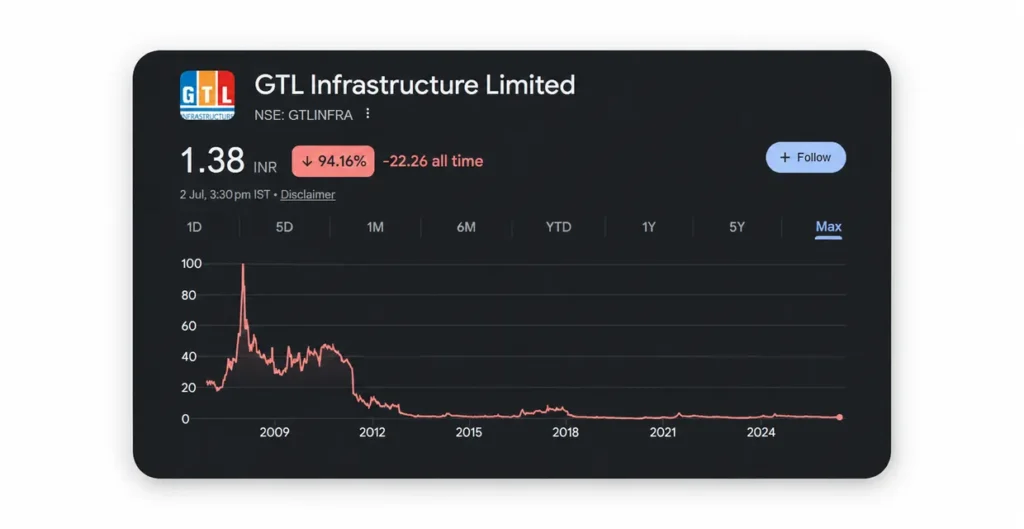
GTL Infrastructure has had a highly volatile market journey. The stock has experienced sharp rallies during periods of telecom-sector optimism, debt-resolution expectations, and speculation around tower monetisation. It has also gone through major corrections because of persistent losses, high finance cost, weak balance-sheet quality, and uncertainty around its debt obligations.
The stock became popular among low-price and speculative traders, especially during the sharp rally seen around 2020 and 2021. However, the rally was not followed by a stable long-term financial turnaround. Over recent years, the share price has mostly remained in a low-price range, reacting strongly to quarterly results, telecom-sector news, debt-related developments, and market sentiment.
| Year | Opening Price | Closing Price | Return |
|---|---|---|---|
| 2021 | Around ₹0.70 | Around ₹2.10 | Strong positive return |
| 2022 | Around ₹2.00 | Around ₹0.90 | Sharp negative return |
| 2023 | Around ₹0.90 | Around ₹1.10 | Moderate positive return |
| 2024 | Around ₹1.10 | Around ₹1.45 | Positive but volatile |
| 2025 | Around ₹1.45 | Around ₹1.16 | Negative return |
Historical prices show that GTL Infrastructure has remained a high-volatility stock. Past rallies should not be treated as assurance of future returns.
Latest Shareholding Pattern
The company has very low promoter holding compared with many established Indian infrastructure companies. Public shareholders hold the largest portion of the equity. This can increase price volatility because retail participation and short-term sentiment can have a major impact on trading activity.
Growth Factors
- Growth in mobile-data demand: India continues to consume more mobile data every year. This supports the need for stronger telecom networks and additional tower infrastructure.
- 4G and 5G network expansion: Telecom operators need better coverage, higher capacity, and denser networks. Tower-sharing companies may benefit if more sites are added or existing towers gain more tenants.
- Tower-sharing business model: Shared infrastructure can reduce costs for telecom operators. If GTL Infrastructure improves tenancy levels, revenue per tower may improve.
- Energy-management opportunity: Telecom towers require uninterrupted power and backup solutions. Efficient energy management can improve margins and strengthen service revenue.
- Large operating footprint: The company has telecom towers across multiple circles. Existing infrastructure can provide value if tower utilisation increases.
- Potential debt resolution: A meaningful reduction or restructuring of debt could improve investor confidence and lower finance-cost pressure.
- Recovery of contractual claims: The company has referred to claims and telecom-sector developments in its disclosures. Any favourable resolution may improve financial flexibility.
- Telecom-sector consolidation: A more stable telecom industry can improve payment discipline and tower-site demand.
- Improved recurring profitability: The key long-term opportunity is not only revenue growth but also sustainable operating profit after interest costs.
GTL Infrastructure Share Price Target 2026 To 2050
The following estimates are based on a conservative view of GTL Infrastructure’s current business model, telecom infrastructure demand, debt burden, financial risk, and possible operating improvement. These are not guaranteed prices. The estimates assume gradual business stabilisation and do not assume a sudden financial turnaround.
| Year | Minimum Target | Average Target | Maximum Target |
|---|---|---|---|
| 2026 | ₹1.15 | ₹1.11 | ₹1.54 |
| 2027 | ₹1.32 | ₹1.25 | ₹1.43 |
| 2028 | ₹1.64 | ₹1.36 | ₹1.05 |
| 2029 | ₹1.12 | ₹1.32 | ₹1.41 |
| 2030 | ₹1.53 | ₹1.67 | ₹1.74 |
| 2035 | ₹1.48 | ₹1.35 | ₹1.60 |
| 2040 | ₹1.58 | ₹1.65 | ₹1.76 |
| 2050 | ₹1.83 | ₹1.72 | ₹1.36 |
These targets remain conservative because GTL Infrastructure has weak net worth, high historical losses, debt-related risks, and uncertain earnings quality. A major debt settlement, consistent cash-profit generation, or significant increase in tower tenancy could improve the long-term outlook. On the other hand, weak operational progress can keep the stock under pressure.
GTL Infrastructure Share Price Target 2026
The 2026 outlook depends on the company’s ability to maintain revenue growth, improve collections, control operating costs, and reduce finance-cost pressure. FY2026 reported a profit turnaround, but investors should check how much of the profit comes from recurring operations rather than exceptional items. The stock may remain volatile because it is a low-priced telecom infrastructure share.
| Period | Estimated Target Price |
|---|---|
| Second Half | ₹1.54 |
GTL Infrastructure Share Price Target 2030
By 2030, telecom operators may require wider 5G coverage, more network capacity, and stronger data infrastructure. GTL Infrastructure can benefit if it improves tower tenancy and reduces financial stress. However, the company must show sustainable operating profit and better balance-sheet quality before a large valuation re-rating becomes possible.
| Period | Estimated Target Price |
|---|---|
| First Half | ₹1.53 |
| Second Half | ₹1.74 |
GTL Infrastructure Share Price Target 2035
The 2035 target assumes gradual growth in telecom infrastructure demand and a better operating environment for tower-sharing companies. It also assumes that GTL Infrastructure manages its debt burden more effectively and improves recurring cash flow. Without debt resolution and stronger earnings visibility, the stock may not achieve the higher end of the projected range.
| Period | Estimated Target Price |
|---|---|
| First Half | ₹1.48 |
| Second Half | ₹1.60 |
GTL Infrastructure Share Price Target 2040
The 2040 estimate is based on the assumption that mobile connectivity, cloud services, machine-to-machine communication, and digital infrastructure continue expanding in India. GTL Infrastructure could benefit from long-term telecom demand, but execution will remain the deciding factor. A company with negative net worth must demonstrate financial discipline before receiving a stronger market valuation.
| Period | Estimated Target Price |
|---|---|
| First Half | ₹1.58 |
| Second Half | ₹1.76 |
GTL Infrastructure Share Price Target 2050
The 2050 projection should be treated as highly uncertain because it depends on several decades of telecom technology change, company strategy, debt management, competition, regulation, and capital allocation. The target assumes that GTL Infrastructure survives its financial challenges, strengthens its operating model, and participates in India’s long-term digital infrastructure growth.
| Period | Estimated Target Price |
|---|---|
| First Half | ₹1.83 |
| Second Half | ₹1.36 |
Bull Case
- Tower tenancy improves as telecom operators increase network coverage.
- 5G rollout creates demand for additional telecom sites.
- Debt restructuring reduces finance cost substantially.
- Recovery of pending contractual claims improves cash flow.
- Energy-management services generate higher operating margins.
- Telecom-sector payment discipline improves.
- The company reports stable operating profits for multiple years.
- Low share price attracts strong speculative and retail interest during positive news flow.
Bear Case
- Debt remains high and finance costs continue to hurt profitability.
- Reported profits remain dependent on exceptional income.
- Negative net worth limits financial flexibility.
- Telecom operators reduce spending or consolidate tower requirements.
- Tower tenancy does not improve meaningfully.
- Dilution through new equity or conversion instruments affects existing shareholders.
- Weak cash flow limits maintenance and network expansion.
- High volatility leads to sharp price corrections during negative market sentiment.
Pros and Cons
Pros
- Presence across major telecom circles in India.
- Telecom tower business has long-term relevance.
- Potential benefit from data growth and 5G expansion.
- Shared infrastructure model can create recurring revenue.
- Large public interest and strong trading liquidity.
Cons
- Negative book value and weak balance-sheet quality.
- High historical debt and finance-cost burden.
- Low promoter holding.
- Earnings quality needs close monitoring.
- Share price can be highly speculative and volatile.
Expert Opinion
GTL Infrastructure should be viewed as a high-risk telecom infrastructure stock rather than a stable long-term compounder at the current stage. The company has operating assets and possible long-term benefits from India’s telecom growth, but the balance sheet remains the main concern. Investors should monitor recurring revenue, tower tenancy, EBITDA, finance cost, debt settlement progress, operating cash flow, and dilution risk.
The reported FY2026 profit is important, but it should be analysed carefully to understand whether it is sustainable. This stock may suit only investors who can handle high volatility and are willing to track financial developments closely. It is not suitable for investors seeking predictable earnings, regular dividends, or low-risk wealth creation.
Also Check:
- Exide Industries Share Price Target
- CG POWER Share Price Target
- BHEL Share Price Target
- Adani Power Share Price Target
- Adani Green Share Price Target
- Amara Raja Energy & Mobility Limited Share Price Target
- L&T Finance Share Price Target
- Bajaj Housing Finance Share Price Target
- IOC Share Price Target
Conclusion
GTL Infrastructure Ltd has a business model linked to India’s growing telecom and digital economy. The company can benefit from rising mobile-data usage, 5G deployment, tower sharing, and energy-management services. Its extensive tower presence is an important business asset.
However, the company’s financial risks cannot be ignored. Negative net worth, debt-related pressure, low promoter holding, historical losses, and uncertain earnings quality make the stock highly speculative. GTL Infrastructure’s long-term potential depends on sustainable operating improvement, lower finance costs, better tower utilisation, and a stronger balance sheet.
Disclaimer: The share price targets mentioned in this article are estimates based on current market conditions, company fundamentals, and industry trends. They should not be considered investment advice. Investors should conduct their own research or consult a qualified financial advisor before making investment decisions.