
Trident Limited is one of India’s leading integrated textile and paper manufacturing companies. The company is widely recognized for its strong presence in home textiles, yarn, towels, bedsheets, and paper products. With large-scale manufacturing facilities and a significant export footprint, Trident serves customers across India, North America, Europe, and other international markets. The company has established itself as a major player in the home textile segment through operational efficiency, scale advantages, and a diversified product portfolio.
Investors closely track Trident because of its exposure to the growing global textile industry, increasing demand for home furnishing products, and India’s emergence as a preferred manufacturing destination. The company’s ongoing focus on modernization, capacity utilization, sustainability initiatives, and debt management could support future earnings growth. While textile businesses remain cyclical, long-term demand from domestic and export markets continues to provide growth opportunities. This article analyzes Trident’s business model, financial performance, risks, growth prospects, and estimated share price targets from 2026 to 2050.
Company Overview
| Particular | Details |
|---|---|
| Company Name | Trident Limited |
| NSE Symbol | TRIDENT |
| BSE Code | 521064 |
| Industry | Textiles & Paper |
| Market Cap | ₹12,000+ Crore (approx.) |
| Founded | 1990 |
| Headquarters | Ludhiana |
| Website | Trident Group |
What Does Trident Do?
Trident Limited operates across multiple business segments:
- Home Textiles (Towels, Bedsheets, Bath Linen)
- Yarn Manufacturing
- Paper & Stationery Products
- Chemicals and Utilities
The company’s primary revenue comes from textile exports and domestic sales. Its towels and bed linen products are supplied to major retailers worldwide. The yarn division contributes significantly to revenue, while the paper segment adds diversification. Trident’s large-scale integrated manufacturing facilities provide cost advantages and operational efficiency. The company benefits from India’s competitive textile ecosystem and growing global demand for home furnishing products.
Trident Share Price Market Overview
| Metric | Value |
|---|---|
| Current Share Price | ₹24.9 |
| Market Capitalization | ₹12,500–12,700 Crore |
| P/E Ratio (TTM) | 33.3–33.7 |
| Book Value | ₹9.36 |
| ROE | ~8.0% |
| Dividend Yield | ~2.0% |
| 52-Week High | ₹33.66–33.70 |
| 52-Week Low | ₹21.98–22.00 |
| Face Value | ₹1 |
| Industry | Textiles |
| P/B Ratio | 2.63 |
| Debt-to-Equity | ~0.38 |
| EPS (TTM) | ₹0.74 |
Revenue & Profit Performance
| Financial Year | Revenue (₹ Cr) | Net Profit (₹ Cr) | EPS (₹) |
|---|---|---|---|
| FY2022 | 6,998 | 804 | 1.58 |
| FY2023 | 6,324 | 285 | 0.56 |
| FY2024 | 6,809 | 327 | 0.64 |
| FY2025 | 7,104 | 415 | 0.81 |
| TTM (Latest) | 7,190+ | 380+ | 0.74 |
*Approximate figures based on reported results.
Debt Position
| Metric | Value |
|---|---|
| Total Debt | ₹1,650–1,750 Crore |
| Debt-to-Equity Ratio | ~0.38 |
| Interest Coverage Ratio | ~4.5–5.0× |
| Total Borrowings Trend | Stable to Moderately Declining |
| Debt Profile | Manageable |
| Financial Risk | Moderate |
Historic Performance
Key Returns
- 1-Year Return: Negative due to textile sector weakness.
- 3-Year Return: Moderate positive return.
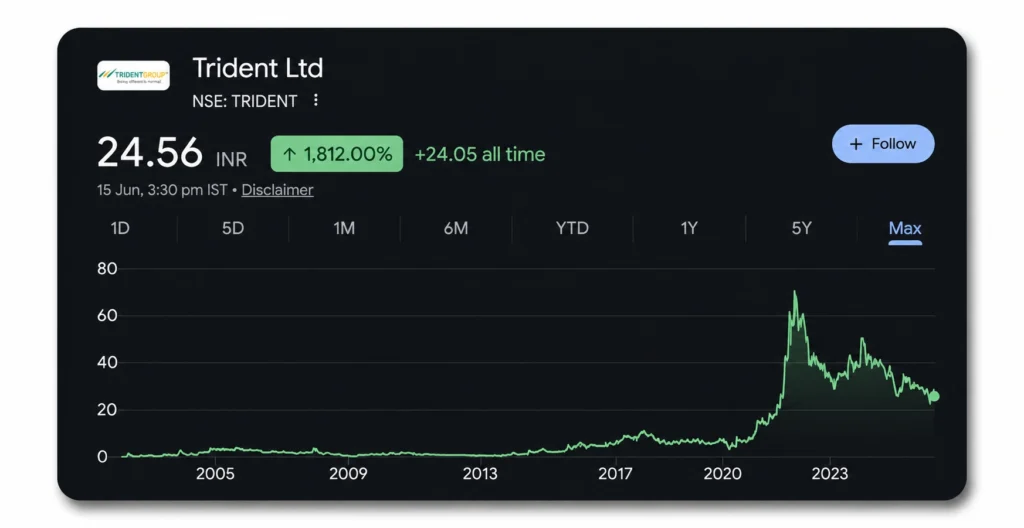
- 5-Year Return: Strong wealth creation despite volatility.
- CAGR Performance: Mid-to-high single-digit range.
- Major Events:
- Post-pandemic textile demand surge.
- Cotton price inflation is affecting margins.
- Export demand fluctuations.
- Capacity expansion and debt reduction efforts.
Shareholding Pattern (Latest Available)
| Shareholder Category | Holding |
|---|---|
| Promoters | 73.68% |
| FIIs | 3.07% |
| DIIs | 0.22% |
| Public | 23.03% |
| Others | 0.01% |
Growth Factors
Industry Growth
India’s textile industry is expected to benefit from export growth, China+1 diversification, and government manufacturing incentives.
Expansion Plans
Trident continues investing in efficiency improvements and value-added products.
Capacity Additions
Modernization and productivity enhancements could improve margins.
New Products
Premium home textiles and branded offerings may strengthen profitability.
Government Policies
PLI schemes, export incentives, and infrastructure development support the sector.
Future Demand Drivers
- Rising global home textile demand
- Growth in e-commerce
- Expansion of organized retail
- Increasing export opportunities
Risks and Challenges
Competition
Competition from domestic and international textile manufacturers.
Regulatory Risks
Export regulations, environmental norms, and trade policies.
Debt Concerns
Although debt levels are manageable, rising interest rates can impact profitability.
Economic Slowdown
Global recessions can reduce textile demand.
Sector Risks
Cotton price volatility and currency fluctuations remain key concerns.
Trident Share Price Target 2026–2050
Estimated Share Price Target Summary
| Year | Minimum Target | Average Target | Maximum Target |
|---|---|---|---|
| 2026 | ₹21 | ₹29.06 | ₹39.08 |
| 2030 | ₹39.89 | ₹61.58 | ₹84.78 |
| 2035 | ₹69.28 | ₹103.89 | ₹148.69 |
| 2040 | ₹109.41 | ₹179.58 | ₹248,49 |
| 2050 | ₹219 | ₹399.99 | ₹648.09 |
Note: These are hypothetical projections based on growth assumptions and should not be considered financial advice.
Trident Share Price Target 2026
If global textile demand stabilizes and Trident improves margins through operational efficiency, the company could experience gradual earnings growth. Export recovery, stable cotton prices, and continued debt reduction may support valuation expansion. However, near-term volatility in raw material costs and global demand could limit upside. Assuming moderate revenue growth and stable profitability, the stock may trade within a broad range during 2026.
| Month | Estimated Target Price |
|---|---|
| January | ₹25 |
| February | ₹26 |
| March | ₹26.87 |
| April | ₹27 |
| May | ₹27.98 |
| June | ₹28.78 |
| July | ₹30 |
| August | ₹30.36 |
| September | ₹31 |
| October | ₹31.89 |
| November | ₹33 |
| December | ₹34.79 |
Trident Share Price Target 2030
By 2030, Trident could benefit from expanding global textile demand, increased exports, and a stronger branded product portfolio. Continued modernization and efficiency improvements may drive earnings growth. If India strengthens its position as a global textile hub, Trident could capture additional market share.
| Month | Estimated Target Price |
|---|---|
| January | ₹52 |
| February | ₹54.78 |
| March | ₹56.49 |
| April | ₹57.98 |
| May | ₹58.79 |
| June | ₹59.38 |
| July | ₹61.57 |
| August | ₹63.01 |
| September | ₹64.99 |
| October | ₹66.19 |
| November | ₹68.88 |
| December | ₹70.31 |
Trident Share Price Target 2035
A long-term growth scenario assumes sustained revenue growth, higher exports, better margins, and continued industry expansion. Trident’s scale advantages could strengthen profitability and cash flows.
| Month | Estimated Target Price |
|---|---|
| January | ₹94.99 |
| February | ₹96.75 |
| March | ₹98.58 |
| April | ₹100.02 |
| May | ₹103.48 |
| June | ₹104.79 |
| July | ₹106.02 |
| August | ₹109.35 |
| September | ₹113.68 |
| October | ₹118.37 |
| November | ₹123.52 |
| December | ₹128.98 |
Trident Share Price Target 2040
If Trident successfully transforms into a larger global home textile brand while maintaining cost leadership, valuation multiples could improve significantly.
| Month | Estimated Target Price |
|---|---|
| January | ₹164.05 |
| February | ₹167.68 |
| March | ₹169.09 |
| April | ₹172.89 |
| May | ₹175.89 |
| June | ₹179.19 |
| July | ₹184.79 |
| August | ₹189.69 |
| September | ₹194.37 |
| October | ₹199.09 |
| November | ₹204.59 |
| December | ₹208.98 |
Trident Share Price Target 2050
Long-term projections assume decades of economic growth, expansion in global textile consumption, and successful execution of strategic initiatives. Such forecasts carry substantial uncertainty.
| Month | Estimated Target Price |
|---|---|
| January | ₹359 |
| February | ₹364.84 |
| March | ₹369.29 |
| April | ₹374.57 |
| May | ₹379.79 |
| June | ₹398.69 |
| July | ₹418.41 |
| August | ₹449.89 |
| September | ₹499.09 |
| October | ₹548.97 |
| November | ₹599.99 |
| December | ₹648.09 |
Bull Case
- Strong promoter holding above 73%.
- Large integrated textile manufacturing capacity.
- Export growth opportunities.
- Improving operational efficiency.
- Attractive dividend yield.
- India’s long-term textile growth story.
Bear Case
- Cyclical textile industry.
- Dependence on cotton prices.
- Export demand uncertainty.
- Margin pressure from competition.
- Global economic slowdown risk.
Pros and Cons
Pros
- Strong market position in home textiles.
- High promoter ownership.
- Diversified business segments.
Cons
- Earnings volatility.
- Commodity price exposure.
- Moderate return ratios.
Expert Opinion
Trident remains a well-known textile company with strong manufacturing capabilities and significant promoter ownership. Investors looking for exposure to India’s textile sector may find the company attractive, particularly if export demand improves and margins recover. However, valuation should be considered alongside cyclical industry risks and earnings volatility. Long-term investors should focus on revenue growth, debt levels, margin trends, and return ratios before making investment decisions.
Future Outlook
The long-term outlook for Trident depends on India’s competitiveness in global textile exports, consumer demand for home furnishing products, and management’s ability to improve profitability. Expansion into premium products, operational efficiency initiatives, and export diversification could create growth opportunities over the coming decade.
Also Check: Infosys Share Price Target
Conclusion
Trident Limited is a recognized player in India’s textile and paper industry with a strong manufacturing base and growing export presence. The company offers long-term growth potential through industry expansion, operational improvements, and favorable demographic trends. However, investors should remain aware of risks such as raw material volatility, economic slowdowns, and competitive pressures.
Disclaimer: Share price targets presented in this article are estimates based on assumptions and should not be treated as investment advice. Investors should conduct their own research and consult a qualified financial advisor before investing.
Frequently Asked Questions (FAQs)
What is the Trident Share Price Target for 2026?
The estimated average target for 2026 is around ₹30, with a potential range of ₹22–₹40.
What is the Trident Share Price Target for 2030?
The estimated average target for 2030 is around ₹60, with upside potential toward ₹85.
Is Trident a good long-term investment?
It may offer long-term potential if the textile industry grows and the company improves profitability.
What are the risks of investing in Trident?
Major risks include cotton price volatility, export demand weakness, competition, and economic slowdowns.
Can Trident reach new all-time highs by 2030?
It is possible if earnings growth accelerates and industry conditions remain favorable.
Should beginners invest in Trident stock?
Beginners should understand the cyclical nature of textile businesses and diversify their portfolios before investing.