
Vodafone Idea Limited (Vi) is one of India’s leading telecom service providers, offering mobile voice, data, broadband, and enterprise connectivity solutions. Formed through the merger of Vodafone India and Idea Cellular in 2018, the company serves millions of subscribers across the country. Despite facing intense competition from larger rivals such as Reliance Jio and Bharti Airtel, Vodafone Idea remains an important player in India’s telecommunications industry.
Investors closely monitor Vodafone Idea because it represents a potential turnaround opportunity. The company has been working to strengthen its network infrastructure, expand 4G coverage, roll out 5G services, and improve customer retention. Government support through equity conversion of dues and ongoing fundraising efforts have improved the company’s survival prospects. As India’s digital economy continues to expand and data consumption rises, Vodafone Idea could benefit from increasing demand for telecom services. However, significant debt obligations and competitive pressures remain key challenges. For investors with a higher risk appetite, Vodafone Idea offers a speculative opportunity that could generate substantial returns if the company successfully executes its long-term recovery strategy.
Company Overview
| Particular | Details |
|---|---|
| Company Name | Vodafone Idea Limited |
| NSE Symbol | IDEA |
| BSE Code | 532822 |
| Industry | Telecommunications |
| Market Cap | ₹55,000+ Crore |
| Founded | 1995 (Idea Cellular), merged in 2018 |
| Headquarters | Mumbai, Maharashtra, India |
| Website | www.myvi.in |
What Does Vodafone Idea Do?
Vodafone Idea provides telecommunications and digital connectivity services across India.
Key Business Segments
Mobile Services
- Prepaid mobile services
- Postpaid mobile services
- Voice and data services
Broadband Services
- Wireless broadband solutions
- Enterprise connectivity
Digital Services
- Entertainment subscriptions
- Mobile applications
- Cloud and digital solutions
Enterprise Business
- IoT solutions
- Managed services
- Corporate communication solutions
Revenue Sources
- Mobile subscriber revenue
- Data usage charges
- Enterprise solutions
- Value-added services
- Roaming services
Competitive Position
Vodafone Idea competes primarily with Reliance Jio and Bharti Airtel. While its subscriber base remains large, the company faces significant challenges in maintaining market share and improving profitability.
Vodafone Idea Share Price Market Overview
| Metric | Value |
|---|---|
| Current Share Price | ₹8.5–9.2 |
| Market Capitalization | ₹92,000–100,000 Crore |
| P/E Ratio | Negative (Loss-Making) |
| Book Value Per Share | Negative |
| ROE | Negative |
| Dividend Yield | 0% |
| 52-Week High | ₹19.2 |
| 52-Week Low | ₹6.5 |
| Face Value | ₹10 |
| Industry | Telecommunications |
| Price-to-Book (P/B) Ratio | Not Meaningful (Negative Net Worth) |
| Debt | ₹2.0–2.3 Lakh Crore |
| EPS (TTM) | Negative |
Financial Performance
| Financial Year | Revenue (₹ Cr) | Net Profit (₹ Cr) | EPS (₹) |
|---|---|---|---|
| FY2022 | 38,515 | -28,245 | -8.52 |
| FY2023 | 42,177 | -29,301 | -6.87 |
| FY2024 | 42,652 | -31,238 | -5.04 |
| FY2025 | 43,571 | -27,383 | -3.95 |
| TTM (Latest) | 45,000–47,000 | -18,000 to -22,000 | -2.2 to -2.8 |
Financial Analysis
Vodafone Idea has managed to stabilize revenue through tariff hikes and improved average revenue per user (ARPU). However, the company continues to report substantial losses due to high interest costs, spectrum liabilities, and competitive pressures. Achieving sustainable profitability remains one of the biggest challenges for the company.
Debt Position
| Metric | Value |
|---|---|
| Total Debt & Liabilities | ₹2.0–2.2 Lakh Crore |
| Bank & Financial Institution Debt | ₹2,000–4,000 Crore |
| Spectrum Liabilities | ₹1.1–1.2 Lakh Crore |
| AGR Liabilities | ₹65,000–75,000 Crore |
| Debt-to-Equity Ratio | Not Meaningful (Negative Net Worth) |
| Interest Coverage Ratio | Negative |
| Net Worth | Negative |
| Financial Risk | Very High |
Debt Analysis
Vodafone Idea carries one of the highest debt burdens in the Indian telecom sector. While government support has provided relief, reducing debt and improving cash flow remain critical for long-term survival.
Historic Performance
1-Year Return
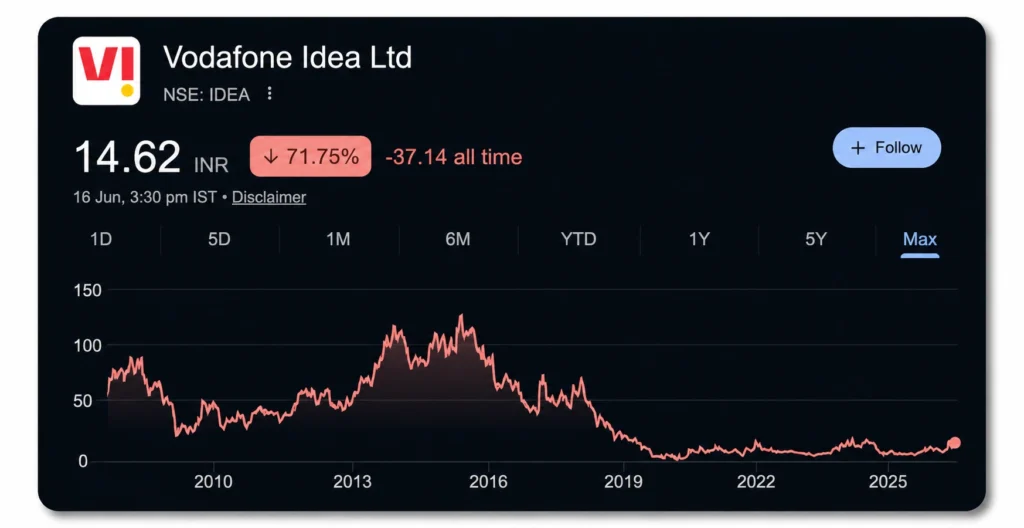
The stock has remained volatile due to fundraising announcements, government support measures, and subscriber trends.
3-Year Return
Despite periodic rallies, long-term performance remains challenged by financial losses and debt concerns.
5-Year Return
The stock has underperformed broader market indices due to prolonged operational difficulties.
Major Price-Moving Events
- Government equity conversion of dues
- Fundraising announcements
- Tariff hikes
- 5G rollout plans
- Subscriber additions/losses
- Regulatory developments
Historical Share Price Performance
| Year | Opening Price (₹) | Closing Price (₹) | Return |
|---|---|---|---|
| 2021 | 10.8 | 13.4 | 24.1% |
| 2022 | 13.4 | 7.2 | -46.3% |
| 2023 | 7.2 | 14.3 | 98.6% |
| 2024 | 14.3 | 8.1 | -43.4% |
| 2025 | 8.1 | 7.5 | -7.4% |
Shareholding Pattern
| Shareholder Category | Holding |
|---|---|
| Promoters | 25.6% |
| Government of India | 49.0% |
| FIIs | 8.5% |
| DIIs | 4.2% |
| Public & Others | 12.7% |
Growth Factors
Industry Growth
India remains one of the world’s fastest-growing telecom and data consumption markets.
Expansion Plans
- Nationwide 4G expansion
- 5G rollout initiatives
- Network modernization
New Products
- Enterprise connectivity
- Digital services
- Cloud-based solutions
Government Policies
- Telecom reforms
- AGR relief measures
- Spectrum payment support
Future Demand Drivers
- Increasing smartphone penetration
- Rising data consumption
- Digital economy expansion
- Enterprise digitization
Risks and Challenges
Competition
Reliance Jio and Bharti Airtel continue to dominate market growth.
Regulatory Risks
Changes in spectrum costs and telecom regulations could impact profitability.
Debt Concerns
Large debt obligations remain a major risk.
Economic Slowdown
Weak consumer spending could affect subscriber growth.
Sector Risks
Technology upgrades require significant capital expenditure.
Vodafone Idea Share Price Target 2026–2050
| Year | Minimum Target | Average Target | Maximum Target |
|---|---|---|---|
| 2026 | ₹8 | ₹12 | ₹18 |
| 2030 | ₹48 | ₹64 | ₹92 |
| 2035 | ₹120 | ₹148 | ₹159 |
| 2040 | ₹197 | ₹236 | ₹261 |
| 2050 | ₹471 | ₹504 | ₹542 |
Also Check:
Vodafone Idea Share Price Target 2026
Vodafone Idea’s 2026 outlook largely depends on its ability to strengthen its financial position, improve subscriber retention, and expand its 4G and 5G network coverage. Recent fundraising initiatives and government support have provided the company with much-needed capital to invest in network infrastructure. If Vodafone Idea successfully improves service quality and increases its Average Revenue Per User (ARPU), investor confidence may improve significantly. The telecom sector is expected to benefit from rising data consumption, digital services growth, and periodic tariff hikes. However, intense competition from Reliance Jio and Bharti Airtel remains a major challenge. Assuming stable operations and moderate subscriber growth, Vodafone Idea could trade within a range of ₹8 to ₹18 during 2026.
Monthly Target 2026
| Month | Estimated Target Price (₹) |
|---|---|
| January | ₹8.0 |
| February | ₹8.3 |
| March | ₹8.8 |
| April | ₹7.93 |
| May | ₹9.50 |
| June | ₹8.72 |
| July | ₹9.56 |
| August | ₹11.38 |
| September | ₹13.09 |
| October | ₹15.51 |
| November | ₹16.44 |
| December | ₹18.01 |
Vodafone Idea Share Price Target 2030
By 2030, Vodafone Idea’s success will depend on whether it can establish itself as a sustainable third telecom operator in India. Successful 5G deployment, higher ARPU, and reduced financial stress could support long-term growth. The company may also benefit from increasing demand for enterprise connectivity, IoT services, and digital applications. If management successfully executes turnaround strategies and telecom tariffs continue to rise, Vodafone Idea’s earnings potential could improve considerably. Nevertheless, competition and debt obligations will remain important factors to monitor. Under favorable circumstances, the stock could reach between ₹15 and ₹40 by 2030.
Monthly Target 2030
| Month | Estimated Target Price (₹) |
|---|---|
| January | ₹48.10 |
| February | ₹53.99 |
| March | ₹56.14 |
| April | ₹58.90 |
| May | ₹61.32 |
| June | ₹64.28 |
| July | ₹74.60 |
| August | ₹79.83 |
| September | ₹82.40 |
| October | ₹76.30 |
| November | ₹87.02 |
| December | ₹92.50 |
Vodafone Idea Share Price Target 2035
The 2035 projection assumes Vodafone Idea successfully survives the current competitive environment and establishes a profitable operating model. Continued expansion of digital services, enterprise solutions, and advanced telecom technologies could create new revenue opportunities. Industry consolidation may also benefit the company by reducing competitive pressures. If subscriber growth stabilizes and profitability improves, Vodafone Idea could experience significant valuation expansion. Long-term investors should recognize that this scenario requires strong execution and financial discipline. Under optimistic conditions, the stock may trade between ₹30 and ₹90 by 2035.
Monthly Target 2035
| Month | Estimated Target Price (₹) |
|---|---|
| January | ₹120 |
| February | ₹137.44 |
| March | ₹126.40 |
| April | ₹154.08 |
| May | ₹132.83 |
| June | ₹124.15 |
| July | ₹109.80 |
| August | ₹127.43 |
| September | ₹139.03 |
| October | ₹145.60 |
| November | ₹154.22 |
| December | ₹159 |
Vodafone Idea Share Price Target 2040
By 2040, the telecommunications industry is expected to be driven by advanced 5G and potentially 6G technologies, artificial intelligence, cloud computing, and connected devices. Vodafone Idea’s long-term value creation will depend on its ability to adapt to evolving technologies and maintain a competitive network. If the company achieves financial stability and captures growth opportunities in digital infrastructure, substantial shareholder returns may be possible. Under favorable market conditions, Vodafone Idea could trade within a range of ₹60 to ₹150 during 2040.
Monthly Target 2040
| Month | Estimated Target Price (₹) |
|---|---|
| January | ₹197 |
| February | ₹209.13 |
| March | ₹203.30 |
| April | ₹183.55 |
| May | ₹219.03 |
| June | ₹201.60 |
| July | ₹208.62 |
| August | ₹215.40 |
| September | ₹246.31 |
| October | ₹217.06 |
| November | ₹254.33 |
| December | ₹261.70 |
Vodafone Idea Share Price Target 2050
The 2050 target represents a highly optimistic long-term scenario where Vodafone Idea successfully transforms into a modern digital communications company. Revenue streams could include advanced telecom services, enterprise cloud solutions, artificial intelligence applications, IoT connectivity, and digital infrastructure offerings. India’s growing digital economy could provide a supportive environment for long-term growth. However, investors should understand that projections extending multiple decades involve substantial uncertainty. Based on favorable assumptions, the stock could trade between ₹120 and ₹400 by 2050.
Monthly Target 2050
| Month | Estimated Target Price (₹) |
|---|---|
| January | ₹471 |
| February | ₹483.24 |
| March | ₹462.08 |
| April | ₹474.50 |
| May | ₹491.30 |
| June | ₹503.81 |
| July | ₹519.60 |
| August | ₹528.52 |
| September | ₹517.07 |
| October | ₹531.93 |
| November | ₹529.05 |
| December | ₹542 |
Bull Case
Several factors could help Vodafone Idea outperform expectations:
- Successful fundraising and debt reduction.
- Faster-than-expected 5G rollout.
- Significant increase in ARPU through tariff hikes.
- Improved subscriber retention and customer acquisition.
- Government support and telecom sector reforms.
- Strong growth in enterprise and digital services.
- Industry consolidation reducing competitive pressure.
- Improvement in profitability and cash flow generation.
Bear Case
The following risks could negatively impact the stock:
- Continued subscriber losses.
- Inability to compete effectively with Jio and Airtel.
- Rising debt and interest obligations.
- Delays in network expansion.
- Regulatory challenges and spectrum costs.
- Weak profitability despite revenue growth.
- Additional equity dilution through fundraising.
- Technological disruptions requiring large investments.
Pros and Cons
Pros
1. Large Subscriber Base
Vodafone Idea remains one of India’s largest telecom operators.
2. Government Support
Government equity participation improves survival prospects.
3. Telecom Industry Growth
Growing data consumption supports long-term demand.
Cons
1. High Debt Burden
The company faces substantial financial obligations.
2. Persistent Losses
Profitability remains a major challenge.
3. Strong Competition
Jio and Airtel continue to dominate the market.
Expert Opinion
Analysts generally view Vodafone Idea as a high-risk turnaround story. While the company has benefited from government support and fundraising efforts, significant challenges remain. Investors should focus on subscriber trends, ARPU growth, network expansion, and debt management. The stock may offer substantial upside if the turnaround succeeds, but it also carries considerable downside risk if operational improvements fail to materialize. Conservative investors may prefer established telecom companies, while aggressive investors may consider Vodafone Idea as a speculative opportunity.
Future Outlook
The future of Vodafone Idea will depend on successful execution of its network investment plans and ability to remain competitive in India’s telecom sector. Rising data usage, digital transformation, enterprise connectivity demand, and future technology upgrades could create growth opportunities. If management successfully improves operational efficiency and strengthens the balance sheet, Vodafone Idea may participate meaningfully in India’s digital growth story.
Conclusion
Vodafone Idea remains one of the most closely watched turnaround stories in the Indian stock market. The company operates in a growing industry with strong long-term demand drivers, but it also faces significant financial and competitive challenges. Investors considering Vodafone Idea should carefully assess both the potential rewards and risks. While successful execution could lead to substantial gains, uncertainty remains high compared to more established telecom operators.
Disclaimer: The share price targets discussed in this article are based on assumptions, historical trends, and industry expectations. Actual stock performance may differ significantly due to market conditions, company performance, regulatory changes, and economic factors. Investors should conduct their own research and consult financial advisors before making investment decisions.
Frequently Asked Questions (FAQs)
What is the Vodafone Idea Share Price Target for 2026?
The estimated Vodafone Idea share price target for 2026 ranges between ₹8 and ₹18.
What is the Vodafone Idea Share Price Target for 2030?
The estimated share price target for 2030 ranges between ₹15 and ₹40.
Is Vodafone Idea a Good Long-Term Investment?
Vodafone Idea offers potential upside as a turnaround story, but it carries significant risks related to debt, competition, and profitability.
What Are the Risks of Investing in Vodafone Idea?
Key risks include high debt levels, subscriber losses, intense competition, regulatory challenges, and continued losses.
Can Vodafone Idea Reach New All-Time Highs by 2030?
Reaching new all-time highs would require substantial operational improvements, strong subscriber growth, reduced debt, and successful execution of its turnaround strategy.
Should Beginners Invest in Vodafone Idea Stock?
Beginners should exercise caution because Vodafone Idea is considered a high-risk investment. Diversification and proper risk management are important before investing in speculative stocks.