

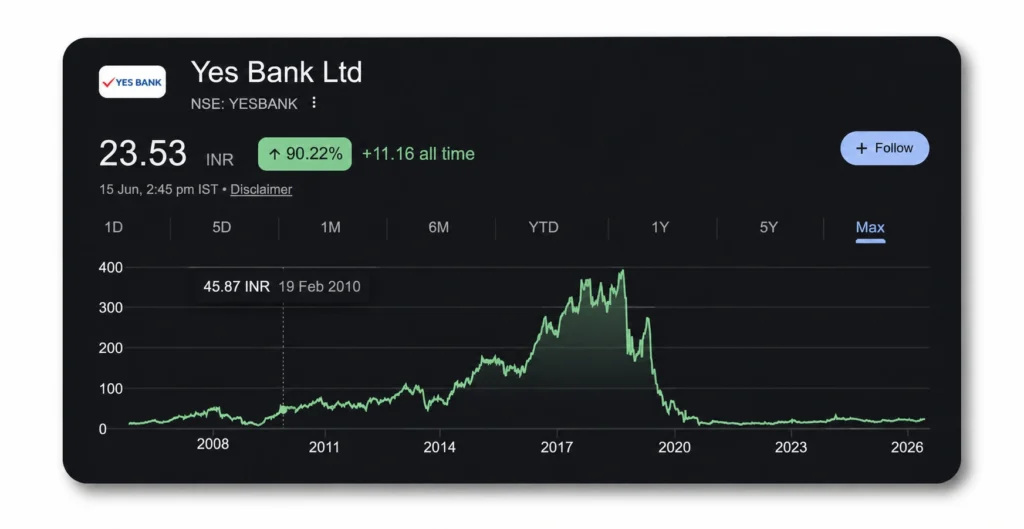
YES Bank Limited is one of India’s leading private-sector banks, offering a wide range of banking and financial services to retail customers, corporate clients, MSMEs, and institutional investors. Established in 2004, the bank rapidly expanded its operations and became one of the fastest-growing private banks in the country. However, the bank faced a major financial crisis in 2020, which led to a restructuring process supported by regulators and major financial institutions.
Since then, YES Bank has made significant progress in improving its asset quality, strengthening its balance sheet, reducing stressed assets, and restoring profitability. The bank has also focused on expanding its digital banking capabilities and increasing its retail customer base. Investors are closely monitoring YES Bank because of its turnaround story and long-term growth potential. If the bank continues improving profitability, increasing loan growth, and maintaining healthy asset quality, it could generate significant value for shareholders over the coming decades.
This article provides a detailed analysis of YES Bank’s business model, financial performance, growth drivers, risks, and share price targets from 2026 to 2050.
Company Overview
| Particular | Details |
|---|---|
| Company Name | YES Bank Limited |
| NSE Symbol | YESBANK |
| BSE Code | 532648 |
| Industry | Private Sector Banking |
| Market Cap | ₹70,000+ Crore |
| Founded | 2004 |
| Headquarters | Mumbai, Maharashtra |
| Website | www.yesbank.in |
What Does YES Bank Do?
YES Bank operates as a full-service commercial bank in India. The bank provides a broad range of financial products and services across retail banking, corporate banking, digital banking, treasury operations, wealth management, and lending.
Key Business Segments
Retail Banking
The bank offers savings accounts, current accounts, personal loans, home loans, credit cards, fixed deposits, and wealth management solutions.
Corporate Banking
Corporate banking remains one of the largest revenue contributors. Services include working capital financing, project finance, trade finance, and treasury solutions.
Digital Banking
YES Bank has invested heavily in digital transformation. The bank provides mobile banking, internet banking, UPI solutions, and fintech partnerships.
Treasury Operations
Treasury activities contribute through investment income, bond trading, and foreign exchange services.
Wealth Management
The bank provides investment and advisory services to high-net-worth individuals and institutional clients.
Revenue Sources
- Interest income from loans and advances
- Fee-based income
- Treasury income
- Wealth management fees
- Digital banking services
YES Bank Share Price Market Overview
Market Overview Table
| Metric | Value |
|---|---|
| Current Share Price | ₹22.8–23.2 |
| Market Capitalization | ₹72,000–74,000 Crore |
| P/E Ratio (TTM) | ~28–30 |
| Book Value Per Share | ~₹16.5–17.0 |
| ROE | ~5–6% |
| Dividend Yield | 0% |
| 52-Week High | ₹27.4 |
| 52-Week Low | ₹16.0 |
| Face Value | ₹2 |
| Industry | Banking (Private Sector Bank) |
| Price-to-Book (P/B) Ratio | ~1.35 |
| Capital Adequacy Ratio (CAR) | ~16–17% |
| EPS (TTM) | ~₹0.80 |
Financial Performance
Revenue & Profit Performance
| Financial Year | Revenue (₹ Crore) | Net Profit (₹ Crore) | EPS (₹) |
|---|---|---|---|
| FY2022 | 18,330 | 1,066 | 0.36 |
| FY2023 | 26,749 | 736 | 0.24 |
| FY2024 | 33,516 | 1,251 | 0.40 |
| FY2025 | 37,684 | 2,406 | 0.77 |
| TTM (Latest) | 39,000–40,000 | 2,700–2,900 | 0.85–0.95 |
Financial Analysis
YES Bank’s profitability has improved significantly over the last few years. The bank has successfully reduced its non-performing assets (NPAs), strengthened capital adequacy, and increased net interest income. Rising profitability indicates that the turnaround strategy is beginning to show results.
Also Check: Ujjivan Small Finance Bank
Debt Position
For banks, traditional debt metrics are interpreted differently because customer deposits form the primary source of funding and are part of normal banking operations.
| Metric | Value |
|---|---|
| Total Deposits | ₹2.8–3.0 Lakh Crore |
| Total Borrowings | ₹45,000–55,000 Crore |
| Debt-to-Equity Ratio | Not Meaningful for Banks |
| CASA Ratio | ~32–34% |
| Capital Adequacy Ratio (CAR) | ~16–17% |
| CET-1 Ratio | ~13–14% |
| Interest Coverage Ratio | Not Applicable for Banks |
| Financial Risk | Moderate |
Historic Performance
1-Year Return
The stock has delivered moderate returns due to improving investor confidence and better financial performance.
3-Year Return
Investors who bought after the restructuring phase have witnessed substantial gains.
5-Year Return
Performance remains mixed due to the severe correction during the banking crisis followed by recovery.
CAGR Performance
The stock’s CAGR has improved significantly since the turnaround phase started.
Major Price-Moving Events
- RBI-led reconstruction in 2020
- Capital infusion from strategic investors
- Significant reduction in NPAs
- Consistent profit growth
- Expansion of retail loan portfolio
- Strategic investment from international banking institutions
Shareholding Pattern
Latest Available Quarter
| Shareholder Category | Holding |
|---|---|
| Promoters | 0.00% |
| FIIs | 46.42% |
| DIIs | 21.82% |
| Public | 31.74% |
| Others | Balance |
Shareholding Analysis
High institutional ownership reflects growing confidence in the bank’s recovery strategy. Foreign Institutional Investors remain the largest shareholder category.
Growth Factors
Industry Growth
India’s banking sector is expected to grow strongly due to increasing financial inclusion, rising credit demand, and expanding digital banking adoption.
Expansion Plans
YES Bank is focusing on:
- Expanding retail banking
- Growing SME lending
- Increasing digital banking services
- Strengthening corporate banking operations
Capacity Additions
The bank continues investing in technology infrastructure and customer acquisition.
New Products
- Digital savings accounts
- Enhanced mobile banking services
- Fintech partnerships
- Wealth management products
Government Policies
Several government initiatives support banking growth:
- Digital India
- Financial Inclusion Programs
- Infrastructure Development
- MSME Support Schemes
Future Demand Drivers
- Rising middle-class population
- Increased consumer spending
- Growth in digital payments
- Expansion of India’s economy
Risks and Challenges
Competition
The bank faces intense competition from large private-sector banks and public-sector banks.
Regulatory Risks
Banking regulations can significantly impact profitability and growth.
Asset Quality Concerns
Any deterioration in asset quality may impact earnings.
Economic Slowdown
Lower economic growth can reduce loan demand and increase defaults.
Interest Rate Risks
Changing interest rates can affect margins and profitability.
YES Bank Share Price Target 2026–2050
Estimated Share Price Target Summary
| Year | Minimum Target | Average Target | Maximum Target |
|---|---|---|---|
| 2026 | ₹22.80 | ₹31.43 | ₹38.04 |
| 2030 | ₹64.75 | ₹75.20 | ₹84.11 |
| 2035 | ₹72.50 | ₹92.32 | ₹133.22 |
| 2040 | ₹160.43 | ₹194.16 | ₹270.40 |
| 2045 | ₹291.54 | ₹325.07 | ₹384.30 |
| 2050 | ₹516.26 | ₹542.80 | ₹622.63 |
These estimates are based on assumptions regarding earnings growth, profitability improvement, industry expansion, economic growth, and valuation re-rating.
YES Bank Share Price Target 2026
YES Bank’s 2026 outlook largely depends on its ability to sustain profit growth and improve operational efficiency. The bank has already shown signs of recovery through improved asset quality, lower provisioning requirements, and growing retail deposits. If management continues executing its turnaround strategy effectively, investor confidence could strengthen further.
The Indian banking sector is expected to benefit from strong economic growth, rising credit demand, and increasing digital banking adoption. YES Bank could gain from these trends by expanding its retail loan book and increasing fee-based income. However, competition from larger private-sector banks remains a challenge. Assuming stable macroeconomic conditions and continued improvement in financial performance, the stock could trade in the ₹25–₹40 range during 2026.
Monthly Target Table 2026
| Month | Estimated Target Price (₹) |
|---|---|
| January | ₹22.80 |
| February | ₹25.59 |
| March | ₹27.18 |
| April | ₹21.84 |
| May | ₹25.66 |
| June | ₹28.04 |
| July | ₹30.10 |
| August | ₹32.45 |
| September | ₹36.08 |
| October | ₹34.90 |
| November | ₹36.88 |
| December | ₹38.04 |
YES Bank Share Price Target 2030
By 2030, YES Bank could emerge as a stronger private-sector bank if it maintains consistent earnings growth and improves return ratios. India’s expanding economy, increasing financial inclusion, and rising credit penetration could support long-term banking growth.
The bank’s ability to increase market share in retail banking and digital financial services will play a crucial role in future performance. If profitability continues to improve and asset quality remains stable, valuation multiples may expand. Under favorable conditions, YES Bank could achieve a share price range of ₹45–₹80 by 2030.
Monthly Target Table 2030
| Month | Estimated Target Price (₹) |
|---|---|
| January | ₹64.75 |
| February | ₹70.43 |
| March | ₹73.84 |
| April | ₹78.20 |
| May | ₹69.04 |
| June | ₹64.41 |
| July | ₹68.15 |
| August | ₹73.85 |
| September | ₹74.53 |
| October | ₹77.04 |
| November | ₹79.22 |
| December | ₹84.11 |
YES Bank Share Price Target 2035
The 2035 outlook assumes that YES Bank successfully completes its transformation into a stable and profitable banking institution. A stronger retail franchise, higher digital adoption, and improved profitability could support sustained growth.
India’s banking sector is expected to expand significantly over the next decade due to economic development, urbanization, and increased demand for financial services. If YES Bank captures a larger share of this opportunity while maintaining healthy asset quality, the stock could experience substantial appreciation. A target range of ₹75–₹130 appears achievable under optimistic growth assumptions.
Monthly Target Table 2035
| Month | Estimated Target Price (₹) |
|---|---|
| January | ₹72.50 |
| February | ₹84.14 |
| March | ₹89.05 |
| April | ₹93.42 |
| May | ₹96.82 |
| June | ₹104.32 |
| July | ₹91.73 |
| August | ₹109.22 |
| September | ₹117.04 |
| October | ₹126.91 |
| November | ₹120.50 |
| December | ₹133.22 |
YES Bank Share Price Target 2040
By 2040, YES Bank’s future will depend on decades of successful execution and adaptation to technological changes. The banking industry is expected to become increasingly digital, with artificial intelligence, automation, and data analytics playing major roles.
If YES Bank remains competitive and continues to innovate, it could benefit from growing customer demand and expanding financial markets. Strong earnings growth and consistent return ratios could justify higher valuations. Under favorable conditions, the stock may trade between ₹120 and ₹220 during 2040.
Monthly Target Table 2040
| Month | Estimated Target Price (₹) |
|---|---|
| January | ₹160.43 |
| February | ₹169.32 |
| March | ₹176.18 |
| April | ₹180.20 |
| May | ₹184.03 |
| June | ₹200.03 |
| July | ₹214.95 |
| August | ₹199.20 |
| September | ₹226.08 |
| October | ₹241.11 |
| November | ₹257.30 |
| December | ₹270.40 |
YES Bank Share Price Target 2045
The 2045 projection assumes sustained growth in India’s economy and continued expansion of the financial services sector. By this stage, YES Bank would need to establish itself as one of the leading private-sector banks with strong profitability, efficient operations, and a diversified revenue base.
If the bank successfully leverages technological advancements and maintains strong customer relationships, long-term shareholder value creation could continue. Based on these assumptions, the stock could reach the ₹180–₹350 range.
Monthly Target Table 2045
| Month | Estimated Target Price (₹) |
|---|---|
| January | ₹291.54 |
| February | ₹298.30 |
| March | ₹308.40 |
| April | ₹319.53 |
| May | ₹341.04 |
| June | ₹357.84 |
| July | ₹361.44 |
| August | ₹372.48 |
| September | ₹341.32 |
| October | ₹352.60 |
| November | ₹375.29 |
| December | ₹384.30 |
YES Bank Share Price Target 2050
Predicting stock prices 25 years into the future involves substantial uncertainty. The 2050 target assumes that YES Bank remains financially strong, consistently profitable, and capable of adapting to future banking trends.
Long-term growth would depend on economic conditions, regulatory developments, competition, technological innovation, and management execution. If the bank continues expanding successfully and generates strong returns for shareholders, the stock could potentially trade between ₹250 and ₹550 by 2050.
Monthly Target Table 2050
| Month | Estimated Target Price (₹) |
|---|---|
| January | ₹516.26 |
| February | ₹529.05 |
| March | ₹537.52 |
| April | ₹549.02 |
| May | ₹561.60 |
| June | ₹575.20 |
| July | ₹583.01 |
| August | ₹595.30 |
| September | ₹579.44 |
| October | ₹591.30 |
| November | ₹616.04 |
| December | ₹622.63 |
Bull Case
Several factors could help YES Bank outperform expectations:
- Strong improvement in profitability
- Sustained reduction in non-performing assets
- Rapid growth in retail lending
- Increased institutional ownership
- Successful digital banking initiatives
- Expansion of fee-based income
- Improved return on equity
- Positive industry growth trends
- Strategic partnerships and investments
- Valuation re-rating by the market
Bear Case
Several risks could limit future growth:
- Deterioration in asset quality
- Rising non-performing assets
- Intense competition from major banks
- Economic slowdown affecting loan demand
- Regulatory restrictions
- Lower-than-expected profitability
- Interest rate volatility
- Technology disruptions
- Capital raising challenges
- Reduced investor confidence
Pros and Cons
Pros
1. Strong Turnaround Story
YES Bank has significantly improved its financial position since the restructuring process.
2. Improving Profitability
The bank has reported steady growth in earnings and improved operational efficiency.
3. Growing Institutional Interest
High institutional ownership reflects confidence in the bank’s future prospects.
Cons
1. Intense Competition
The banking sector remains highly competitive.
2. Lower Profitability Than Leading Peers
Return ratios still trail major private-sector banks.
3. Turnaround Risks Remain
The bank must continue executing its recovery strategy successfully.
Expert Opinion
Most market experts now view YES Bank as a recovery and growth story rather than a distressed banking stock. Significant improvements in profitability, asset quality, and capital adequacy have strengthened investor confidence. However, the bank still needs to improve return on equity and consistently deliver strong earnings growth to justify higher valuations.
For aggressive long-term investors, YES Bank may offer attractive upside potential. Conservative investors may prefer established banking leaders with stronger financial metrics and lower risk profiles.
Future Outlook
The future outlook for YES Bank remains positive, provided management continues executing its strategic objectives effectively. Growth opportunities include:
- Expansion of retail banking
- Growth in SME lending
- Digital banking innovation
- Wealth management services
- Increased financial inclusion
- Rising demand for credit
India’s long-term economic growth could provide a favorable environment for banking sector expansion. If YES Bank successfully capitalizes on these opportunities, shareholder returns could improve significantly over the coming decades.
Conclusion
YES Bank has made remarkable progress since its restructuring and has successfully restored profitability. The bank’s improving financial performance, stronger balance sheet, and growing institutional ownership indicate that the turnaround strategy is gaining traction.
While risks remain, particularly related to competition and asset quality, the bank appears better positioned for future growth than it was a few years ago. Investors seeking exposure to a turnaround banking story may find YES Bank attractive, but they should carefully evaluate risks before investing.
Disclaimer: The share price targets mentioned in this article are estimates based on assumptions regarding business growth, economic conditions, and market valuations. They are not guarantees of future performance and should not be considered investment advice.
Frequently Asked Questions (FAQs)
What is the YES Bank Share Price Target for 2026?
The estimated share price target for 2026 ranges between ₹25 and ₹40.
What is the YES Bank Share Price Target for 2030?
The estimated share price target for 2030 ranges between ₹45 and ₹80.
Is YES Bank a Good Long-Term Investment?
YES Bank may offer long-term growth potential if it continues improving profitability and maintaining strong asset quality.
What Are the Risks of Investing in YES Bank?
Key risks include competition, regulatory changes, economic slowdowns, and deterioration in asset quality.
Can YES Bank Reach New All-Time Highs by 2030?
While possible, achieving new all-time highs would require sustained earnings growth, strong profitability, and favorable market conditions.
Should Beginners Invest in YES Bank Stock?
Beginners should understand the risks associated with turnaround stocks and maintain a diversified investment portfolio before investing.