

Reliance Home Finance Limited is a housing finance company engaged in providing home loans, affordable housing loans, loans against property, and construction finance in India. Incorporated in 2008 and headquartered in Mumbai, the company operates in the mortgage lending segment under strict regulatory oversight. Over time, its financial performance has been heavily affected by asset quality stress, debt restructuring issues, and operational constraints, which have significantly reduced its market position in the housing finance industry.
Despite these challenges, the stock continues to attract attention due to its extremely low valuation and potential restructuring-led turnaround scenario. The broader Indian housing finance sector is expected to grow steadily, supported by urbanization, government-backed affordable housing initiatives, and increasing credit demand. If the company stabilizes its balance sheet and restores lending operations, long-term recovery potential exists. However, it remains a high-risk, speculative stock with uncertain fundamentals and is highly dependent on corporate restructuring outcomes.
In this article, we will get compleate overview of Reliance Home Finance Share Price Target 2026, 2030, 2040, to 2050.
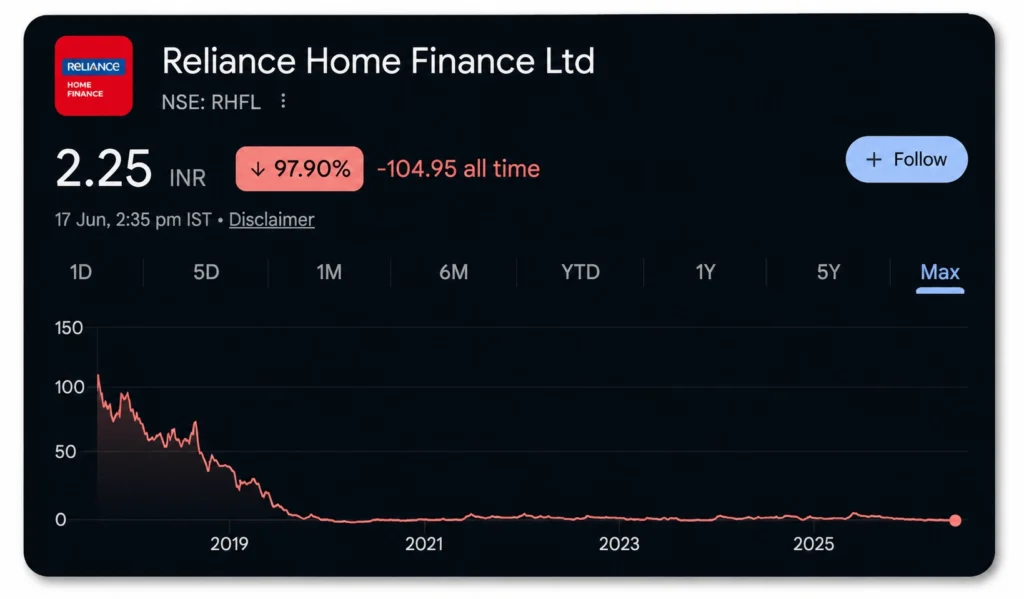
Reliance Home Finance Share Price Target Company Overview
| Particular | Details |
|---|---|
| Company Name | Reliance Home Finance Limited |
| NSE Symbol | RHFL |
| BSE Code | 540709 |
| Industry | Housing Finance |
| Market Cap | ~₹100–135 Crore |
| Founded | 2008 |
| Headquarters | Mumbai, India |
| Website | reliancehomefinance.com |
What Does Reliance Home Finance Do?
Reliance Home Finance operates in the housing finance and mortgage lending space. Its core services include:
- Home loans for individual buyers
- Affordable housing finance
- Loans against property (LAP)
- Construction and project finance
- Property-backed lending services
Revenue is primarily generated through interest income on loans and lending-related fees. Historically, the company targeted retail borrowers and small businesses in the housing segment. However, lending activity has been significantly reduced in recent years due to financial stress and regulatory constraints, impacting competitiveness against stronger NBFCs and banks.
Market Overview
| Metric | Value |
|---|---|
| Current Share Price | ₹2.2–₹2.3 |
| Market Capitalization | ~₹105 Crore |
| P/E Ratio | ~4.3 (not very meaningful due to exceptional items) |
| Book Value | Negative |
| ROE | Negative |
| Dividend Yield | 0% |
| 52-Week High | ₹7.84 |
| 52-Week Low | ₹1.82 |
| Face Value | ₹10 |
| Industry | Housing Finance |
| NSE Symbol | RHFL |
| BSE Code | 540709 |
Financial Performance
| Financial Year | Revenue | Net Profit | EPS |
|---|---|---|---|
| FY2022 | Stressed operations | Loss | Negative |
| FY2023 | Restructuring impact | Volatile | Negative |
| FY2024 | Minimal lending activity | Loss | Negative |
| FY2025 | Very limited operations | Small reported profit / exceptional gains | Positive but not sustainable |
| FY2026 (TTM) | Negligible operating business | Earnings distorted by restructuring items | Not reliable for valuation |
Debt Position
| Metric | Status |
|---|---|
| Total Debt | High legacy liabilities remain |
| Debt-to-Equity | Distorted due to negative net worth |
| Interest Coverage Ratio | Weak |
| Net Worth | Negative |
Historic Performance
| Period | Performance |
|---|---|
| 1-Year Return | Highly volatile |
| 3-Year Return | Negative overall |
| 5-Year Return | Severe wealth erosion |
| Long-Term CAGR | Deeply negative |
| Key Drivers | Debt restructuring, insolvency-related developments, speculative trading activity, and regulatory developments |
Analysis
- 1-Year Return: Highly volatile with speculative movements
- 3-Year Return: Negative overall performance
- 5-Year Return: Significant capital erosion
- CAGR: Negative long-term trend
- Key Drivers: restructuring news, regulatory actions, sentiment shifts
Shareholding Pattern
| Shareholder Category | Holding |
|---|---|
| Promoters | 0.74% |
| FIIs | 0.00% |
| DIIs | 1.54% |
| Mutual Funds | 0.01% |
| Public / Retail | 97.71% |
Growth Factors
- Expansion in Indian housing finance demand
- Government housing schemes support
- Urbanization-driven credit growth
- Potential restructuring-led revival
- Long-term mortgage penetration increases.
Risks and Challenges
- Weak financial position
- High legacy debt burden
- Regulatory scrutiny
- Intense competition from strong NBFCs and banks
- Uncertain business continuity and execution risk
- Macroeconomic sensitivity (interest rates, credit cycle)
Reliance Home Finance Share Price Target 2026 To 2050
| Year | Minimum Target | Average Target | Maximum Target |
|---|---|---|---|
| 2026 | ₹1.90 | ₹3.42 | ₹5.10 |
| 2030 | ₹9.14 | ₹11.04 | ₹12.04 |
| 2035 | ₹16.05 | ₹16.30 | ₹17.83 |
| 2040 | ₹11.20 | ₹13.40 | ₹15.11 |
| 2050 | ₹28.03 | ₹30.63 | ₹32.15 |
Also Check:
Reliance Home Finance Share Price Target 2026
The 2026 outlook assumes continued stabilization attempts and limited operational revival. Price movement is expected to remain driven mainly by restructuring updates, liquidity conditions, and sentiment rather than strong earnings visibility. Any meaningful upside depends on improvement in balance sheet quality and restoration of lending activity. Without structural recovery, gains are likely to remain capped and volatile.
Monthly Target 2026
| Month | Target |
|---|---|
| Jan | ₹1.90 |
| Feb | ₹2.17 |
| Mar | ₹2.83 |
| Apr | ₹3.29 |
| May | ₹1.96 |
| Jun | ₹4.41 |
| Jul | ₹2.74 |
| Aug | ₹2.11 |
| Sep | ₹3.67 |
| Oct | ₹4.67 |
| Nov | ₹4.82 |
| Dec | ₹5.10 |
Share Price Target 2030
By 2030, outcomes depend on whether the company successfully exits legacy financial stress. The housing finance sector is expected to expand, but participation depends on capital strength and credibility restoration. If restructuring succeeds, valuation re-rating is possible; otherwise, the stock may remain in low-value consolidation.
Monthly Target 2030
| Month | Target |
|---|---|
| Jan | ₹9.14 |
| Feb | ₹9.78 |
| Mar | ₹10.18 |
| Apr | ₹9.43 |
| May | ₹9.54 |
| Jun | ₹10.15 |
| Jul | ₹10.74 |
| Aug | ₹11.04 |
| Sep | ₹11.39 |
| Oct | ₹10.69 |
| Nov | ₹10.90 |
| Dec | ₹12.04 |
Reliance Home Finance Share Price Target 2035
By 2035, performance depends on long-term survival and operational normalization. If lending operations scale again, the company may benefit from India’s expanding mortgage market. However, execution risk remains high due to historical financial instability.
Monthly Target 2035
| Month | Target |
|---|---|
| Jan | ₹16.05 |
| Feb | ₹16.26 |
| Mar | ₹16.58 |
| Apr | ₹16.79 |
| May | ₹16.36 |
| Jun | ₹16.82 |
| Jul | ₹16.97 |
| Aug | ₹17.16 |
| Sep | ₹17.03 |
| Oct | ₹17.39 |
| Nov | ₹17.22 |
| Dec | ₹17.83 |
Reliance Home Finance Share Price Target 2040
The 2040 scenario assumes long-term survival and participation in India’s housing credit expansion cycle. Growth would depend on rebuilding trust, capital adequacy, and sustainable lending margins.
Monthly Target 2040
| Month | Target |
|---|---|
| Jan | ₹11.20 |
| Feb | ₹11.54 |
| Mar | ₹11.81 |
| Apr | ₹12.38 |
| May | ₹12.84 |
| Jun | ₹12.89 |
| Jul | ₹13.40 |
| Aug | ₹13.83 |
| Sep | ₹14.73 |
| Oct | ₹14.05 |
| Nov | ₹14.84 |
| Dec | ₹15.11 |
Share Price Target 2050
The 2050 projection is highly speculative and assumes full turnaround, stable operations, and long-term sector participation. Such long-dated forecasts are highly uncertain and depend on multiple macroeconomic and company-specific variables.
Monthly Target 2050
| Month | Target |
|---|---|
| Jan | ₹28.03 |
| Feb | ₹28.36 |
| Mar | ₹28.72 |
| Apr | ₹28.89 |
| May | ₹29.05 |
| Jun | ₹29.41 |
| Jul | ₹29.89 |
| Aug | ₹30.14 |
| Sep | ₹30.86 |
| Oct | ₹31.42 |
| Nov | ₹31.90 |
| Dec | ₹32.15 |
Bull Case
- Successful debt restructuring
- Operational revival in lending
- Sector-wide housing credit expansion
- Strong turnaround in investor sentiment
- Asset recovery improvement
Bear Case
- Continued financial distress
- Regulatory and legal complications
- Weak or failed turnaround execution
- Persistent negative net worth
- Liquidity and funding constraints
Pros and Cons
Pros
- Extremely low valuation base
- High turnaround potential if restructuring succeeds
- Exposure to large housing finance market
Cons
- Weak financial fundamentals
- High uncertainty in business continuity
- Historical debt and governance concerns
Expert Opinion
The stock is generally categorized as a high-risk turnaround candidate rather than a fundamentally strong financial institution. Valuation is heavily driven by sentiment and restructuring expectations rather than stable earnings. Institutional participation remains limited due to financial uncertainty, and long-term re-rating depends entirely on sustained operational recovery and balance sheet strengthening.
Future Outlook
Long-term prospects depend on whether the company can re-enter meaningful lending operations and stabilize its financial structure. The Indian housing finance sector is expected to expand due to urban demand, income growth, and government housing initiatives. However, participation requires strong capital access, risk management capability, and regulatory confidence, all of which remain key hurdles.
Conclusion
Reliance Home Finance represents a highly speculative investment opportunity with asymmetric risk. While the housing finance industry offers long-term structural growth, the company’s current financial instability makes outcomes uncertain. Any investment decision depends heavily on restructuring progress, financial recovery, and sustained operational revival.
Disclaimer: This content is for informational purposes only and does not constitute financial advice. Market investments involve risk, including loss of capital.