

Hindustan Aeronautics Limited, commonly known as HAL, and defence companies. It designs, manufactures, repairs, and upgrades aircraft, helicopters, engines, and defence systems for the Indian armed forces.
HAL share is closely followed because the company plays a major role in India’s defence modernisation and Make in India programme. Rising defence spending, aircraft replacement needs, helicopter demand, and new fighter jet programmes can support its long-term business growth.
This article explains HAL’s business, financial position, shareholding pattern, historical performance, major growth factors, risks, and estimated Hindustan Aeronautics share price targets from 2026 to 2050 in simple language.
Hindustan Aeronautics Ltd Company Overview
| Company Essential | Value |
|---|---|
| Market Cap | ₹2,93,000 Cr. (Approx.) |
| Enterprise Value | ₹2,78,900 Cr. (Approx.) |
| No. Of Shares | 66.67 Cr. |
| P/E | 32.2 |
| P/B | 7.14 |
| Face Value | ₹5 |
| Book Value | ₹614 |
| Debt | ₹0 Cr. (Debt Free) |
| Sales Growth | 6.9% (TTM) |
| ROE | 24.0% |
| Dividend Yield | 0.91% |
What Does Hindustan Aeronautics Ltd Do?
Hindustan Aeronautics Limited is a government-owned aerospace and defence manufacturing company. Its main customers are the Indian Air Force, Indian Army, Indian Navy, Defence Research and Development Organisation, and other government defence organisations.
HAL manufactures fighter aircraft, trainer aircraft, helicopters, aircraft engines, avionics systems, spare parts, and defence equipment. Its major programmes include Tejas light combat aircraft, Dhruv helicopters, Light Combat Helicopters, Sukhoi aircraft upgrades, Hawk trainers, and aircraft engine services.
The company also earns revenue from repair, overhaul, maintenance, upgrades, spares, and support services. This creates a recurring income source because defence platforms need long-term servicing.
HAL’s biggest strength is its strategic position in India’s defence ecosystem. It has deep technical capabilities, government support, a large order book, and long-term demand visibility.
Historic Share Price Performance
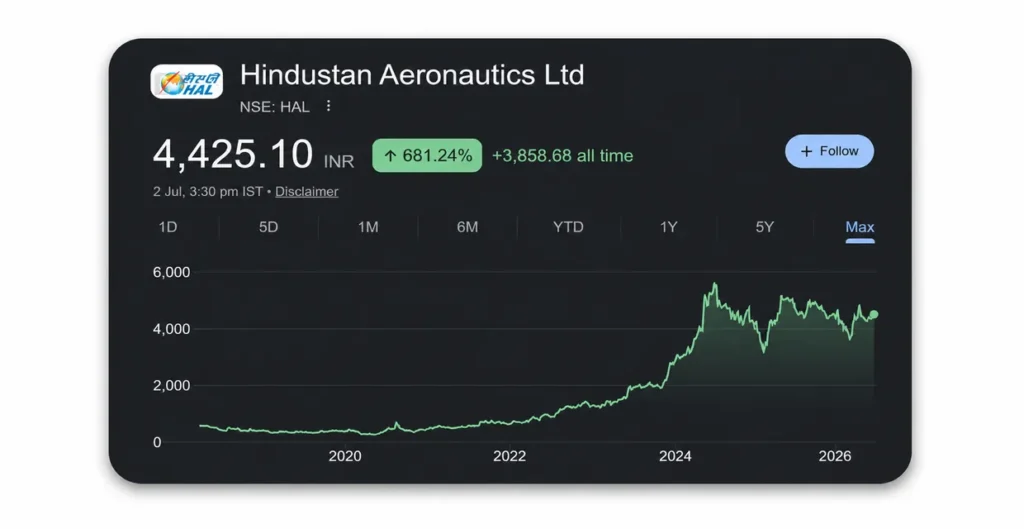
HAL was listed on the stock market in 2018. In its early listed years, the share moved gradually because investors were still evaluating the company’s growth potential, defence order pipeline, and government ownership structure.
The major rally came after India increased focus on defence self-reliance, indigenous manufacturing, fighter aircraft orders, helicopter programmes, and capital expenditure for modernising the armed forces. HAL benefited from investor interest in defence stocks and became one of the strongest performers in the public sector defence segment.
The stock also faced corrections during periods of high valuation, delivery concerns, supply-chain pressure, and broad market volatility. Overall, HAL has created strong long-term wealth for investors, although the share price can remain volatile in the short term.
| Year | Opening Price | Closing Price | Return |
|---|---|---|---|
| 2021 | ₹1,200 | ₹1,270 | 6% |
| 2022 | ₹1,270 | ₹2,470 | 94% |
| 2023 | ₹2,470 | ₹4,000 | 62% |
| 2024 | ₹4,000 | ₹4,560 | 14% |
| 2025 | ₹4,560 | ₹4,700 | 3% |
| 2026* | ₹4,700 | Around ₹4,400 | Volatile |
Latest Shareholding Pattern
The Government of India remains the promoter of HAL and holds a controlling stake. High promoter holding gives stability, but it also means the company’s direction is closely connected to government defence spending, policy decisions, and procurement cycles.
Institutional ownership is also meaningful. Foreign investors, mutual funds, insurance companies, and domestic institutions track HAL because of its strong market position in the aerospace and defence industry.
Growth Factors
- Rising defence spending: India is increasing defence spending to modernise aircraft fleets, helicopters, engines, surveillance systems, and other military equipment.
- Make in India opportunity: The government wants to reduce dependence on imported defence products. HAL can benefit from local manufacturing and indigenous defence programmes.
- Large order book: HAL has a strong order pipeline across aircraft, helicopters, engines, upgrades, maintenance, and spare parts.
- Tejas aircraft programme: Tejas fighter aircraft deliveries can become an important long-term revenue driver for the company.
- Helicopter demand: Demand for utility helicopters, combat helicopters, maritime helicopters, and special-purpose helicopters can support future growth.
- Recurring maintenance income: Aircraft repair, overhaul, spares, upgrades, and long-term support services provide steady business income.
- Technology partnerships: HAL is working with domestic and international technology partners in aerospace, engines, helicopters, and maintenance services.
- Export potential: Defence exports are still a small portion of HAL’s business, but successful international sales can create additional growth opportunities.
- Strong financial position: HAL has strong profitability, limited debt, healthy return ratios, and regular dividend payments.
- Strategic importance: HAL is not just another manufacturing company. It is important for India’s defence preparedness, which gives it a strong long-term business position.
HAL Share Price Target 2026 To 2050
The following targets are estimates based on expected revenue growth, order execution, defence spending, profit growth, valuation levels, and general market conditions. These figures are not guaranteed.
| Year | Minimum Target | Average Target | Maximum Target |
|---|---|---|---|
| 2026 | ₹3,480 | ₹4,243 | ₹4,963 |
| 2027 | ₹5,205 | ₹5,542 | ₹5,464 |
| 2028 | ₹5,632 | ₹5,574 | ₹5,873 |
| 2029 | ₹5,943 | ₹6,142 | ₹6,364 |
| 2030 | ₹6,573 | ₹6,842 | ₹7,143 |
| 2035 | ₹9,437 | ₹9,743 | ₹10,053 |
| 2040 | ₹14,258 | ₹14,968 | ₹15,632 |
| 2050 | ₹31,643 | ₹31,895 | ₹32,284 |
Hindustan Aeronautics Ltd Share Price Target 2026
HAL’s 2026 performance may depend on execution of existing defence orders, Tejas deliveries, helicopter production, engine programmes, repair revenue, and operating margin movement. The company has strong business visibility, but the stock may remain volatile because its valuation is already at a premium level.
A positive surprise in order inflow or delivery execution can support the stock. On the other hand, supply delays, lower margins, or broad market weakness can create temporary pressure.
| Period | Estimated Target Price |
|---|---|
| Second Half | ₹4,963 |
Hindustan Aeronautics Ltd Share Price Target 2030
By 2030, HAL may benefit from higher domestic aircraft demand, more helicopter deliveries, defence upgrades, maintenance income, and new-generation aerospace programmes. India’s defence manufacturing push can remain a major long-term trigger.
The company’s ability to meet delivery schedules will be important. Revenue growth alone will not be enough; investors will also watch profit margin, working capital, order execution, and return on equity.
| Period | Estimated Target Price |
|---|---|
| First Half | ₹6,573 |
| Second Half | ₹7,143 |
Hindustan Aeronautics Ltd Share Price Target 2035
HAL’s 2035 outlook depends on how successfully India develops indigenous aerospace capabilities. The company may gain from advanced fighter aircraft programmes, engine development, drones, helicopters, exports, maintenance work, and defence technology partnerships.
At this stage, growth may be supported by a much bigger defence manufacturing ecosystem. However, competition from private defence companies and global suppliers may increase over time.
| Period | Estimated Target Price |
|---|---|
| First Half | ₹9,437 |
| Second Half | ₹10,053 |
Hindustan Aeronautics Ltd Share Price Target 2040
By 2040, HAL may become a larger aerospace platform company if it successfully expands into advanced aircraft systems, military engines, space-related components, exports, and global maintenance services.
The company’s future valuation will depend on execution quality. If HAL delivers complex programmes on time and maintains profitability, the stock may continue to create value. However, long-term projections remain uncertain because defence technology and government policies can change.
| Period | Estimated Target Price |
|---|---|
| First Half | ₹14,258 |
| Second Half | ₹15,632 |
Hindustan Aeronautics Ltd Share Price Target 2050
A 2050 target should be viewed only as a broad long-term estimate. Over the next two decades, HAL’s performance will depend on India’s defence budget, aircraft replacement cycle, export success, new technology, domestic manufacturing capability, and global geopolitical conditions.
If HAL maintains its strategic importance, expands its product range, and improves execution, it may remain a major long-term defence company. Still, investors should not rely only on distant price estimates.
| Period | Estimated Target Price |
|---|---|
| First Half | ₹31,643 |
| Second Half | ₹32,284 |
Bull Case
- Strong increase in India’s defence capital expenditure.
- Faster Tejas aircraft and helicopter deliveries.
- Large new orders from the Indian Air Force and Navy.
- Better execution of the existing order book.
- Higher defence exports to friendly countries.
- Successful expansion into aircraft engines and advanced aerospace systems.
- Strong growth in maintenance, repair, overhaul, and spare parts revenue.
- Premium valuation continues because of strategic importance and high profitability.
Bear Case
- Delays in aircraft, engine, or helicopter deliveries.
- Supply-chain issues affecting production schedules.
- Lower operating margins due to higher raw material and component costs.
- Slow order conversion or delayed government approvals.
- High valuation may lead to sharp corrections during weak market sentiment.
- Increased competition from private defence companies.
- Dependence on government procurement and budget allocation.
- Rising working-capital requirements may affect cash flow.
Pros and Cons
Pros
- Strong position in India’s aerospace and defence sector.
- Large government-backed order pipeline.
- High promoter holding by the Government of India.
- Limited debt and healthy profitability.
- Strong growth opportunity from Make in India and defence modernisation.
Cons
- Stock valuation can remain expensive.
- Heavy dependence on government defence orders.
- Delays in complex projects can affect results.
- High working-capital cycle can impact cash flow.
- Private sector competition may rise in future.
Expert Opinion
Hindustan Aeronautics Limited has a strong long-term business profile because it is central to India’s defence manufacturing ecosystem. The company has an established product base, long customer relationships, steady maintenance income, and a large opportunity from local defence production.
However, the stock is already valued at a premium compared with many traditional public sector companies. Investors should closely monitor new order inflow, Tejas deliveries, helicopter programmes, operating margin, cash flow, receivables, and export growth.
HAL may suit investors with a long-term view who understand that defence stocks can be volatile and are closely linked to government policy and execution performance.
Also Check:
- GTL Infrastructure Share Price Target
- Exide Industries Share Price Target
- CG POWER Share Price Target
- BHEL Share Price Target
- Adani Power Share Price Target
- Adani Green Share Price Target
- Amara Raja Energy & Mobility Limited Share Price Target
- IEX Share Price Target
- IFCI Share Price Target
- Hindustan Zinc Share Price Target
Conclusion
Hindustan Aeronautics Limited is one of India’s strongest defence manufacturing companies. Its business can benefit from higher defence spending, indigenous aircraft production, helicopter demand, maintenance services, and long-term aerospace projects.
The company’s strong order pipeline, government support, low debt, and strategic importance provide a solid base for future growth. However, investors should also consider valuation risk, delivery delays, working-capital pressure, and dependence on government procurement.
HAL can remain an important long-term stock in the defence sector, but investment decisions should be based on financial performance, valuation, risk tolerance, and portfolio diversification.
Disclaimer: The share price targets mentioned in this article are estimates based on current market conditions, company fundamentals, and industry trends. They should not be considered investment advice. Investors should conduct their own research or consult a qualified financial advisor before making investment decisions.