
Tata Steel Ltd is one of India’s best-known steel companies and a major player in the global steel industry. The company has a strong presence in flat steel, long steel, automotive steel, construction steel, branded products, mining, and value-added steel solutions.
Investors follow Tata Steel because its business is linked with India’s infrastructure growth, housing demand, automobile production, railway spending, renewable-energy projects, and industrial expansion. The stock is also closely affected by global steel prices, raw-material costs, demand from China and Europe, and changes in import policies.
This article explains Tata Steel’s business, financial position, shareholding pattern, growth opportunities, risks, and estimated Tata Steel share price targets from 2026 to 2050.
Tata Steel Ltd Financial Highlights
| Company Essential | Latest Value |
|---|---|
| Market Cap | ₹2,48,772 Cr. |
| Enterprise Value | ₹3,19,110 Cr. (Approx.) |
| No. Of Shares | 1,249.63 Cr. |
| P/E | 17.30 (Approx.) |
| P/B | 1.46 (Approx.) |
| Face Value | ₹1 |
| Book Value | ₹127.50 (Approx.) |
| Debt | ₹88,700 Cr. (Approx.) |
| Sales Growth | 8.21% (5-Year CAGR) |
| ROE | 9.69% |
| Dividend Yield | 1.91% (Approx.) |
Tata Steel reported strong improvement in FY2026 profitability, helped by better steel realisations, cost control, and stronger India operations. The company also reduced net debt while continuing expansion projects.
What Does Tata Steel Ltd Do?
Tata Steel manufactures and sells steel products for many industries. Its key customers come from automobiles, construction, engineering, appliances, renewable energy, railways, agriculture, defence, and infrastructure.
The company produces flat steel, long steel, coated steel, pipes, wires, tubes, rebars, automotive steel, branded construction products, and specialised industrial steel. It also operates in mining, ferro alloys, industrial by-products, and downstream processing.
Tata Steel earns revenue from India, Europe, Southeast Asia, and other export markets. Its major strength is an integrated business model, which includes raw-material sourcing, steel manufacturing, value-added products, distribution networks, and strong brands such as Tata Tiscon and Tata Shaktee.
Its future strategy focuses on capacity expansion, lower-cost production, premium products, and cleaner steelmaking technologies.
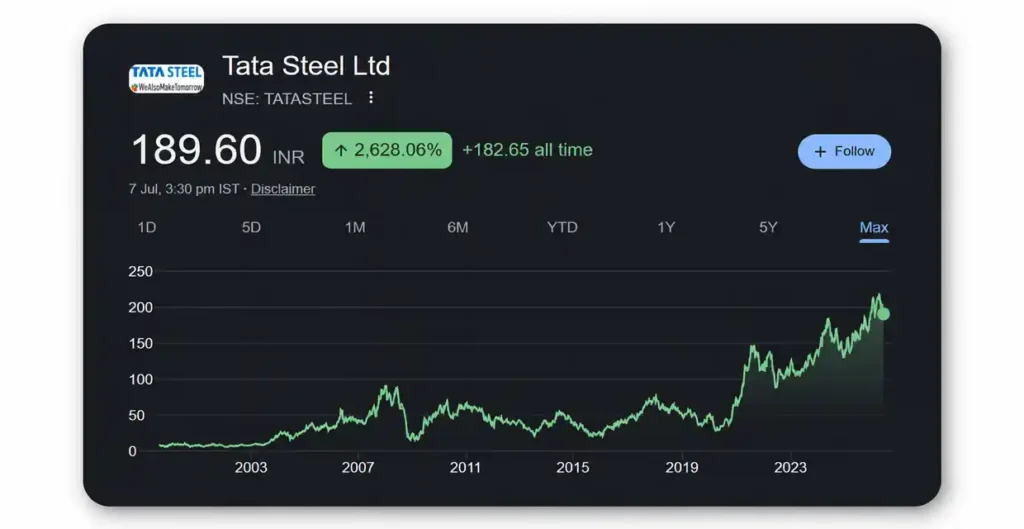
Historic Share Price Performance
Tata Steel has been a cyclical stock for many years. Its performance is strongly connected with steel prices, demand from infrastructure and automobile sectors, global economic activity, and raw-material costs.
The stock delivered a major rally during the post-pandemic steel upcycle, when demand improved and steel prices increased sharply. After that, the share price moved through periods of correction and recovery as global steel prices weakened, energy costs increased, and European operations faced pressure.
The company has also gone through important corporate actions, mergers, capacity additions, and business restructuring. These events can affect price comparisons across different years. Overall, Tata Steel has rewarded patient investors during strong steel cycles, but it has also seen sharp volatility during weak market conditions.
| Year | Opening Price | Closing Price | Return |
|---|---|---|---|
| 2021 | ₹65.10 | ₹111.20 | 70.8% |
| 2022 | ₹111.50 | ₹112.70 | 1.1% |
| 2023 | ₹114.40 | ₹136.80 | 19.6% |
| 2024 | ₹136.80 | ₹136.10 | -0.5% |
| 2025 | ₹137.00 | ₹180.10 | 31.5% |
Prices are rounded and based on market-history data. Historical prices may be affected by stock splits and other corporate actions.
Latest Shareholding Pattern
The latest available shareholding pattern shows strong institutional ownership. Domestic institutions hold a large stake, while foreign investors also have meaningful exposure to Tata Steel.
Growth Factors
- India’s infrastructure spending: Roads, railways, ports, housing, industrial corridors, defence projects, and power infrastructure can support long-term steel demand.
- Automobile demand: Tata Steel supplies specialised steel to passenger vehicles, commercial vehicles, electric vehicles, and auto-component manufacturers.
- Capacity expansion: The company is expanding capacity in India through projects at Kalinganagar, Ludhiana, NINL, and other manufacturing locations.
- Premium product mix: Higher sales of automotive steel, coated steel, electrical steel, construction steel, and branded products can improve margins.
- Cost-saving programmes: Tata Steel has focused on raw-material efficiency, logistics improvement, productivity, energy savings, and procurement discipline.
- Debt reduction: Lower net debt can reduce interest costs and improve financial flexibility during weak steel cycles.
- Domestic steel demand: India’s growing urbanisation and industrialisation can create long-term demand for steel products.
- Cleaner steel technologies: Electric arc furnaces, scrap usage, low-carbon steelmaking, and green-energy projects may improve Tata Steel’s future competitiveness.
- Strong brand position: Tata Steel has trusted brands, a large dealer network, technical capability, and long experience in the steel industry.
Tata Steel Ltd Share Price Target 2026–2050
The following Tata Steel share price targets are estimates, not guaranteed prices. They are based on possible earnings growth, steel demand, India’s infrastructure spending, capacity expansion, debt reduction, global steel cycles, and valuation assumptions.
The lower range assumes weak steel prices, slower demand, higher costs, or pressure in overseas operations. The average range reflects stable growth and normal business conditions. The higher range assumes stronger demand, better margins, successful expansion, and improved investor confidence.
| Year | Minimum Target | Average Target | Maximum Target |
|---|---|---|---|
| 2026 | ₹183 | ₹205 | ₹250 |
| 2027 | ₹240 | ₹265 | ₹284 |
| 2028 | ₹290 | ₹205 | ₹320 |
| 2029 | ₹330 | ₹365 | ₹389 |
| 2030 | ₹360 | ₹384 | ₹405 |
| 2035 | ₹426 | ₹480 | ₹528 |
| 2040 | ₹548 | ₹590 | ₹635 |
| 2050 | ₹1,320 | ₹1,490 | ₹1,780 |
Tata Steel Ltd Share Price Target 2026
Tata Steel’s 2026 outlook depends on domestic steel demand, global steel prices, input costs, and quarterly earnings growth. The company’s better FY2026 profit, lower net debt, and strong India business can provide support. However, the stock may remain volatile because steel prices can change quickly.
Since the first half of 2026 is already completed, the first-half figure is only a reference estimate. The second-half estimate assumes stable domestic demand and no major global slowdown.
| Period | Estimated Target Price |
|---|---|
| Second Half | ₹250 |
Tata Steel Ltd Share Price Target 2030
By 2030, Tata Steel may benefit from higher steel demand from infrastructure, renewable energy, electric vehicles, railways, housing, and manufacturing. Capacity additions and better value-added product sales can help improve earnings.
The main risks will remain steel-cycle weakness, higher coking-coal prices, competition, currency movement, and performance of overseas businesses. Under normal business conditions, Tata Steel could gradually move toward the ₹300 range by the end of 2030.
| Period | Estimated Target Price |
|---|---|
| First Half | ₹360 |
| Second Half | ₹405 |
Tata Steel Ltd Share Price Target 2035
The 2035 target depends on Tata Steel’s ability to expand its India capacity, maintain profitability, reduce debt, and improve its premium product mix. India could remain one of the fastest-growing steel markets if infrastructure and manufacturing investment continue.
A stronger domestic business can reduce dependence on volatile global markets. However, environmental costs, technology investment, and steel oversupply in some regions may affect margins. A balanced estimate places the stock in the ₹440 to ₹480 range during 2035.
| Period | Estimated Target Price |
|---|---|
| First Half | ₹426 |
| Second Half | ₹528 |
Tata Steel Ltd Share Price Target 2040
By 2040, Tata Steel’s share price potential will depend on long-term industrial growth in India and the company’s success in low-carbon steelmaking. Demand from green-energy projects, railways, electric vehicles, urban development, and defence could become more important.
The company may also benefit from higher use of recycled steel and electric arc furnace technology. The target assumes disciplined capital spending, steady demand, and healthy returns on new projects. A reasonable estimated range is around ₹660 to ₹730.
| Period | Estimated Target Price |
|---|---|
| First Half | ₹548 |
| Second Half | ₹635 |
Tata Steel Ltd Share Price Target 2050
A 2050 forecast is highly uncertain because steel prices, inflation, technology, competition, policies, and global economic conditions can change significantly over time. The estimate should be treated only as a long-term scenario.
If Tata Steel remains financially strong, expands profitably, adapts to low-carbon steel production, and benefits from India’s long-term infrastructure growth, it may create meaningful shareholder value. Under a stable long-term growth scenario, the stock could move toward the ₹1,220 to ₹1,380 range by 2050.
| Period | Estimated Target Price |
|---|---|
| First Half | ₹1,320 |
| Second Half | ₹1,780 |
Also Check:
- TCS Share Price Target
- NMDC Ltd Share Price Target
- Mazagon Dock Shipbuilders Share Price Target
- Amara Raja Energy & Mobility Limited Share Price Target
- L&T Finance Share Price Target
- Bajaj Housing Finance Share Price Target
- IOC Share Price Target
- IEX Share Price Target
- BPCL Share Price Target
- IFCI Share Price Target
- Canara Bank Share Price Target
- South Indian Bank Share Price Target
- GAIL Share Price Target
Bull Case
- India’s infrastructure and construction spending grows faster than expected.
- Steel demand from automobiles, railways, defence, and renewable energy rises strongly.
- Tata Steel completes capacity expansions without major cost overruns.
- Higher sales of premium steel products improve operating margins.
- Coking-coal costs remain under control.
- Net debt continues to reduce over the next few years.
- Global steel prices recover and remain favourable.
- The company successfully improves profitability in its overseas operations.
Bear Case
- Global steel prices fall due to oversupply or slower economic growth.
- Cheap steel imports increase pressure on domestic selling prices.
- Coking coal, energy, and freight costs rise sharply.
- Capacity expansion projects face delays or exceed planned costs.
- European operations continue to report weak profitability.
- A global recession reduces steel demand from industrial customers.
- Higher interest rates affect construction and automobile demand.
- Environmental compliance costs increase faster than expected.
Pros and Cons
Pros
- Strong Tata Group brand and long operating history.
- Large presence in India’s growing steel market.
- Wide range of steel products and branded offerings.
- Capacity expansion can support future volume growth.
- Improving profitability and net debt position in FY2026.
Cons
- Steel is a highly cyclical industry.
- Earnings depend heavily on commodity prices.
- Overseas operations can create financial pressure.
- High capital expenditure is needed for expansion.
- Raw materials and energy costs can affect margins sharply.
Expert Opinion
Tata Steel’s valuation should be judged carefully because steel companies can look cheap or expensive depending on the stage of the steel cycle. Its current market position reflects improving earnings, better India operations, and expectations of long-term infrastructure demand.
For long-term investors, the company may be relevant because of its strong brand, scale, capacity growth plans, and product portfolio. However, it is not a low-volatility stock. Important factors to monitor include steel realisations, EBITDA per tonne, net debt, coking-coal costs, capex spending, domestic demand, and the financial performance of European businesses.
Conclusion
Tata Steel remains one of India’s leading steel companies with a strong domestic presence, recognised brands, large manufacturing capacity, and exposure to long-term infrastructure growth. Its FY2026 financial performance showed a major improvement in revenue, profit, cost control, and debt management.
The company has opportunities in premium steel, construction products, automobiles, green steelmaking, and capacity expansion. At the same time, investors should understand that steel stocks are cyclical and can be affected by global prices, raw-material costs, imports, and economic slowdowns.
Disclaimer: The share price targets mentioned in this article are estimates based on current market conditions, company fundamentals, and industry trends. They should not be considered investment advice. Investors should conduct their own research or consult a qualified financial advisor before making investment decisions.
Frequently Asked Questions
Is Tata Steel Ltd a good long-term investment?
Tata Steel may be suitable for investors who understand the cyclical nature of the steel sector. It has a strong business position, trusted brands, capacity growth plans, and exposure to India’s infrastructure demand. However, returns can fluctuate because steel prices are volatile.
Are there any major risks of investing in Tata Steel Ltd?
Major risks include weak global steel prices, higher coking-coal costs, low demand from construction and automobiles, cheaper imports, high capital expenditure, overseas business pressure, and global economic slowdown.
Can Tata Steel Ltd reach new all-time highs by 2030?
Tata Steel can potentially reach new all-time highs by 2030 if steel demand remains strong, earnings improve, capacity expansion succeeds, and global conditions stay supportive. However, there is no certainty because the steel sector can be highly volatile.
Should beginners invest in Tata Steel Ltd stock?
Beginners should first understand that Tata Steel is a cyclical stock and its price can move sharply. A diversified investment approach, proper research, and awareness of steel-sector risks are important before considering any individual company stock.